
SAM DIALA x-rays Nigeria’s reclassification to a frontier market status by FTSE Russell and argues that the feat does not translate to productive economic transformation
September 06, (THEWILL) — Nigeria is celebrating what it considers another major validation of the economic reforms of the Bola Tinubu administration: the country’s return to the FTSE Russell Frontier Market universe. The celebration is understandable. FTSE Russell has confirmed that Nigeria will be reclassified from “Unclassified” to “Frontier Market” status from the opening of trading on September 21, 2026. The decision follows improvements in foreign-exchange liquidity, capital repatriation and market accessibility — precisely the problems that contributed to Nigeria’s removal from the FTSE Frontier Market index in 2023.
Government officials and capital-market operators are understandably enthusiastic. Finance Minister and Coordinating Minister of the Economy, Taiwo Oyedele, has described the decision as an endorsement of the government’s reform trajectory, while the Nigerian Exchange Group has called it an opportunity to deepen participation, improve liquidity and mobilise more long-term capital for Nigerian businesses.

But there is a danger in celebrating this achievement as though it were equivalent to an economic transformation. It is not. Nigeria has improved the plumbing of its capital market. That is important. But the country has yet to demonstrate that it has fundamentally transformed the productive economy beneath that market. The distinction matters.
A country can have a better-functioning stock exchange while its factories remain starved of electricity, its roads and logistics networks remain expensive, insecurity continues to disrupt production, households lose purchasing power and millions remain trapped in poverty. That is the uncomfortable question the FTSE celebration should provoke: What exactly is being transformed — Nigeria’s investment architecture or Nigeria’s economy?
Market Classification Not Development Certificate
FTSE Russell did not classify Nigeria as a Frontier Market because Nigerian factories have suddenly become more productive, because poverty has fallen dramatically, because electricity supply has become reliable or because infrastructure has been transformed. The classification is principally about the accessibility and investability of the capital market.
FTSE’s own assessment centred on issues including foreign-exchange accessibility, capital repatriation and market operations. Nigeria was previously removed from the FTSE universe because international investors faced significant difficulties repatriating capital and executing foreign-exchange transactions. FTSE subsequently concluded that the relevant FX queues had been cleared and that international investors were no longer experiencing material delays in repatriating funds.That is positive.
But it would be an analytical mistake to extrapolate from that development that Nigeria has solved its broader economic problems.
A country does not become industrialised because foreign portfolio investors can move money in and out of its stock exchange more efficiently.
It becomes industrialised when its factories can produce competitively.
It becomes prosperous when productivity rises.
It becomes inclusive when economic growth translates into higher real incomes, better jobs and improved living standards. And it becomes resilient when its infrastructure, institutions and security systems allow businesses to operate efficiently. Nigeria is still struggling on virtually all those fronts.
Worrying Paradox
Perhaps the greatest danger in the current celebration is the widening psychological distance between the stock market and the ordinary Nigerian. The NGX can boom while Nigerians remain poor. That is the worrying paradox.
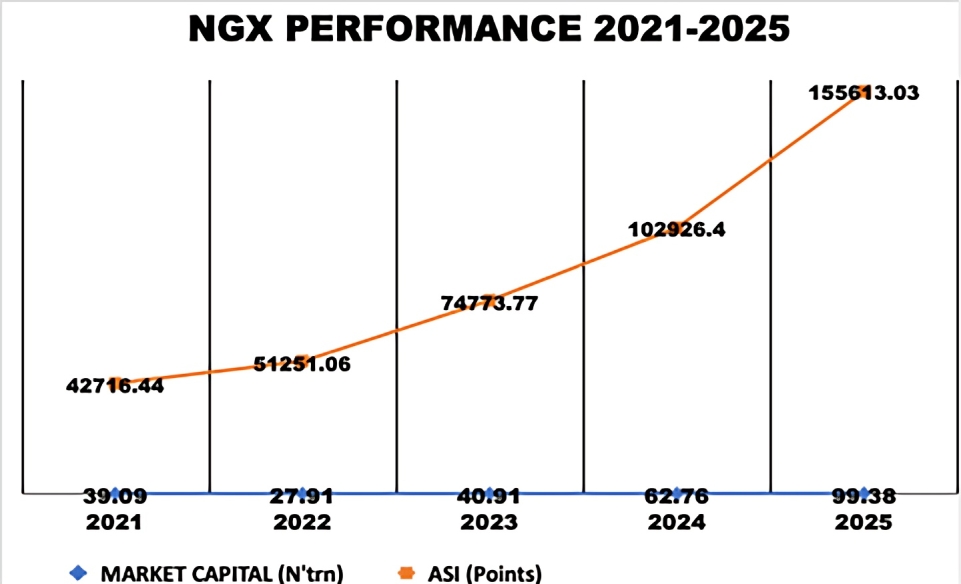
The Nigerian equities market has already produced spectacular gains in recent years. The Securities and Exchange Commission noted that equity-market capitalisation expanded from about N62.8 trillion to N100 trillion within twelve months, while the NGX All-Share Index rose sharply during the first quarter of 2026, reaching 201,287.78 points by March 31. Market capitalisation rose to N129.21 trillion at the end of that quarter.
Those numbers look impressive.
But stock-market wealth is not the same thing as household wealth. The majority of Nigerians do not own meaningful quantities of listed shares. Many are not even in a position to save, let alone invest.
Indeed, Reuters recently reported that while investors have welcomed the government’s reforms and the stock market has surged, poverty has remained above 50 percent and the benefits of the recovery have largely bypassed ordinary households.
The World Bank’s current Nigeria assessment is even more sobering: more than 60 percent of Nigerians were estimated to be living below the national poverty line in 2025. The Bank also identifies weak state capacity, insecurity and infrastructure gaps — particularly in electricity, transport and logistics — as continuing constraints on productivity and domestic market integration. This is the paradox Nigeria must confront.
The stock market can be creating paper wealth at precisely the moment millions of Nigerians are losing purchasing power. That is not necessarily a contradiction in financial-market terms. Share prices reflect expectations about listed companies, liquidity, corporate earnings and investor demand. But it becomes a contradiction when government presents stock-market performance as proof that the broader economy is already delivering prosperity.
Dearth of Productivity Revolution
Nigeria’s biggest economic problem is not the absence of a stock-market classification. It is low productivity. The country has spent decades discussing industrialisation without adequately solving the most basic industrial requirement: reliable and affordable energy. A factory cannot compete internationally if it must manufacture its own electricity.
Yet that remains the reality for many Nigerian manufacturers.Data presented by the Manufacturers Association of Nigeria indicate that manufacturers spent about N1.35 trillion on alternative power in 2025, a 21.6 percent increase from the previous year’s N1.11 trillion. Think about what that means:
Money that should be invested in machinery, research, worker training, expansion, product development and export competitiveness is instead being diverted into generators, diesel, gas and alternative power systems. That is not productivity. It is economic survival.
The Nigerian Electricity Regulatory Commission reported in April 2026 that only about 4,286MW — roughly 31 percent of the country’s 13,625MW installed generation capacity — was available for dispatch. The World Bank likewise identifies electricity access and infrastructure deficiencies as major constraints on Nigeria’s productivity.
Nigeria remains among the countries with the largest populations without electricity access globally.
How, then, can Nigeria credibly speak of an imminent economic boom simply because FTSE Russell has restored the country’s capital market to the Frontier Market universe?
A financial analyst, Mike Akannor, put the matter in the needed context. He said the stock exchange can attract foreign capital.
“But what happens when that capital arrives?
Does it finance new factories?
Does it finance railways?
Does it build power plants?
Does it create millions of productive jobs?
Does it expand manufacturing capacity?
Does it lower the cost of food?
Does it improve agricultural productivity?
Does it build export industries?
Those are the questions that should define the next phase of reform.”
Ben Okagbue, an investment expert emphasised that Nigeria needs productive capital, not merely portfolio capital. “This distinction is crucial. Portfolio capital can be useful. Foreign investors can provide liquidity, improve price discovery and deepen the market. Frontier Market classification can increase Nigeria’s visibility among global asset managers and potentially encourage index-linked investment.”
Temi Popoola, CEO, NGX Group, recognises this when he said the real challenge is to convert greater international visibility into broader participation, deeper liquidity and more capital for Nigerian businesses. That is exactly the right ambition.
But Nigeria should resist the temptation to confuse capital inflow with capital formation.
Foreign money entering Nigerian equities and pushing share prices higher does not automatically mean that Nigeria has acquired new productive capacity.
The country needs capital that builds.
Capital that creates factories.
Capital that expands agro-processing.
Capital that finances power generation.
Capital that supports technology.
Capital that builds logistics infrastructure.
Capital that produces tradable goods.
Capital that creates sustainable employment.
Capital that increases Nigeria’s ability to export rather than merely import.
That is the difference between a financial-market recovery and an economic transformation.
READ ALSO:
Insecurity Remains Economic Tax
Nigeria also cannot claim a fully successful reform programme while insecurity continues to impose a massive tax on economic activity. The latest evidence is disturbing.
A report by SBM Intelligence cited by Reuters estimated that 7,825 people were kidnapped between July 2025 and June 2026 — a 66 percent increase from the previous year — while at least 1,142 people were killed. Confirmed ransom payments exceeded N7.78 billion, or about $5.79 million. These numbers are not merely security statistics. They are economic statistics.
When farmers cannot safely reach their farms, agricultural output suffers. When transporters fear highways, logistics costs rise. When communities are displaced, productive assets are destroyed. When businesses spend more on security, their operating costs increase. When investors perceive entire regions as unsafe, capital avoids them. When children cannot safely attend school, the country’s future human capital is damaged.
And when people are kidnapped for ransom, household savings are transferred from productive activities into criminal networks.
A country cannot achieve sustained productivity growth while insecurity remains structurally embedded in its economic system
Infrastructure as Missing Foundation
The same argument applies to infrastructure. Nigeria’s economic transformation requires roads, rail, ports, electricity, water, digital infrastructure and efficient logistics. The World Bank continues to identify infrastructure gaps, especially in electricity, transport and logistics, as constraints on productivity and domestic-market integration.
For manufacturers, the consequences are immediate.
A company may have access to finance through the capital market, but if it cannot move raw materials efficiently, obtain reliable power or distribute finished products cheaply, the money does not translate into competitive production.
This is why Nigeria’s reform conversation must move beyond financial indicators.
The All-Share Index is important.
Market capitalisation is important.
Foreign portfolio flows are important.
FTSE classification is important.
But they are means, not ends.
The ultimate test of economic reform is whether Nigerians can produce more at lower cost and earn more from their productivity.
The GDP Numbers Illusion
The GDP numbers provide another warning. There is evidence that Nigeria’s economy is recovering. The National Bureau of Statistics reported on August 31 that real GDP expanded by 4.43 percent year-on-year in the second quarter of 2026, compared with 3.89 percent in the first quarter. The economy grew by 3.87 percent in 2025, up from 3.38 percent in 2024. That improvement should not be dismissed. But neither should it be exaggerated.
A 4.43 percent growth rate is positive, yet it remains below the administration’s stated ambition of achieving 7 percent annual growth by 2027. More importantly, Nigeria’s population is growing rapidly, meaning headline GDP growth does not automatically translate into significant growth in GDP per capita.
Indeed, Reuters recently reported that GDP per capita had fallen substantially over the past decade, illustrating the enormous gap between aggregate economic statistics and individual prosperity.
This is why Nigerians are justified in asking a simple question:
If the economy is recovering, why does life still feel poorer?
The answer lies partly in the composition and distribution of growth.
Growth in oil production, financial services or a handful of large listed corporations can raise GDP and stock-market valuations without producing sufficiently broad-based improvements in household welfare.
The Real Frontier Irony
There is an irony in Nigeria’s return to the Frontier Market category. The country has returned to a financial frontier while much of its real economy remains stuck on an older frontier — the frontier of unreliable electricity, poor roads, insecurity, weak industrial capacity and mass poverty. That is the frontier that matters more. Nigeria does not need merely to become an attractive destination for portfolio investors.
It needs to become an attractive place to produce.
It needs to make it cheaper to manufacture in Aba, Kano, Lagos, Nnewi, Kaduna and other industrial centres.
It needs electricity that allows factories to plan production without calculating the cost of diesel.
It needs roads and railways that reduce logistics costs.
It needs security that allows farmers to cultivate and businesses to operate without fear.
It needs an education system that produces productive workers.
It needs a tax system that encourages investment rather than suffocating it.
And it needs a financial system that channels savings into productive enterprise.
That is the real economic reform agenda.
FTSE Russell has given Nigeria a window of opportunity. It has not given the country an economic miracle. The government should therefore celebrate the reclassification — but modestly.
Because the return to Frontier Market status is a certificate of improved market accessibility, not a certificate of national prosperity. The ultimate measure of reform will not be the number of foreign investors tracking Nigerian equities.
It will be the number of Nigerians who can afford three meals a day.
It will not be the height of the NGX All-Share Index.
It will be the productivity of the Nigerian worker.
It will not be the volume of foreign portfolio investment.
It will be the number of new factories, new businesses, new exporters and new productive jobs created.
And it will not be Nigeria’s classification on a global financial index.
It will be whether the Nigerian economy finally begins to produce enough wealth to make prosperity visible in the lives of its people.
Until then, Nigeria should celebrate the FTSE achievement for what it is: a promising capital-market development — but only one small step in a much longer journey from financial reform to genuine economic transformation.

Sam Diala is a Bloomberg Certified Financial Journalist with over a decade of experience in reporting Business and Economy. He is Business Editor at THEWILL Newspaper, and believes that work, not wishes, creates wealth.