
September 21, (THEWILL) – SAM DIALA highlights Nigeria’s troubling situation and argues that the country can no longer afford to treat environmental sustainability as an afterthought.
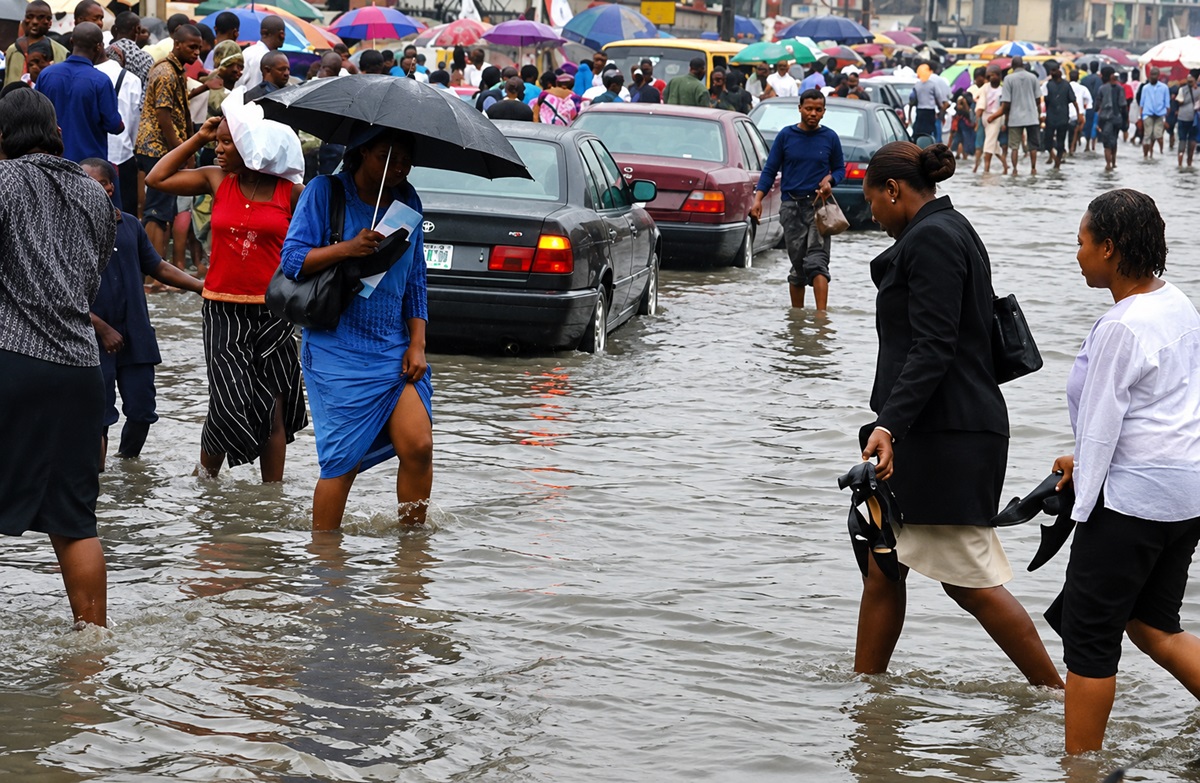
Nigeria often counts the cost of flooding in the most visible terms: houses submerged, roads washed away, farms destroyed, vehicles swept off the streets and, tragically, lives lost. Yet these are only the first layer of the bill.
Beneath the floodwater lies a much larger economic disaster—one that continues long after the water recedes. Businesses lose trading days. Farmers lose entire production cycles. Children miss school. Hospitals become inaccessible. Food prices rise. Government diverts scarce resources from development to emergency repairs. Families sell assets, borrow money or withdraw children from school to survive. Investors become more cautious. Infrastructure deteriorates faster. Poverty deepens.

Hidden Costs Manifest
This is the hidden economic cost of environmental degradation: the losses that do not always appear immediately in government budgets or national accounts but steadily erode Nigeria’s productive capacity.
The evidence is already stark. The World Bank estimates that Nigeria’s devastating 2022 floods generated about US$6.7 billion in economic losses, equivalent to 1.6 percent of GDP. More than 650,000 hectares of crops were destroyed, while roads, irrigation, water supply, sanitation and electricity infrastructure suffered substantial damage.
But even that figure does not fully capture the economic consequences. The real price of environmental neglect is accumulated across thousands of households, businesses and communities. Nigeria, therefore, faces a fundamental choice: continue paying repeatedly for environmental disasters—or invest deliberately in preventing them.
Flooding is no longer simply a seasonal inconvenience
For decades, flooding in Nigeria was largely treated as a seasonal problem. During the rainy season, communities expected water to rise and recede. But the scale, frequency and economic consequences of flooding have changed.
The Human Angle
Nigeria’s environmental vulnerability is being intensified by climate variability and climate change, but climate change alone does not explain the destruction. Poor drainage, blocked waterways, indiscriminate construction, deforestation, erosion, weak urban planning, inadequate waste management and the degradation of wetlands all turn heavy rainfall into an economic catastrophe.
The World Bank has identified Nigeria as highly vulnerable to climate change, with environmental degradation—including deforestation, land degradation, erosion, floods and desertification—already affecting agriculture, infrastructure and livelihoods. This distinction is important.
Rain is a natural phenomenon. Disaster is often a consequence of vulnerability. When wetlands are converted into buildings, drainage channels blocked with waste and natural waterways narrowed by construction, rainfall that might previously have been absorbed or channelled safely becomes destructive.
Economy as Casualty
The economy ultimately pays for these decisions. Consequently, the first hidden cost is lost productivity. Experts maintain that the most underestimated consequence of flooding is lost productivity.
“When roads become impassable, workers cannot reach factories, offices, markets and construction sites. When public transport collapses, working hours disappear. When electricity infrastructure is damaged, production falls. When shops and warehouses are flooded, businesses lose inventory and operating time,” said Chamberlain Adeleye, an environmental specialist.
Adeleye added that for a small business already struggling with high energy costs, inflation, expensive credit and weak consumer purchasing power, several days of closure can be devastating.
The same applies to farmers. A farmer whose crops are washed away loses more than the value of the harvested produce. He loses the seeds, fertilizer, labour and time already invested. He may also lose the income needed to finance the next farming season.
Adeleye illustrates the economic chain thus:
Flood destroyed production income loss reduced consumption weaker business revenue lower investment greater poverty.
“That chain rarely appears as one line item in a national budget. Yet multiplied across millions of Nigerians, it represents a substantial economic loss,” Adeleye added.
Agriculture Joins Casualty League
The National Bureau of Statistics’ flood assessment found that 64 percent of surveyed households were affected by the 2022 floods, with the impact significantly higher in rural areas, where 74 percent of households were affected. The damage extended beyond livelihoods to housing, food sources, health facilities, schools and access to basic services.
That is not merely an environmental problem. It is a productivity crisis.
Agriculture joins the casualty league. When environmental destruction results in food inflation, the disaster is inestimable. Few sectors demonstrate the connection between environmental sustainability and economic survival more clearly than agriculture. Nigeria cannot achieve food security while its agricultural land is repeatedly degraded or destroyed. The 2022 floods demonstrated the scale of the problem. The World Bank estimates that more than 650,000 hectares of crops were destroyed. The consequence does not end on the farm.
When supply falls, food prices rise. When food becomes more expensive, household purchasing power falls. Workers demand higher wages. Businesses face higher operating costs. Government faces pressure to intervene through subsidies, imports or social programmes.
Thus, a flood in a farming community can eventually become inflation in Lagos, Abuja, Kano, Port Harcourt or Onitsha. This is why environmental degradation should be viewed as an economic policy issue.
A damaged ecosystem reduces agricultural productivity. Reduced productivity constrains food supply. Constrained supply pushes up prices. Higher prices increase poverty. Poverty reduces the ability of households to invest in education, healthcare and productive assets. Environmental destruction therefore reproduces poverty.
The Unbudgeted Infrastructure Bill
Nigeria already has an enormous infrastructure deficit. Flooding compounds it by repeatedly destroying infrastructure that taxpayers have already paid for.
Roads are particularly vulnerable. Floodwater weakens road foundations, destroys culverts and bridges and accelerates erosion. Public funds that could have financed new infrastructure are instead spent repairing damaged infrastructure. The same applies to electricity facilities, water systems, schools, health centres, markets and public buildings.
READ ALSO:
According to Adeleye, this creates an expensive cycle which he describes as fiscally irrational:
Build neglect environmental protection flood repair flood again rebuild.
The World Bank’s assessment of Nigeria’s flood risks specifically highlights severe damage to infrastructure including roads, irrigation, water supply, sanitation and electricity. Every naira spent repairing preventable flood damage is a naira that cannot be spent on a new hospital, school, industrial park, irrigation system or productive infrastructure.
The poverty multiplier
Flooding does not affect everyone equally. Wealthier households may have insurance, savings, stronger buildings and alternative sources of income. Poor households often have none of these. For them, a flood can wipe out virtually everything accumulated over years.
A trader may lose merchandise. A farmer may lose crops and livestock. A motorcycle operator may lose his means of transportation. A family may lose household possessions. A child may lose months of schooling.
The poor therefore suffer a double economic penalty: they are more exposed to environmental disasters and less capable of recovering from them.
The NBS assessment showed that rural households experienced substantially greater impacts from the 2022 floods than urban households. This means environmental sustainability must be integrated into Nigeria’s poverty-reduction strategy. It is impossible to sustainably reduce poverty while allowing environmental shocks to repeatedly destroy the assets of poor households.
The Health Cost
There is another hidden bill: healthcare.
Floods can contaminate drinking water, damage sanitation systems and create conditions favourable to waterborne diseases. When health risks rise, households spend more on treatment and lose more working days.
A sick worker is not productive. A sick child also imposes costs on parents, who may have to miss work to provide care. When thousands of households experience this simultaneously, the national productivity loss becomes significant.
Environmental degradation therefore creates a health-productivity nexus: degraded environments increase health risks, which reduce labour productivity and household incomes. The cost is borne by individuals, businesses and the government.
Education as a Casualty
Flooding can close schools, damage classrooms and make roads impassable. But the economic consequence extends far beyond the immediate interruption.
Every school day lost represents a reduction in human-capital accumulation. Children who repeatedly experience disruptions to education may fall behind their peers. For a country already struggling with human-capital challenges, environmental disasters constitute another obstacle to developing the skilled workforce required for industrialisation.
Nigeria cannot build a competitive knowledge economy while environmental disasters repeatedly interrupt education.
The Cost to Government Finances
Perhaps the most dangerous hidden cost is fiscal. When disasters occur, the government must mobilise emergency funds. It must provide relief materials, rebuild roads, repair bridges, restore electricity and water systems, compensate affected communities and support displaced populations.
These expenditures are often reactive rather than productive.
At a time when Nigeria faces substantial demands on public finances, repeated disaster-related expenditure represents an opportunity cost. Government could spend money on long-term development, but environmental disasters force it to spend on recovery.
This is why prevention is economically cheaper than reconstruction.
Spending money on drainage, flood-control infrastructure, watershed restoration, early-warning systems, urban planning and ecosystem protection may seem expensive today. But the cost is likely to be far lower than repeatedly rebuilding damaged communities.
Nigeria’s climate challenge is an economic challenge as it is expected to make Nigeria’s environmental risks more difficult to manage.
The World Bank notes projections of rising temperatures and increasing intensity of extreme precipitation. It also estimates that climate change could reduce agricultural productivity and impose substantial losses on the economy.
This creates a powerful argument for mainstreaming climate resilience into economic policy. Climate policy should not remain confined to environmental ministries. Most importantly, economic planners must recognize that environmental resilience is productive infrastructure.
When Prevention is Superior
The country must therefore move from disaster response to disaster prevention. Environmental degradation destroys natural economic infrastructure. One of Nigeria’s greatest economic mistakes is failing to recognise that ecosystems themselves are infrastructure.
Mangroves protect coastal communities from storm surges. Wetlands absorb excess water. Forests regulate water flows and protect soils. Healthy watersheds reduce erosion. Vegetation helps stabilize land.
Destroy these systems and the government must eventually attempt to replace them with concrete infrastructure. That replacement is expensive—and often less effective.
Nigeria’s coastal areas illustrate the danger. The World Bank has warned that coastal erosion, rising sea levels and oil pollution are damaging mangrove forests that provide an important natural buffer against storm surges.
The lesson is straightforward: nature provides services, and when those services are destroyed, society must pay to replace them. This is an economic concept that deserves much greater attention in Nigeria’s development planning.
The economic opportunity hidden in sustainability
There is, however, an optimistic side to the challenge. Environmental sustainability should not be presented only as a cost. It is also an economic opportunity.
Nigeria can create thousands of jobs through recycling, renewable energy, forest restoration, sustainable agriculture, waste-to-energy projects, green construction, climate-smart infrastructure and environmental services. The country’s transition toward a greener economy can stimulate new industries while making existing industries more resilient.
Nigeria’s experience with sovereign green bonds demonstrates that climate-related investment can mobilise financing for environmental and economic objectives. The World Bank reported that the country’s first sovereign green bonds supported thousands of direct and indirect jobs in climate-adaptation-related sectors.
This suggests that environmental sustainability should be positioned not as an obstacle to development, but as a new pathway to development.
What Nigeria Must do Differently
The solution is not simply to build more drainage channels after floods occur. Nigeria needs a comprehensive environmental-economic strategy.
-
Make flood-risk mapping compulsory:
Every state should have accurate flood-risk maps identifying vulnerable communities, roads, farms, schools, hospitals and industrial zones. Construction should be restricted in high-risk areas. Development planning must be based on environmental realities rather than political expediency.
-
Protect wetlands and waterways:
Wetlands should be treated as economic assets, not vacant land waiting for development. The indiscriminate conversion of drainage channels, wetlands and natural waterways must end.
-
Invest in drainage and storm-water infrastructure:
Urban Nigeria is expanding rapidly. Drainage systems must therefore be designed for today’s cities—not yesterday’s population. Drainage infrastructure should be integrated into urban development approvals.
-
Restore forests and degraded land:
Reforestation should become a major economic programme. Forest restoration can protect watersheds, reduce erosion, improve biodiversity and create employment. Nigeria should view environmental restoration as a job-creation strategy rather than merely a conservation exercise.
-
Build climate-smart agriculture:
Farmers need access to flood-resistant seeds, improved irrigation, drainage, weather information, agricultural insurance and climate advisory services. Agricultural policy must prepare farmers for changing rainfall patterns rather than assuming that historical weather patterns will continue indefinitely.
-
Strengthen early-warning systems:
An early warning is economically valuable only if people receive it and can act on it. Warnings should reach farmers, traders, transport operators, schools and households through radio, mobile networks, community organisations and local authorities.
-
Introduce stronger environmental enforcement:
Environmental regulations are meaningless if violations have no consequences. Developers who build on waterways, industries that pollute rivers and businesses that illegally dispose of waste should face meaningful sanctions.
-
Make environmental sustainability part of public budgeting:
Every major infrastructure project should include climate and environmental risk assessments.
The question should no longer be simply: How much will this road cost to build?
It should also be: How much will it cost to maintain? What happens during extreme rainfall? Does it destroy natural drainage? Can it withstand future climate risks?
-
Expand environmental insurance and climate finance:
Nigeria needs a deeper market for agricultural insurance, property insurance and disaster-risk financing.
Government cannot be the only shock absorber.
Banks, insurers, pension funds, development finance institutions and capital-market investors should participate in financing climate-resilient infrastructure.
-
Empower local communities:
Environmental protection cannot succeed if communities are treated merely as recipients of government intervention. Local residents understand their waterways, erosion patterns and environmental vulnerabilities. Community participation should therefore be embedded in flood-control, forest-restoration, waste-management and watershed projects.
Last Word
Nigeria can continue spending billions to repair the consequences of environmental neglect, or invest substantially less in preventing those consequences in the first place.
Sustainability is therefore not a luxury for a richer Nigeria of the future. It is an economic necessity for the Nigeria of today.
And the nation that understands this early will not merely survive the age of climate crisis—it will discover that protecting the environment can become one of the foundations of its next phase of economic transformation.

Sam Diala is a Bloomberg Certified Financial Journalist with over a decade of experience in reporting Business and Economy. He is Business Editor at THEWILL Newspaper, and believes that work, not wishes, creates wealth.