
-
Tinubu says Nigeria’s state-owned refineries will undergo a comprehensive structural, technical and managerial reset aimed at delivering profitable and sustainable operations rather than symbolic production.
-
President pledges evidence-based reforms, insisting years of failed rehabilitation and huge public investments will no longer be allowed to end in waste.
-
NUPENG endorses the administration’s fuel subsidy removal policy but urges the Federal Government to fast-track refinery rehabilitation to strengthen energy security and create jobs.
-
The President also promises greater labour involvement in the CNG initiative, addresses concerns over local government autonomy and receives NUPENG’s Grand Patron honour.
August 14, (THEWILL) — President Bola Ahmed Tinubu has declared that Nigeria’s long-troubled state-owned refineries will undergo another comprehensive overhaul to restore them to profitable operations, insisting that years of failed rehabilitation efforts and huge public investments must no longer end in waste.
The President said his administration would undertake an extensive structural, technical and managerial reset of the refineries, stressing that success would no longer be measured by the mere resumption of operations but by their ability to generate value, operate efficiently and return profits to the country.
THEWILL reports that Tinubu spoke on Thursday while receiving the National Executive Council of the National Union of Petroleum and Natural Gas Workers (NUPENG), led by its National President, Comrade Salimon Akanni Oladiti, at the Presidential Villa, Abuja.

The meeting came as the oil workers’ union endorsed key economic reforms introduced by the administration, particularly the removal of fuel subsidy, while urging the Federal Government to ensure the nation’s refineries are fully revived to strengthen domestic refining capacity.
Responding to NUPENG’s appeal for the rehabilitation of the refineries, the President acknowledged the enormous investments successive governments had committed to the facilities, saying they could not be abandoned despite their prolonged underperformance.
He disclosed that the Federal Government would commission detailed technical studies and comprehensive assessments to identify the structural, operational, financial and managerial factors responsible for the refineries’ poor performance before implementing lasting solutions.
According to Tinubu, restarting refinery operations without guaranteeing efficiency and profitability would amount to another failed intervention.
“The refineries that you mentioned are going to come back to work. We are building a very firm reset and structural reworking around them. The ordinary flame and smoke of a refinery do not mean it is working until it becomes profitable and delivers the value for which it was built”, the President said.
Tinubu said he had accepted responsibility for inherited challenges in the petroleum sector and would focus on fixing them rather than assigning blame.
“I have accepted the assets and liabilities of my predecessors. Whatever happened in the past, it is now my responsibility as President to fix it and make it work for the greatest common good of Nigerians. We will do it”, he added.
The President also appealed to Nigerians to remain committed to democratic governance despite prevailing economic challenges, expressing confidence that ongoing reforms would ultimately deliver a stronger economy and better living standards.
Addressing another issue raised by the union, Tinubu said constitutional matters affecting the implementation of local government autonomy were still being reviewed for possible fine-tuning and appealed for patience from stakeholders.
He also pledged greater inclusion of NUPENG in the implementation of the Presidential Compressed Natural Gas (CNG) Initiative, urging the union to help ensure that the benefits of cheaper and cleaner transportation reach ordinary commuters.
Tinubu further paid tribute to late former NUPENG President, Frank Kokori, describing him as a courageous pro-democracy activist and long-time ally in Nigeria’s struggle for democratic rule.
READ ALSO: Local Refineries Supply 79% of Nigeria’s Petrol in H1 as Imports Slump
Local Refineries Receive 53.7m Barrels Of Crude In Q2 As Supply Obligation Hits 97.4 Percent
FG Weighs New Crude Supply Rules As Local Refiners Face High Feedstock Costs
NUPENG Backs Reforms, Presses for Functional Refineries
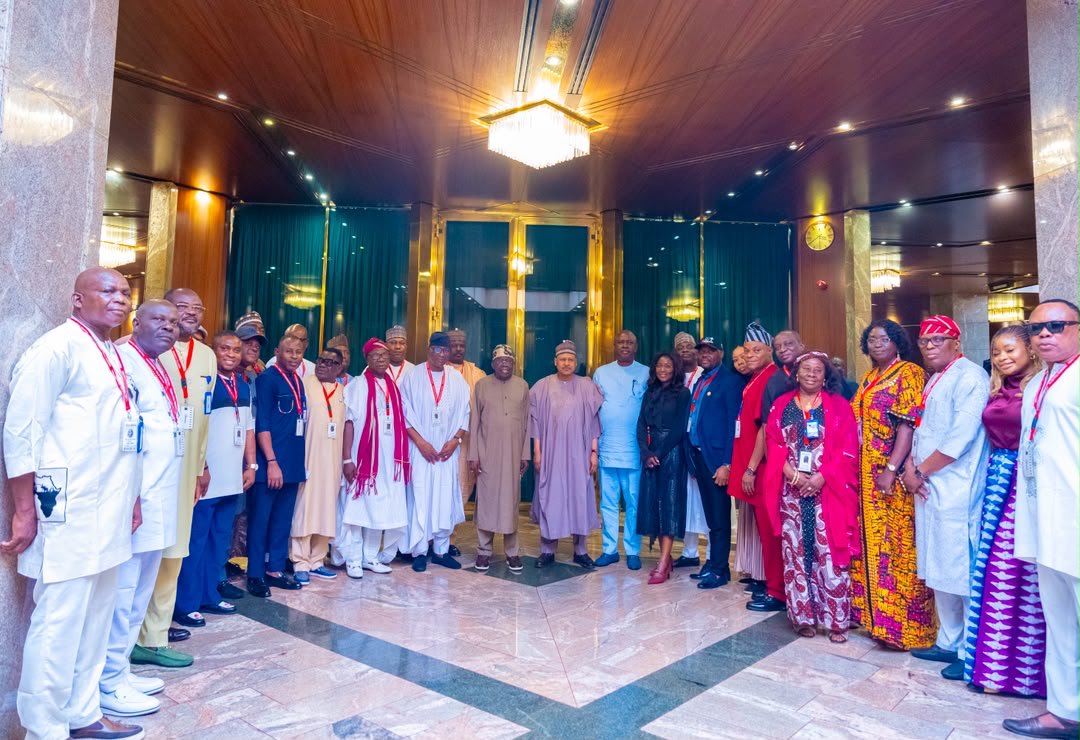
Earlier, NUPENG President, Comrade Salimon Akanni Oladiti, applauded Tinubu’s decision to remove the fuel subsidy, describing it as a bold reform that has halted decades of financial leakages and freed public resources for infrastructure development.
He pointed to the ongoing construction of the 750-kilometre Lagos-Calabar Coastal Highway and the 1,068-kilometre Sokoto-Badagry Superhighway as evidence that savings from the subsidy removal are being channelled into critical national projects.
According to Oladiti, improved federal highways are already making transportation safer for petroleum tanker drivers and other road users by reducing accidents, spillages and travel risks.
Despite commending the administration’s reforms, the union leader appealed to the President to sustain efforts to revive the nation’s refineries, arguing that functional domestic refining would strengthen Nigeria’s energy security, reduce dependence on imported petroleum products and create employment opportunities across the oil and gas value chain.
Minister of Information and National Orientation, Mohammed Idris, described NUPENG’s endorsement of the administration’s reforms as an uncommon development, noting that it is rare for organised labour to publicly commend a sitting government for its economic policies.
According to the minister, the union’s recognition of the positive impact of fuel subsidy removal and ongoing infrastructure development reflects increasing confidence in the administration’s reform agenda.
The NUPENG leadership later decorated President Tinubu as the Grand Patron of the Union in recognition of what it described as his commitment to reforms in the oil and gas sector.
Nigeria’s four government-owned refineries located in Port Harcourt, Warri and Kaduna have remained largely dormant despite repeated turnaround maintenance programmes that have consumed hundreds of billions of naira over several administrations. Their poor performance has left Africa’s largest crude oil producer heavily dependent on imported refined petroleum products for decades.
Felix Ifijeh is a journalist with years of professional reporting experience. Known for his keen news sense, compelling storytelling and commitment to accurate, impactful reporting, he has built a reputation for turning leads into clear, engaging, and well-structured reports that resonate with readers. His work reflects deep newsroom experience and a commitment to accurate, impactful journalism.