
-
Former Ekiti State Governor, Ayodele Fayose, predicts that Oyo State Governor, Seyi Makinde, will leave Nigeria between January and March 2027 after the general elections, alleging that he will not stay to face the consequences of his actions in office.
-
Fayose claims Makinde will leave before receiving the Federal Government’s April 2027 allocation and continue issuing directives from exile.
-
The prediction comes amid a prolonged political feud between the former allies over control of the Peoples Democratic Party (PDP) in the South-West, including the disputed 2021 zonal congress.
-
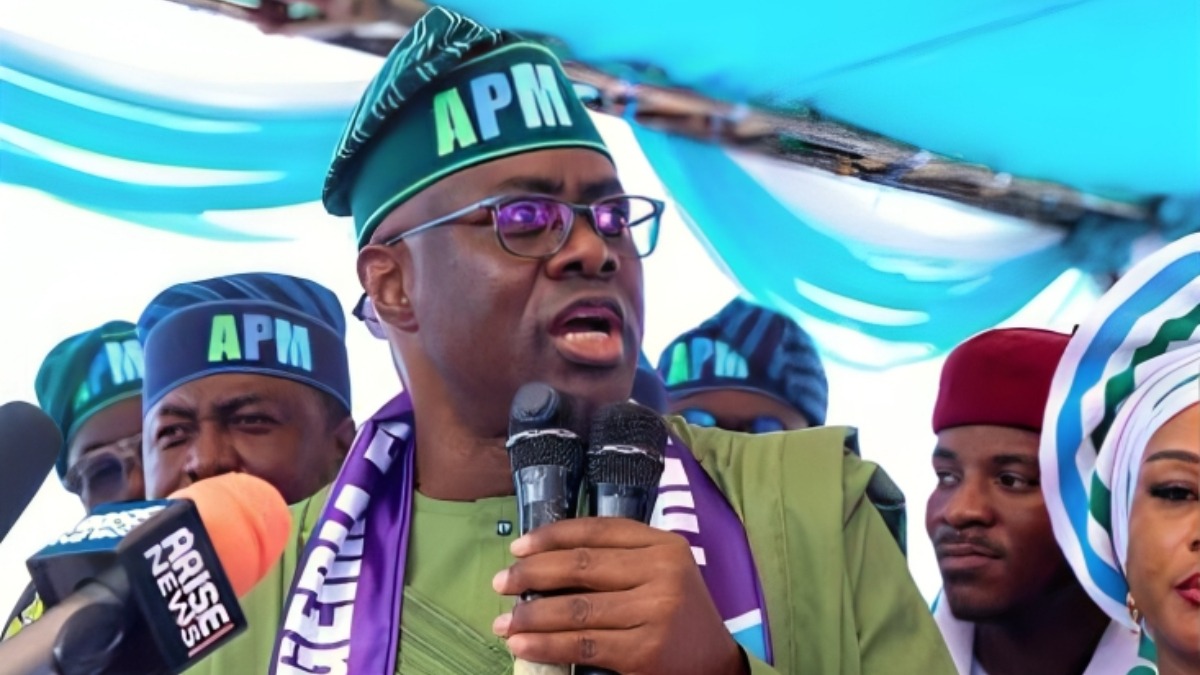
Their disagreement has widened over the 2027 presidential election, with Fayose endorsing President Bola Tinubu’s re-election while Makinde, now the presidential candidate of the Allied Peoples Movement (APM), has declared his intention to challenge the incumbent.
November 17, (THEWILL) – Former Ekiti State Governor, Ayodele Fayose, has predicted that Oyo State Governor, Seyi Makinde, will flee Nigeria after the 2027 general elections, alleging that the governor would leave the country to avoid facing the consequences of his actions while in office.
Fayose made the allegation on Monday during an interview on TVC, where he insisted that Makinde would not remain in Nigeria after the elections.
The former governor specifically predicted that Makinde would leave the country between January and March 2027, adding that he would not wait until April to receive the Federal Government’s monthly allocation. He further claimed that the Oyo governor would continue to issue directives from exile.
“Write my words down. After this election, Governor Makinde will run from Nigeria between January and March. I’ve said so many things in Nigeria. I was the one who spoke about this Fubara thing. Between March and April, let me be precise: Makinde will run. He won’t take April allocation. He will be directing from exile”, Fayose said.
He challenged Nigerians to keep a record of his prediction, claiming that some of his previous statements about political developments in the country, including the crisis involving Rivers State Governor, Siminalayi Fubara, and developments surrounding former Edo State Governor, Godwin Obaseki, had eventually materialised.
The latest remarks come against the background of a prolonged political disagreement between the two former allies, which began as a struggle over the leadership and control of the Peoples Democratic Party (PDP) in the South-West but has since extended to their opposing positions on the 2027 presidential election.

Fayose supported Makinde’s emergence as Oyo State governor in 2019. However, their relationship deteriorated from 2020 following disagreements over the PDP’s regional leadership, the party’s Ekiti State structure and the return of former Ondo State Commissioner for Information, Eddy Olafeso, to the position of National Vice Chairman (South-West).
The disagreement became particularly pronounced after Olafeso resigned from the zonal position to contest the PDP governorship primary in Ondo State. Following his defeat in the primary, his supporters sought his return to the position, an arrangement Fayose backed.
According to a December 2020 report by The Punch, Lagos State PDP Chairman, Adedeji Doherty, alleged that Makinde had earlier agreed at a meeting with South-West party chairmen in Ibadan that Olafeso would be allowed to return if he failed to secure the Ondo governorship ticket.
Doherty said the understanding was reached because Olafeso had served the party well in the region.
However, he alleged that Makinde subsequently failed to honour the agreement, creating divisions among party leaders.
The disagreement was further complicated by Makinde’s position as the only serving PDP governor in the South-West following Fayose’s departure from office in 2018.
While Makinde’s supporters maintained that his position as the region’s only PDP governor made him the natural leader of the party, Fayose rejected what he considered an attempt to diminish his political influence and interfere in the affairs of other state chapters.
In December 2020, Fayose openly challenged Makinde’s leadership claim, declaring that the Oyo governor was not his political leader.
“Governor Makinde is not my leader. He is my follower. Respect should beget respect”, Fayose said.
He maintained that his disagreement with Makinde was partly over the failure to honour the understanding concerning Olafeso’s return and the alleged interference in the Ekiti PDP leadership crisis.
The disagreement divided PDP state chairmen, lawmakers and prominent party chieftains across the South-West, with some supporting Makinde and others aligning with Fayose.
The crisis intensified in February 2021 when both camps mobilised support for different candidates ahead of the party’s South-West zonal congress.
Makinde backed former Oyo State Deputy Governor, Taofeek Arapaja, while Fayose supported Olafeso.
The congress, initially scheduled to hold in Ibadan, was moved to Osogbo, Osun State, amid disagreements between the rival camps and interventions by the PDP national leadership.
Former Senate President Bukola Saraki and other prominent party figures were involved in efforts to reconcile the factions.
The contest eventually held on April 12, 2021, with Arapaja defeating Olafeso by 343 votes to 330.
The outcome represented a victory for Makinde’s camp, although Fayose subsequently raised questions about the voting process, particularly alleged over-voting.
In a report published on April 18, 2021, The Punch said Fayose had described the congress as a contest that deepened the rivalry between the two politicians, despite efforts to reconcile them.
Interestingly, Fayose had publicly embraced Makinde shortly before the commencement of voting, acknowledging him as the leader of the PDP in the South-West and promising to accept the outcome.
“Governor Seyi Makinde is our leader. Our supporters and lovers should not continue to put a wedge between us. Either way this election goes, I will accept”, Fayose said.
Makinde, on his part, described the exercise as a family contest, insisting that the party should concentrate on defeating the All Progressives Congress (APC) rather than fighting among its members.
However, the apparent reconciliation did not end the underlying disagreements, which resurfaced in subsequent political engagements.
2027 Presidential Ambition Deepens Rift
The rivalry has acquired another dimension ahead of the 2027 general elections, following Fayose’s open endorsement of President Bola Tinubu for a second term and Makinde’s decision to challenge the President for the presidency.
Fayose publicly endorsed Tinubu’s re-election in July 2025 at a political gathering in Ado-Ekiti, despite remaining a member of the opposition PDP.
At the event, the former Ekiti governor declared his support for the President’s second-term ambition, describing his endorsement as unconditional.
“I hereby endorse publicly, without reservation, President Bola Tinubu for a second term”, Fayose said.
He also endorsed Ekiti State Governor, Biodun Oyebanji, and his deputy for re-election.
Fayose subsequently intensified his support for Tinubu, arguing that the President remained in a strong position ahead of the 2027 election despite the activities of opposition politicians.
In June 2026, he dismissed suggestions that the opposition could mount a serious challenge against Tinubu, declaring during an interview on Channels Television’s ‘Politics Today’ that “nobody is contesting against Tinubu”.
He argued that the opposition’s failure to unite behind a common candidate had weakened its chances.
In September 2026, Fayose again expressed confidence in Tinubu’s re-election prospects, claiming that the President would defeat former Vice-President Atiku Abubakar and former Anambra State Governor, Peter Obi, even if they joined forces.
Makinde, however, has taken a different political position, emerging as the presidential candidate of the Allied Peoples Movement (APM) and declaring his intention to contest against Tinubu in 2027.
The Oyo governor formally explained his decision in a statement published on his RESET Nigeria platform on November 12, 2026, saying he had withdrawn his support for the President because he no longer believed the administration was taking the country in the right direction.
Makinde recalled supporting Tinubu during the 2023 presidential election because he believed the President would establish a government of national unity and competence capable of addressing Nigeria’s economic challenges.
However, he said his assessment of the administration had changed.
“I supported President Bola Ahmed Tinubu in 2023. Today, I am running against him in the 2027 presidential election”, Makinde declared.
He said his decision was not motivated by a personal disagreement with Tinubu or merely by an ambition to occupy Aso Rock, but by concerns about the country’s economic direction, governance, national unity and the living conditions of Nigerians.
Makinde also defended his decision to contest against Tinubu despite both politicians coming from the South-West, arguing that the region should not be restricted to producing only one presidential candidate.
During a presidential town hall meeting in Akure, Ondo State, on October 22, 2026, he said the choice of Nigeria’s president should be determined by competence, capacity and the ability to deliver good governance rather than geographical considerations.
The governor cited the 1999 presidential election, when former President Olusegun Obasanjo and Chief Olu Falae, both from the South-West, contested against each other. He maintained that the region could produce two presidential candidates without creating a political crisis.
READ ALSO:

Fayose Accuses Makinde Of Breaking Political Understanding
The disagreement over Tinubu’s re-election has featured prominently in Fayose’s recent attacks on Makinde.
In an interview on TVC’s ‘Politics Tonight’ in August 2026, Fayose alleged that Makinde had previously assured him that he would not allow himself to be used against Tinubu.
According to Fayose, the conversation followed his discovery of a campaign flyer promoting Makinde’s presidential ambition, which he forwarded to the Oyo governor.
He claimed Makinde subsequently called him and dismissed those promoting the presidential ambition as political associates seeking financial benefits.
Fayose further alleged that Makinde told him that if he decided to contest for president, he would personally announce his intention and would not allow himself to become the Yoruba politician used against Tinubu.
“He told me that if he wanted to contest, he would say it himself and he would not be the Yoruba man who would be used against another Yoruba man like Asiwaju. God is my witness, and let him deny it”, Fayose said.
The former governor also accused Makinde of taking control of the PDP structure in Ekiti State and handing it over to people who were not his political allies. He said the development contributed to his decision to abandon the party’s structure to Makinde.
Fayose further blamed Makinde’s political ambition for the disagreements that fractured the PDP, arguing that the governor’s actions had undermined the understanding among members of the G-5, a group of five PDP governors who opposed the party’s presidential candidate, Atiku Abubakar, in the 2023 election.
He questioned what had gone wrong with the political arrangement that brought the G-5 together, arguing that Makinde’s ambition had contributed to the subsequent disagreements.
Makinde, however, has maintained that his decision to challenge Tinubu is based on his assessment of the Federal Government’s performance and his desire to offer Nigerians an alternative.
The Oyo governor has also said he supported Tinubu in 2023 because he believed the President would promote national unity and competence, but that his confidence in the administration’s direction had since diminished.
Fayose Threatens Political Retaliation
The hostility between the two politicians became more explicit in June 2026 when Fayose threatened to teach Makinde a political lesson, accusing him of betraying their relationship and taking over the South-West PDP structure.
“We will teach Makinde a political lesson. If you respect me, you will get all my values and support, but if you disrespect me, you will get the downside of Fayose. I’m not a politician that is taken for granted”, he said during an interview on Channels Television.
He further accused Makinde of taking over the political structure he had built in the region.
“Makinde destroyed the South-West Peoples Democratic Party and took my structure. When we are in politics, we are meant to be fair”, Fayose said.
Makinde had yet to publicly respond to Fayose’s latest allegation as of the time of filing this report.
Felix Ifijeh is a journalist with years of professional reporting experience. Known for his keen news sense, compelling storytelling and commitment to accurate, impactful reporting, he has built a reputation for turning leads into clear, engaging, and well-structured reports that resonate with readers. His work reflects deep newsroom experience and a commitment to accurate, impactful journalism.