
-
A giant portrait of rocket scientist Qian Xuesen first went viral after appearing on a shopping mall in Shandong.
-
The campaign has since spread to cities including Zhengzhou, where subway screens now feature Qian Xuesen, Deng Jiaxian, Yuan Longping and Nobel laureate Tu Youyou.
-
Some of the displays carry a blunt message: “They are the top stars we should follow.”
The displays are part of public-service campaigns, not a nationwide ban on commercial advertising.
September 04, (THEWILL) — A strange thing has been happening on China’s advertising screens this summer.
In places normally reserved for fashion campaigns, consumer brands and celebrity endorsements, commuters and shoppers are suddenly seeing scientists.
Qian Xuesen, the rocket scientist who helped establish China’s missile and space programmes, appears in a giant illuminated portrait. Nuclear physicist Deng Jiaxian appears on other screens. Agricultural scientist Yuan Longping and Nobel Prize-winning pharmacologist Tu Youyou have also taken prominent spots.

Some of the displays are enormous. Others occupy digital screens in subway stations and shopping centres.
And instead of selling anything, they carry photographs, short biographies and messages about the scientists’ work.
One slogan has attracted particular attention; “They are the top stars we should follow.”
The displays have generated a wave of online approval, but the story is not quite as simple as “China replaced advertising with scientists.”
No national order has been found requiring commercial advertising to be removed.
Instead, available reporting shows a series of public-service campaigns and voluntary decisions by commercial venues and media operators, beginning in Shandong and spreading to other parts of China.
It Started With One Giant Qian Xuesen Poster
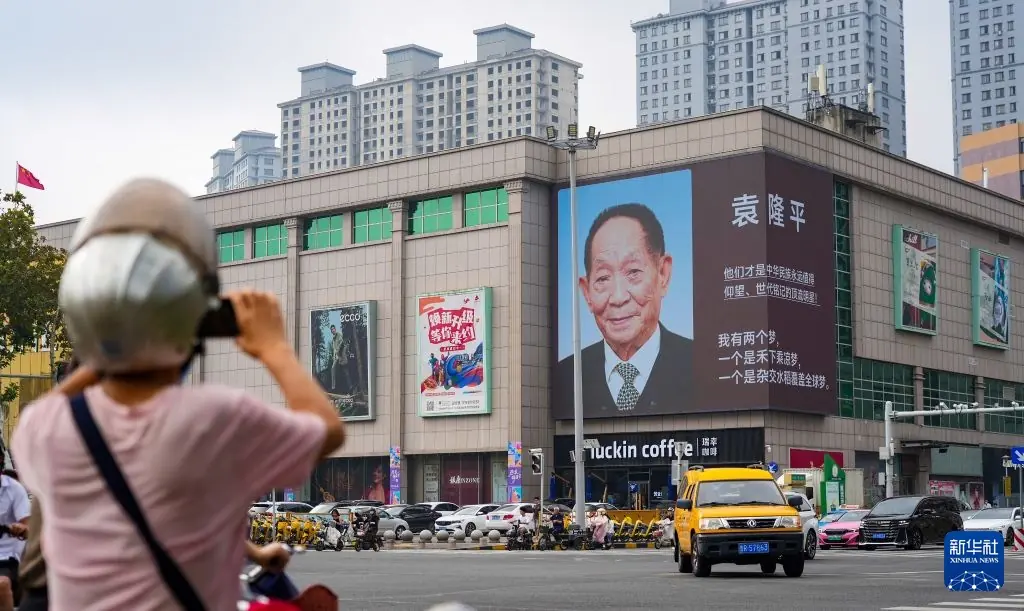
One of the clearest starting points was Single County in Heze, Shandong province.
On August 7, a giant illuminated poster of Qian Xuesen appeared on the eastern exterior wall of the Single County Yinzuo shopping mall.
The dimensions were hard to miss; 7.8 metres high and 5.6 metres wide, covering roughly 44 square metres.
A portrait of the young Qian stood above a quotation attributed to him, “Don’t lose confidence. As long as you persevere, you will eventually achieve results.”
Another line described scientists such as Qian as people who should be remembered and admired as China’s genuine “top stars.”
The location mattered almost as much as the portrait.
The poster occupied an exterior commercial advertising position that had previously carried a paid advertisement.
According to the mall’s operations manager, Zhu Wei, the decision was made with an advertising company and the new installation was intended as a public-service advertisement. It was not AI-generated. Workers installed the physical lightbox using a crane.
Zhu said the mall wanted younger people to remember the scientists who had helped build the country.
A video of the display then travelled across Chinese social media. Local reports said it received more than 100,000 likes within 24 hours, with residents and online commenters praising the decision and calling for similar displays elsewhere.
What happened next is what turned one mall’s decision into a story.
From Shandong To Cities Across China
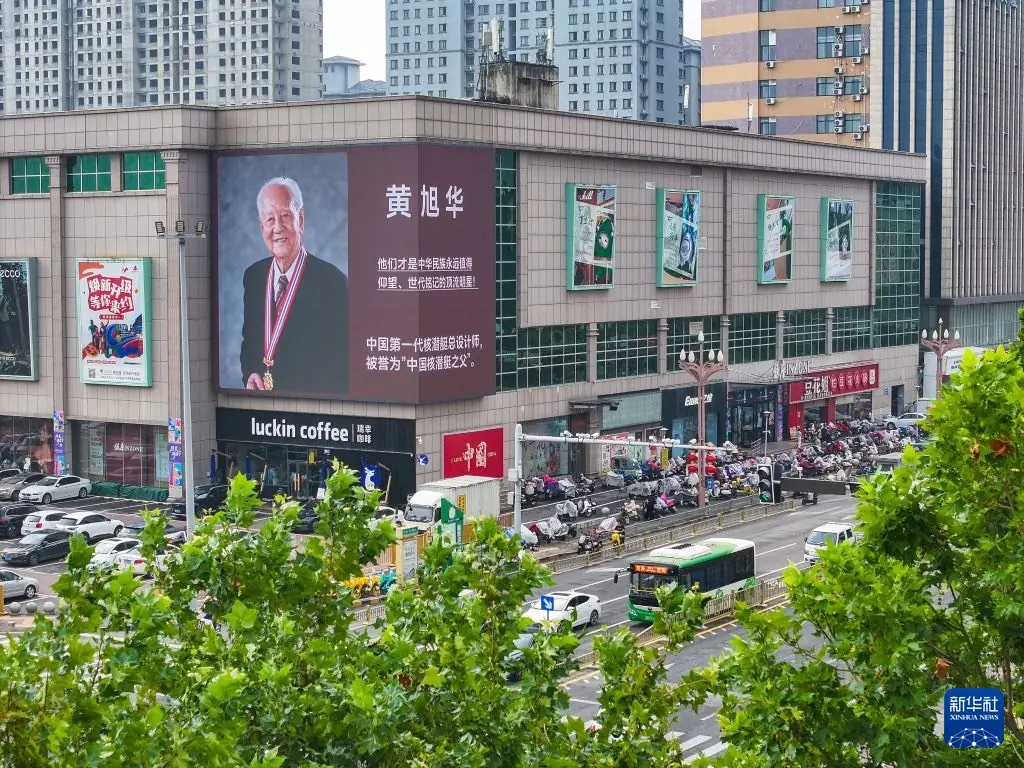
Other commercial spaces in Shandong began displaying similar portraits.
Reports documented displays featuring Qian Xuesen, Deng Jiaxian, Qian Sanqiang and Guo Yonghuai in cities including Heze and Zibo. The idea then appeared outside Shandong, including in Hohhot-area Inner Mongolia, Hefei in Anhui and other locations.
By late August, the campaign had reached Zhengzhou, where the idea moved beyond shopping-centre exteriors and into the city’s subway system.
Zhengzhou Metro introduced a public-service campaign across three major interchange stations: Convention and Exhibition Center, Lvcheng Square and Huanghe South Road.
Those are not obscure advertising positions.
The campaign used long electronic screens, pillar displays, corridor screens and other high-traffic advertising surfaces across the stations.
Six figures were featured:
Qian Xuesen, associated with China’s missile and space programmes.
Deng Jiaxian, a leading figure in China’s nuclear-weapons programme.
Yu Min, a major contributor to China’s thermonuclear weapons development.
Zhang Fuqing, a decorated military figure.
Yuan Longping, whose hybrid-rice research transformed agricultural production.
Tu Youyou, whose work on artemisinin earned her the 2015 Nobel Prize in Physiology or Medicine.
Online reactions have followed the campaign with people praising the decision as an alternative to the usual hierarchy of public attention, where actors, influencers, athletes and commercial brands dominate high-visibility spaces.
One recurring sentiment is “if society is going to put people on giant screens, why not put people there whose work changed millions of lives?”
Why This Is Bigger Than A Viral Poster
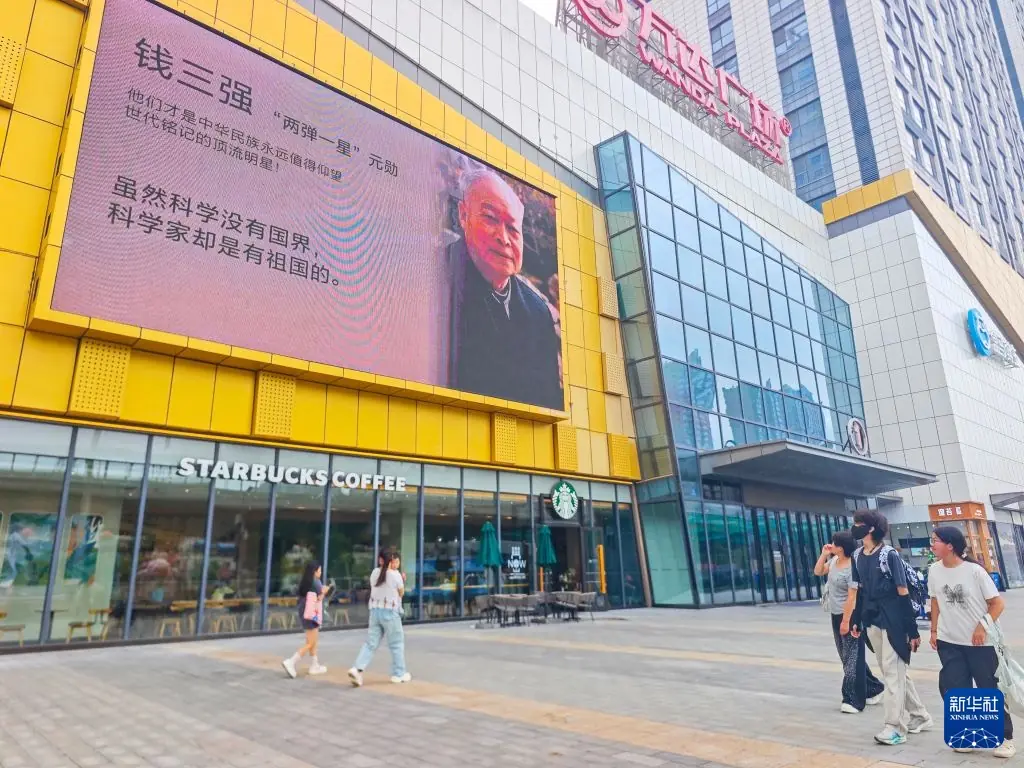
China already has an established institutional emphasis on celebrating “scientist spirit.”
In 2026, the Chinese Academy of Sciences has continued organising programmes around the scientific contributions and personal stories of figures such as Qian Xuesen and Yu Min.
A May event marking the scientific community’s traditions featured their families discussing their careers, national service and approach to research.
China also maintains museums and educational programmes devoted to scientists and scientific history.
The new advertising displays therefore did not appear in a vacuum.
What is new is where the recognition is happening.
A museum requires someone to decide to visit but a subway advertisement does not.
A student may see Qian Xuesen while rushing to class. A parent may encounter Yuan Longping while taking a child home. A shopper may see Tu Youyou while walking past a mall.
That changes the audience from people already interested in science to people who were simply passing through.
READ ALSO:
The Business Of Giving Up An Advertising Slot
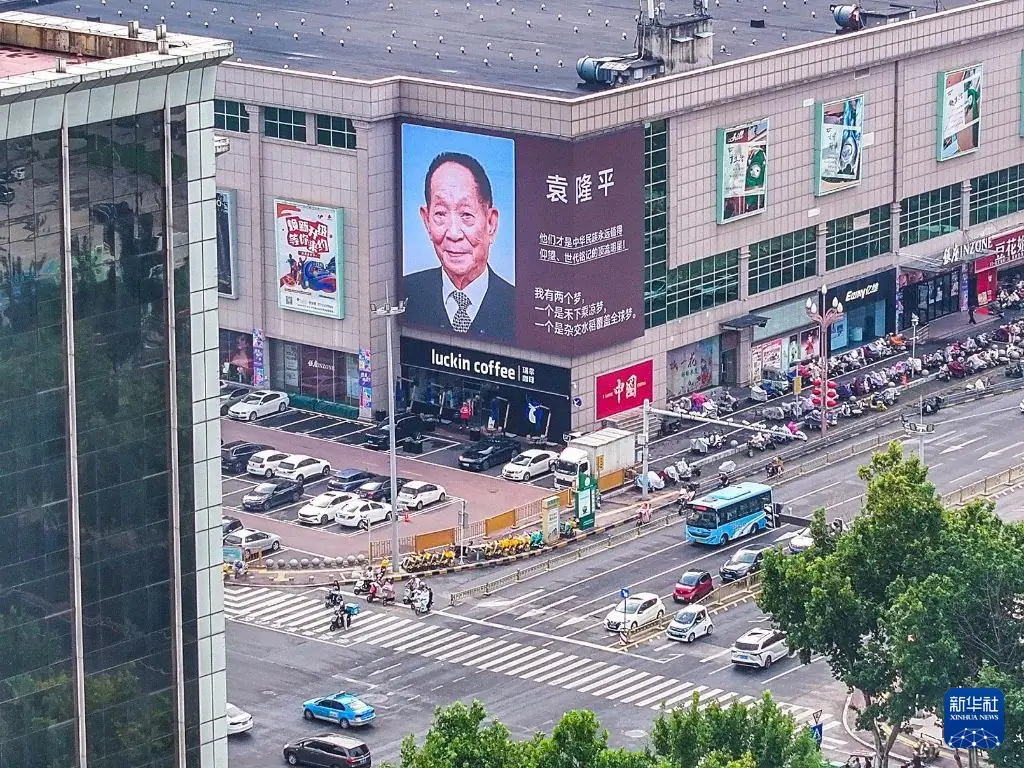
There is another reason this story has attracted attention. Advertising space in prominent urban locations has economic value.
Commercial billboards and digital screens are normally there because companies are willing to pay for the attention of the people passing them.
Giving that space to a public-service message means using valuable visibility for something that is not directly selling a product.
In Single County, the decision was explicit; the Qian Xuesen poster replaced a commercial advertisement.
In Liaocheng, Workers’ Daily reported that three shopping centres were using their outdoor screens to run scientist posters for around 20% of their screen time.
That makes the phenomenon more substantial than a handful of social-media images.
At the same time, there is no evidence that commercial advertising has broadly disappeared from Chinese public spaces.
The more accurate description is that some venues are voluntarily allocating portions of prime advertising inventory to public-service campaigns celebrating scientists and other national role models.

Joy Onuorah is a business journalist and brand communications specialist covering financial markets, artificial intelligence, digital economy, and the ideas reshaping business across Africa and the global market. Beyond her reporting for TheWill, Joy uses brand strategy, storytelling, copywriting, and high-value SEO to help brands build lasting market authority.
