
-
Nigerian software engineer Oluwafikayomi Adeleke has developed Dayroom, an AI-powered team collaboration platform.
-
Dayroom combines conversations, calls, project management and AI assistance within a shared virtual workspace.
-
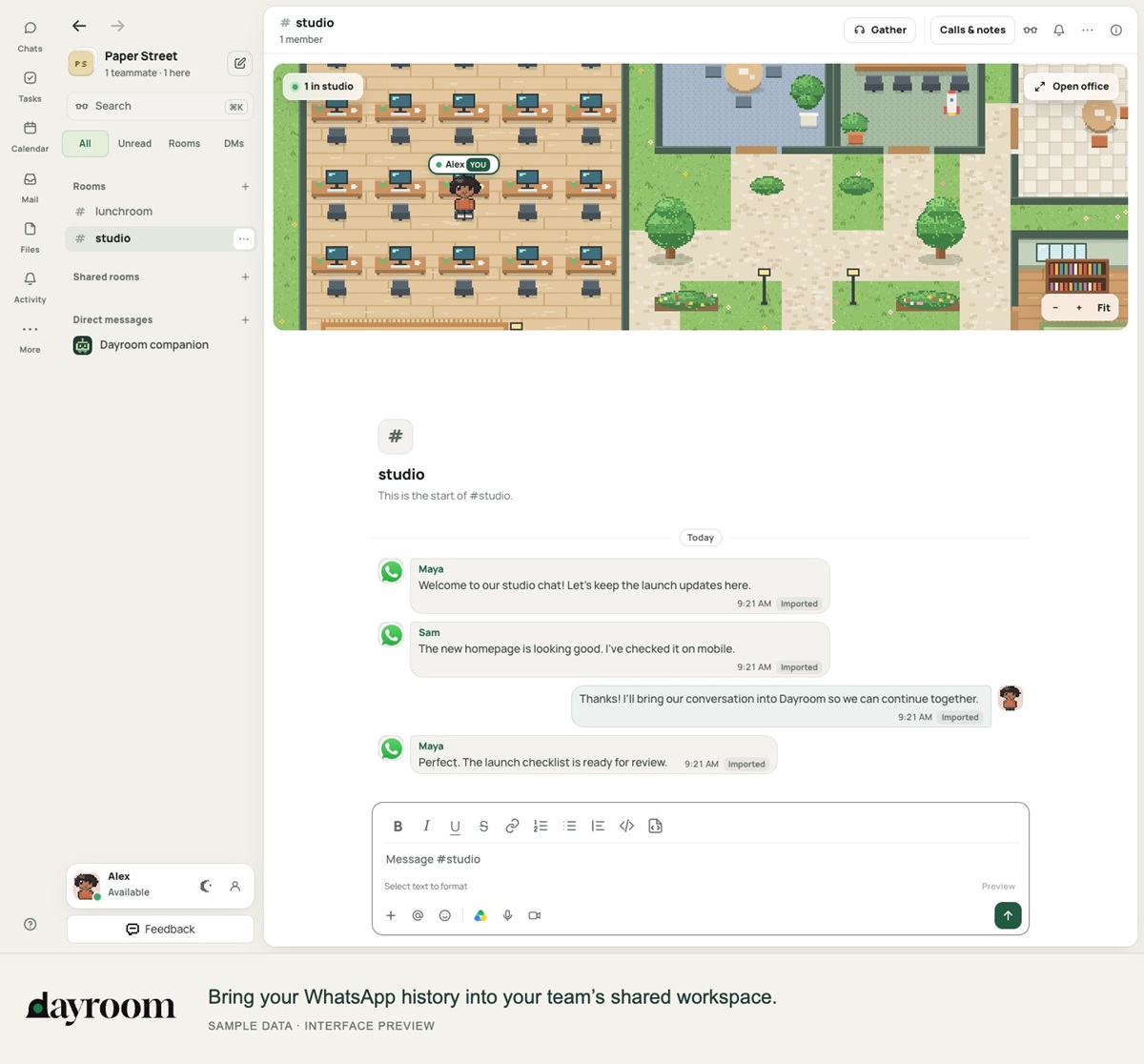
WhatsApp history import allows teams to bring earlier conversations into the platform.
-
The platform aims to help teams recover decisions and organise follow-up work without losing valuable context.
November 13, (THEWILL) – Workplace software has become remarkably good at helping people communicate, record meetings and organise tasks. Keeping all three connected remains a challenge, particularly for smaller businesses whose work moves between messaging applications, video calls and project management platforms.
Nigerian software engineer Oluwafikayomi Gideon Adeleke is building a product around that problem.
His startup, Dayroom, brings team messaging, calls, project management and an AI assistant into a shared virtual office, allowing users to retrieve earlier discussions and prepare tasks without moving between separate applications for each activity.
It also supports importing WhatsApp conversation histories, an attempt to address the difficulty businesses face when moving years of informal communication into more structured software.
Publicly launched on October 12, 2026, Dayroom enters a workplace software market that already includes Slack, Otter.ai, Asana and Microsoft Teams. These platforms offer different combinations of communication, meeting assistance and project management, with integrations that allow businesses to connect their services.
Adeleke’s approach is to bring several of these everyday activities closer together, particularly for smaller teams whose coordination depends heavily on conversation.

“I kept seeing how easily work loses context when discussions happen in one place, decisions on calls and tasks in another,” Adeleke told THEWILL in an interview.
Dayroom is his attempt to preserve the relationship between what colleagues discuss, what they agree to do and the tasks that follow.
Bringing Conversations, Decisions and Tasks Into One Workspace
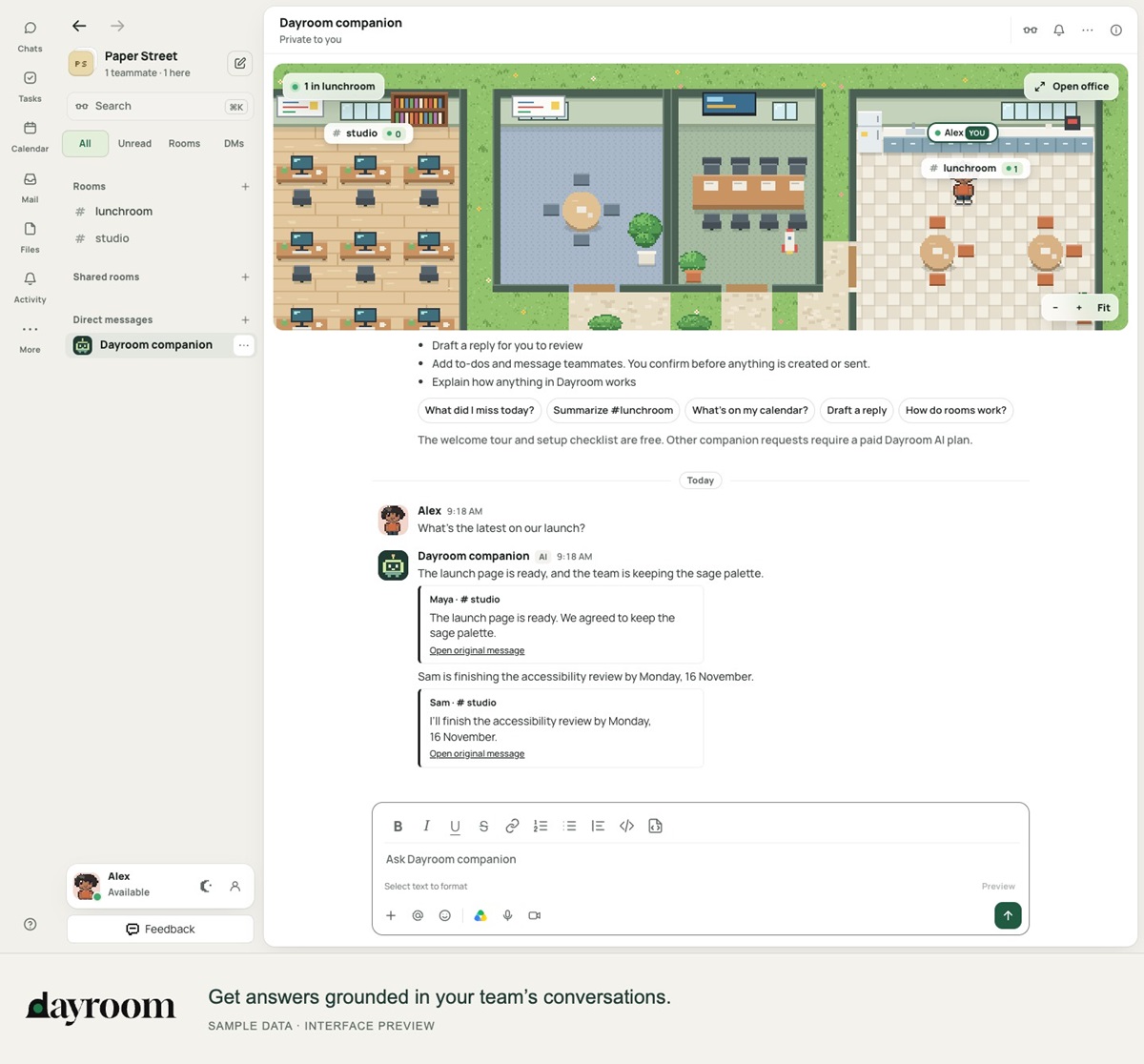
Dayroom operates as an online office organised around project rooms, messages, calls and shared work. Users can see colleagues’ availability through a virtual office interface, enter conversations and access an AI companion designed to help them recover information from earlier discussions.
Its project management feature, Dayroom Works, allows teams to organise responsibilities alongside those conversations. A user can ask the assistant about an earlier discussion, inspect references to the underlying messages and request that @Works prepare a task with an assignee and deadline.
The proposed task remains subject to human review before creation.
That arrangement addresses a problem that can persist even when communication and project management applications function properly. Information recorded during a discussion may not become an assigned responsibility, and an assigned responsibility may lose the context that explains why it exists.
Adeleke wants the original conversation to remain accessible when a team member needs to understand or complete the resulting work.
His approach also accounts for the limitations of AI-generated summaries. An assistant interpreting a conversation can overlook conditions, confuse suggestions with decisions or present something tentative as a firm agreement.
Adeleke illustrated the risk using a conditional delivery promise. If a teammate says a project could be completed on Friday provided the design receives approval, a summary that omits that condition could misrepresent the deadline.
Dayroom allows users to follow references back to source discussions and review suggested tasks before accepting them, although those safeguards do not establish that its AI outputs are consistently accurate.
“Source links help people verify a claim; they do not guarantee the AI is correct,” Adeleke said.
Slack already offers AI-assisted conversation summaries and meeting notes, while Otter.ai can identify action items from meetings and connect them with project management tools. Asana also offers AI features that help users organise project information and coordinate work.
Dayroom brings similar activities into its own shared workspace, with conversations, calls, task management and AI assistance designed to operate alongside one another.
Smaller organisations that coordinate much of their work through ongoing discussions may find such an arrangement useful, particularly when they want to reduce the effort involved in moving information between applications.
Its effectiveness, however, will depend on how reliably those features work together during ordinary team activities.
READ ALSO:
Why WhatsApp History Matters to Dayroom’s Ambition
Many small businesses begin organising their work through familiar communication channels, including WhatsApp groups and email threads. Over time, these conversations can become informal records of customer interactions, staff responsibilities, project decisions and unfinished work.
Introducing a dedicated collaboration platform does not automatically transfer that information or persuade colleagues to abandon routines they already understand.
Adeleke considered this problem when developing Dayroom’s WhatsApp import feature.
“People stay with familiar apps not only because of individual features but because their colleagues, routines and shared context are already there,” he explained.
Through the import function, teams can bring exported WhatsApp conversations into Dayroom, preserving information that might otherwise remain separate from the workspace they intend to use.
The feature could prove useful where earlier conversations contain decisions, instructions and project details that colleagues still need to reference. It also reflects an understanding of the practical difficulties involved in introducing new software to an existing team.
People may recognise the benefits of a more organised system and still hesitate to adopt it because their current application contains years of shared information.
“Moving to a better workspace should not mean starting from scratch,” Adeleke said.
Importing conversations does not, by itself, establish that a team will adopt Dayroom or find its existing information easier to use. Other workplace services also provide migration and integration options, although their capabilities and supported formats differ.
Dayroom’s approach is particularly relevant to teams whose communication histories remain central to how they understand projects and coordinate responsibilities.
However, transferring those histories introduces important questions about privacy and permission.
Workplace WhatsApp groups can contain personal details, confidential business information and messages from individuals who have never used Dayroom. Importing those conversations creates a separate copy that may be accessible through different systems and permissions.
Dayroom’s published privacy documentation advises users to import only material they are authorised to share. It also explains that disconnecting an integration does not automatically remove previously imported conversations.
The platform’s messages are not currently end-to-end encrypted, and its AI features may process relevant information through external providers. Adeleke advises prospective users to evaluate the service with non-sensitive material rather than confidential client records, medical information or similarly sensitive content.
“People trust us with their conversations, files and work context,” he told THEWILL.
Dayroom uses encryption at rest for database storage, but that protection does not prevent authorised server-side systems from processing readable messages. Its published documentation also states that complete account erasure across all backups has not been fully verified.
These limitations deserve attention because keeping information connected within a workplace also means managing access to that information responsibly.
Teams considering Dayroom must understand what they can safely upload, who can access their material and what happens to it when they leave.

From a Four-Week Build to a Growing Workplace Platform
Adeleke developed Dayroom’s first version in approximately three to four weeks, drawing on experience accumulated through software projects, machine learning training and professional engineering work.
He studied Insurance and Actuarial Science at the University of Lagos while pursuing software development and completed a 13-month ALX Data Science programme in September 2024.
In August of that year, he joined Nigerian insurtech company Curacel as a machine learning intern before progressing into a machine learning engineering role in January 2025.
His work involved chatbots, information retrieval and workflow automation, exposing him to the challenges of connecting AI systems with information people need to perform tasks.
Adeleke also worked on evaluating AI coding agents at Turing, where he examined how automated systems handled extended tasks, unexpected failures and verification.
“The three to four weeks describe the first Dayroom build, not all the preparation behind it,” he said.
As the project’s only engineer during its initial development, he handled the interface, backend, storage, AI integrations and deployment. He also used Codex and Claude as coding assistants while developing features, including the virtual office environment and its integration with room conversations.
His previous engineering experience helped him decide how the features should work together, assess their reliability and determine what was ready for release.
“The initial release was fast because I could apply those skills, but shipping a first version was the beginning of the product work, not the end,” Adeleke explained.
Dayroom’s early figures provide some indication of the interest it has attracted since its public launch.
A builder dashboard dated November 2 recorded 258 registered accounts, including 249 signups during the selected 30-day reporting period. Adeleke also reported an active-team rate of 35%, although the available information did not establish the measurement period, activity criteria or number of workspaces underlying that percentage.
As of the same date, Dayroom had no paying customers. Although the figures suggest early interest in the platform, they do not establish how consistently teams use it or what improvements they have experienced.
“Registrations do not tell us how many teams return to work together,” Adeleke acknowledged.
Feedback from a creative agency evaluating the platform has already offered insight into some of the practical considerations influencing adoption.
The agency wanted to understand whether Dayroom’s storage allowance applied to individual files or the entire workspace, and whether the product was intended primarily for software developers.
Adeleke clarified that the allowance applied to the workspace and that the service was designed for teams across different industries.
Such questions reveal how prospective users assess workplace software beyond its most prominent features. Storage limits, integration support, accessible files and dependable communication are important to teams deciding how to organise their daily activities.
Dayroom remains bootstrapped, with Adeleke financing development and handling much of its engineering and early customer support himself.
Operating the platform also involves hosting, storage and AI processing expenses, which require attention as more people begin using its features.
“The more a feature processes, the more important its unit economics become, so affordability has to be part of product design,” he said.
As adoption grows, Adeleke will need to manage the practical demands of keeping Dayroom reliable, supporting users and maintaining the services that allow its features to function.
He considers small technology, product, creative and operations teams among its potential users, particularly those whose work involves frequent conversations, shared decisions and responsibilities requiring follow-up.
His approach comes from a simple observation; teams already spend considerable time communicating about work, but the information produced during those conversations does not always remain accessible when someone needs to act on it.
Dayroom brings those activities closer together, allowing colleagues to revisit discussions, recover decisions and organise tasks within the same workspace.
Its WhatsApp import feature also acknowledges something easily overlooked when new workplace software is introduced. People do not arrive empty-handed. They come with conversations, existing relationships, established routines and information they cannot simply afford to leave behind.
Adeleke is building around that reality, using AI to help teams make better use of information they already possess rather than requiring them to continually reconstruct what happened elsewhere.

Joy Onuorah is a business journalist and brand communications specialist covering financial markets, artificial intelligence, digital economy, and the ideas reshaping business across Africa and the global market. Beyond her reporting for TheWill, Joy uses brand strategy, storytelling, copywriting, and high-value SEO to help brands build lasting market authority.