
-
Graduates of Exercise RESTORE HOPE X to form the operational backbone of newly established Army divisions, formations, and units created to strengthen Nigeria’s fight against terrorism.
-
COAS directs troops to uphold professionalism, discipline, operational excellence, and strict respect for human rights as they prepare for frontline deployments.
-
Army says intensive combat training has equipped soldiers with advanced tactical, counterinsurgency, leadership, and battlefield decision-making skills for modern warfare.
-
Military leadership credits President Tinubu’s support for accelerating force expansion, capability enhancement, and the Nigerian Army’s ongoing transformation.
August 07, (THEWILL) — The Nigerian Army has intensified its drive to strengthen national security with the graduation of another batch of combat-ready infantry personnel, as the Chief of Army Staff (COAS), Lieutenant General Waidi Shaibu, announced that the newly trained soldiers would spearhead operations in newly established divisions, formations, and units created to confront the country’s evolving security threats.
The Army Chief described the development as a significant milestone in the Service’s ongoing transformation agenda, saying the expansion of operational formations would improve force deployment, increase battlefield responsiveness, and enhance the military’s capacity to tackle terrorism, insurgency, banditry, kidnapping, and other violent crimes.
Speaking on Friday during the graduation ceremony of the Advanced Infantry Training Programme, codenamed Exercise RESTORE HOPE X, at the Nigerian Army Training Centre (NATC), Kachia, Kaduna State, Lieutenant General Shaibu said the programme remains the flagship of the Nigerian Army’s post-basic infantry training architecture.

According to him, the exercise was deliberately designed to sharpen combat proficiency, strengthen the warrior ethos, and prepare soldiers to effectively confront the increasingly sophisticated nature of modern warfare.
The COAS disclosed that the graduation coincides with one of the most ambitious force expansion programmes in the history of the Nigerian Army.
He revealed that following the approval of President Bola Ahmed Tinubu, in his capacity as Commander-in-Chief of the Armed Forces, additional divisions, formations, and operational units have been established to optimise force disposition and strengthen operational effectiveness across the country.
Lieutenant General Shaibu explained that many of the graduating soldiers would constitute the nucleus of these newly created formations, making their competence and professionalism central to the success of the Army’s renewed operational strategy.
He stressed that the substantial investment committed to their training must translate into outstanding operational performance, courage, sound tactical judgment, and unwavering commitment to defending Nigeria’s territorial integrity.
Army Chief Demands Professionalism, Human Rights Compliance From Graduating Troops
The COAS charged the graduating soldiers to maintain the highest standards of discipline and professionalism throughout their careers, urging them to remain physically fit, mentally resilient, and technologically proficient in an era where emerging technologies continue to reshape military operations.
He encouraged them to embrace innovation, adapt to evolving security threats, and pursue continuous professional development to remain effective in increasingly complex operational environments.
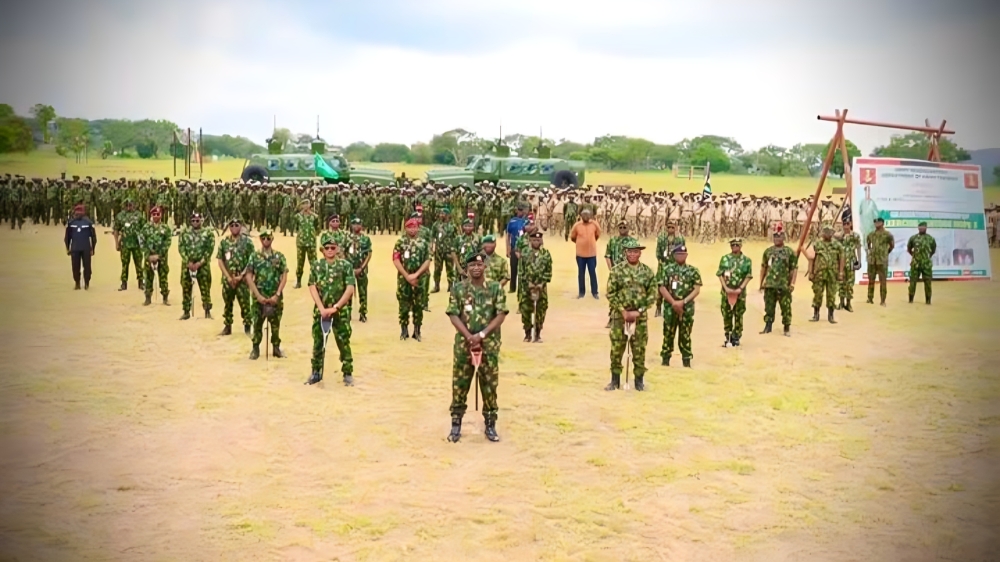
Lieutenant General Shaibu also reminded the soldiers that military success must be anchored on professionalism and accountability, insisting that all operations should be conducted with full respect for the Constitution, the rule of law, human rights, and established rules of engagement.
According to him, maintaining public confidence in the Armed Forces is as important as achieving success on the battlefield.
The Army Chief expressed profound appreciation to President Tinubu for his unwavering support for the Nigerian Army’s operational, administrative, and training requirements.
READ ALSO: COAS Deploys Top Generals To Lead Newly Established Army Divisions
He noted that the President’s sustained investment in manpower development, infrastructure, and military capability has continued to drive the Army’s transformation while strengthening its ability to respond decisively to security challenges across the country.
Lieutenant General Shaibu reaffirmed that realistic, mission-oriented training would remain the cornerstone of the Army’s strategy to build a highly skilled, agile, and combat-ready fighting force capable of delivering decisive victories in all theatres of operation.
Earlier, the Chief of Training (Army), Major General Valentine Okoro, described Exercise RESTORE HOPE X as one of the Nigerian Army’s most important professional military training programmes, noting that it has consistently produced highly motivated and combat-ready soldiers who have distinguished themselves in various operational theatres.
He said the rigorous curriculum exposed participants to realistic battlefield scenarios, tactical operations, advanced marksmanship, field craft, combat endurance, leadership development, and counter-insurgency operations.
According to him, the intensive exercise significantly enhanced the soldiers’ confidence, battlefield decision-making, leadership capacity, and overall combat effectiveness.
Major General Okoro added that beyond producing better soldiers, the programme has strengthened institutional capacity by standardising post-basic infantry training, refining instructional methodologies, and promoting continuous improvement across the Nigerian Army’s training establishments.
Felix Ifijeh is a journalist with years of professional reporting experience. Known for his keen news sense, compelling storytelling and commitment to accurate, impactful reporting, he has built a reputation for turning leads into clear, engaging, and well-structured reports that resonate with readers. His work reflects deep newsroom experience and a commitment to accurate, impactful journalism.