
November 14, (THEWILL) – This is one of those moments for the kind of self-reflection that, I’ll admit openly, Nigerians don’t do very well as a people. The question is, what do you do when reality collides with your preconceptions?
This is about what I saw at Chatham House in London two days ago, vis-à-vis the narrative that has come to dominate the online space. I’ll stick with the facts of what I saw and heard first, and then give my opinion afterwards. I’m writing this in the full knowledge that some would accuse me of having corn in my pocket. A Nigerian expression, for those who may not know, that indicates the accuser believes I have sold out to the Tinubu movement.
The first point I need to make is that at no point during the day-long occasion did the INEC chairman wear APC paraphernalia. By day-long, I mean the private discussion where various academics, researchers, and civil society actors spoke and made presentations, and then the public event where he and I were on a panel with two others. He was professional all through, came across as sincere in his intentions, and while publicly I told him that his main job is to conduct an election that everyone would agree with, even if they weren’t happy with the outcome, privately I asked him if he would be able to resist the political pressure from the ruling party when it comes, and it will come. His response satisfied me in the sense that he didn’t give a definite answer, but he wasn’t evasive either. He said something along the lines of his integrity matters to him, and he knows he has a lot of work to do. I equate that kind of response to a new groom who is asked if he would ever cheat on his wife. For me, an immediate and emphatic negative answer is the response of someone who hasn’t given the matter any thought and would fall at the first real hurdle. I’m not holding brief for Prof Amupitan here; I’m just saying that he struck me as a person who thinks. That gives room for the benefit of the doubt, and I must also say that I’m fully aware that his predecessor was at the same venue four years ago, made promises, and fell when the time came.
Second is the APC UK chair, Mr Tunde Doherty. I have never spoken to Mr Doherty before, but I have been in the same space with him four times – the first time I noticed him was four years ago when Peter Obi came to Chatham House for his event. Doherty was present. The second time was during President Tinubu’s state visit to the UK. I was involved in something at Southwark Crown Court, which required me to pass through Westminster Tube Station on my way to the court. On the day of the state visit, on my way back, I saw Mr Doherty at Westminster Tube Station in his full APC/Tinubu regalia, marshalling crowds of “volunteers” to go and do the hailing thing for the President’s entourage. The third time I was in the same space as the man was during the infamous Daniel Bwala interview. He was on the panel; I was in the crowd. After the interview, the other panellists, who happen to be my friends, invited me upstairs to meet Mehdi Hassan. Doherty was there, hobnobbing with pretty much everyone else. From the APC side of the aisle, Juliana Olayinka spoke with me. The next time I saw Mr Doherty was, of course, on Thursday at Chatham House, and here it is critical for me to state that contrary to the stories making the rounds, he did not arrive at Chatham House with the INEC delegation of three people, nor did he leave with them. He did what a professional networker would do – after the public event, he walked up to them, introduced himself and did a small chitchat.
This is where something needs to be said about work rate, turning up, and, as some would have it, hustle culture. Whatever you want to say about the APC UK chairman, Tunde Doherty, he is always present, advancing his interests. Many of his detractors are happy to stay online heckling, and that heckling is essentially what the ‘protest’ against the INEC chair amounted to, which I will come to. The needle won’t be moved by staying on the sidelines throwing stones. I won’t hold it against the NDC or the ADC as bodies because they are relatively new arrivals on the political party scene in Nigeria, so I don’t think they have strong enough branches in the UK to have someone who is always at events. However, the Obidient movement and the Atikulated movement have been around for a bit. Why have they not identified a committed person to attend all events and ensure that their interests, visual interests at least, are represented?
READ ALSO:
Third, the ‘protest’. Protest? It was between six and ten individuals who surrounded the INEC chair’s car. It did not interrupt anything; it was over before one could say balablu, and the day went on as if nothing happened. So I was very surprised later in the day when I saw stories making the rounds about the INEC chair being “disgraced in the UK”, and the next day, when I turned on Arise News, I saw a report about the man’s “convoy” being stopped. One car does not a convoy make. In any event, and this is important, I think the photograph that captured the ‘protest’ in its true glory was in Daily Trust.

This brings me to my opinion: I have just witnessed the power that social media has to reinforce people’s biases. We have an election coming, and because of our unfortunate history, so many Nigerians are, quite correctly, already wired to distrust the electoral umpire. I hope Prof Amupitan has an understanding of that reality, which is what informed my challenge to him at the end of my opening remarks. It is not just about conducting an election; the election must be seen by all sides (well, except those who have their minds completely made up regardless) as credible. That is a bar that he must clear.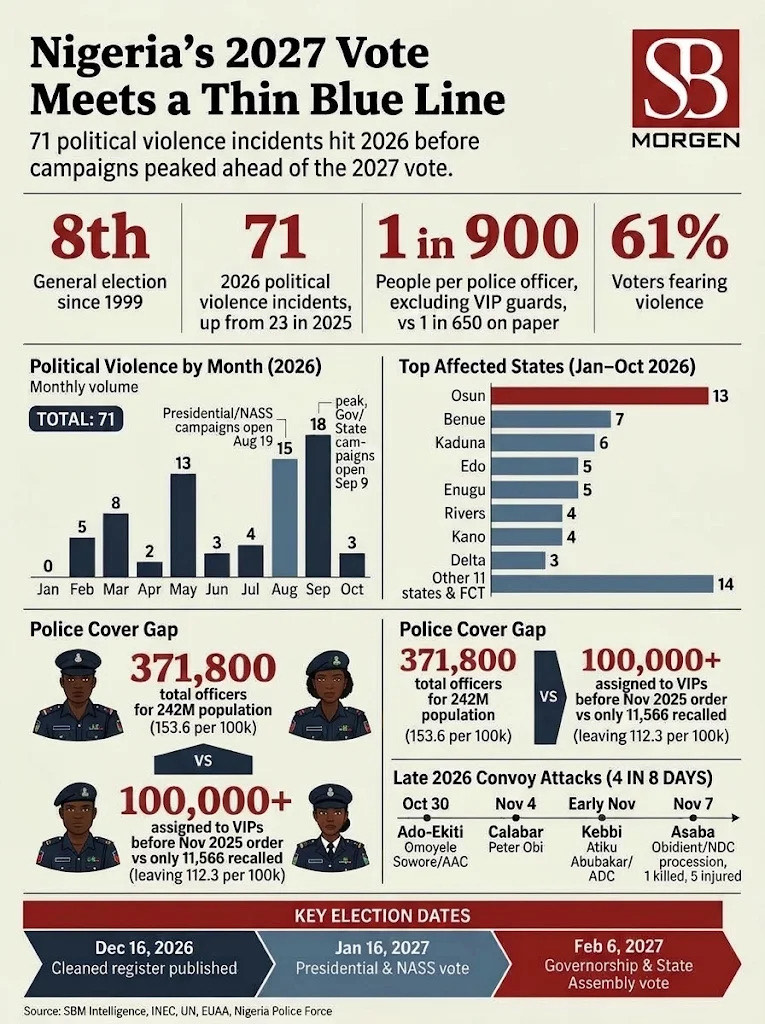
A lot must be said about people’s yearning to believe stuff that reinforces their perceptions. I saw a number of clips on Twitter where people claimed that Mr Doherty was the INEC chair; someone would come and correct them, but the person making the claim would double down. This atmosphere of mistrust is amplified by the social media algorithm simply because it is profitable. To be fair, it’s not happening only to Nigeria’s democracy; it’s a genuinely global problem among democracies, which makes a strong case for the Chinese approach of tight control. But tight control only works when the government has repeatedly shown that it has the population’s interests at heart, and that can hardly be said about the Nigerian government in a historical sense.
Then I must express a lot of sympathy for Prof Amupitan. Something changes when you have had a chance to meet a figure in person; suddenly he becomes human, and you see his motivations, fears, and challenges through the man’s eyes, not through a television screen. The man is facing a challenging election, and he thinks he understands how he can be undermined by the political class he is meant to referee. I fear that he is unprepared for how desperate these guys can be.
Finally, I will come back to the theme of what I presented at the event. The violence is ticking up, and the political class, especially people from the ruling party with access to the levers of power, are getting more and more desperate. It does not matter how well-intentioned Prof Amupitan and his fellow INEC staff are; what matters is the outcome of what they give us in January and February. Given the suffering Nigerians have endured over the last four years, if the elections are seen as less than kosher, we are in for serious trouble.
The author, Cheta Nwanze is CEO at SBM Intelligence.
