
-
Nigerians in the diaspora confront INEC Chairman, Joash Amupitan, outside Chatham House, demand his resignation and accuse the commission of compromising the 2027 elections.
-
Protesters allege manipulation of the preliminary voters’ register through suspected AI-generated photographs, duplicate entries, deceased voters and questionable registrations.
-
Amupitan acknowledges that the 2023 presidential election created a significant trust deficit for INEC but insists new technical safeguards will prevent inaccurate results from being uploaded to IReV.
-
INEC discloses removal of 1,608,660 invalid registrations and 873 deceased voters’ records, identifies 54 persons for possible prosecution and schedules a nationwide mock election exercise for November 28.
November 13, (THEWILL) – The chairman of the Independent National Electoral Commission (INEC), Prof. Joash Amupitan, on Thursday, faced an angry protest by Nigerians in the diaspora outside Chatham House in London, with demonstrators demanding his resignation over alleged irregularities in the preliminary voters’ register and questioning the commission’s neutrality ahead of the 2027 general elections.
The protesters, who surrounded the INEC chairman’s vehicle as he departed the international policy institute, accused the commission of failing to provide satisfactory explanations for alleged anomalies in the voters’ register and demanded greater transparency in the preparation for the next general elections.
Videos of the confrontation circulating on social media showed the demonstrators holding placards, shouting at Amupitan and demanding that he address their concerns publicly rather than leave the venue without responding to their grievances.
Some of the protesters resorted to personal insults, describing the INEC chairman as a “bastard” and an “evil corrupt man”, while calling on him to step down.
The demonstration, which was planned ahead of Amupitan’s appearance at Chatham House, was intended to draw international attention to concerns over the credibility of Nigeria’s electoral preparations.
The organisers accused INEC of allegedly working in favour of the ruling All Progressives Congress (APC), claiming that irregularities in the voters’ register could undermine the credibility of the 2027 presidential election and give President Bola Tinubu an electoral advantage.

They specifically raised concerns over suspected artificial intelligence (AI)-generated photographs, duplicate registrations, unusual names, questionable voter details and records allegedly belonging to deceased persons.
The protesters also questioned the retention of additional polling units reportedly contained in the commission’s database, demanding that INEC account for the disputed entries and remove all invalid registrations.
They insisted that the commission must demonstrate transparency and accountability to restore public confidence in the electoral process before the 2027 polls.
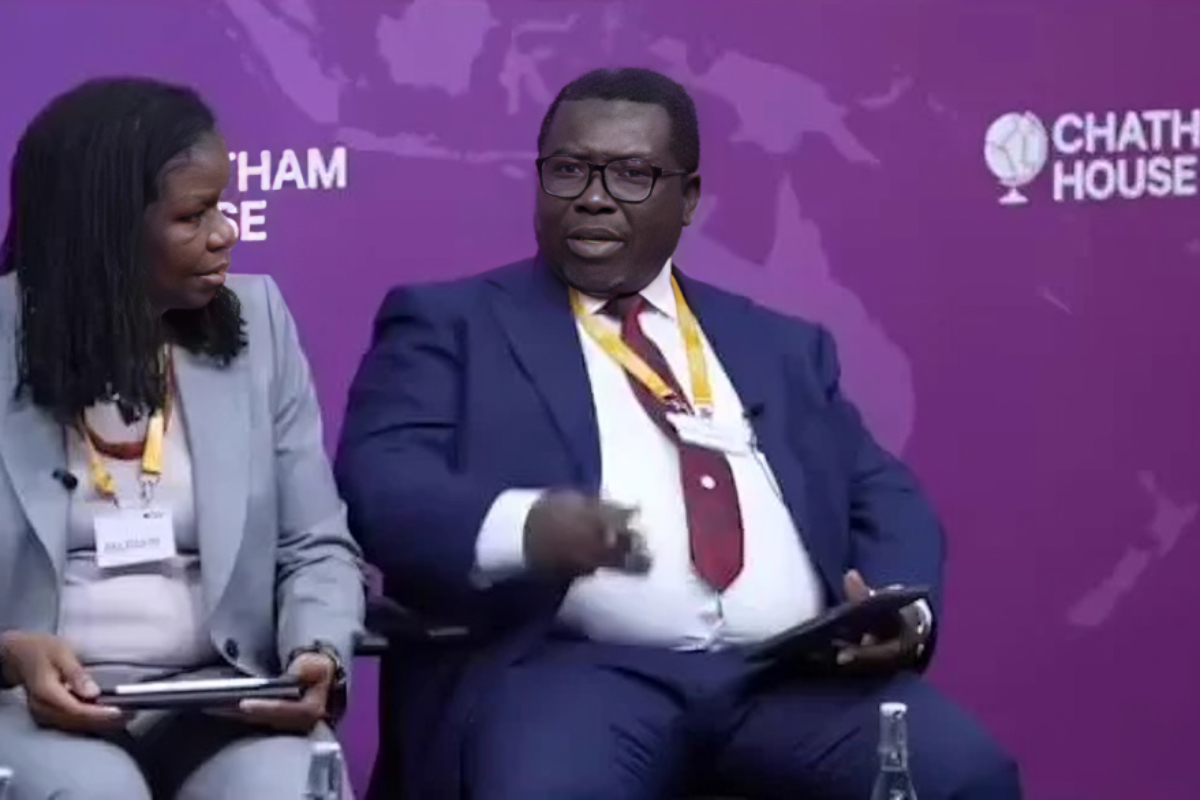
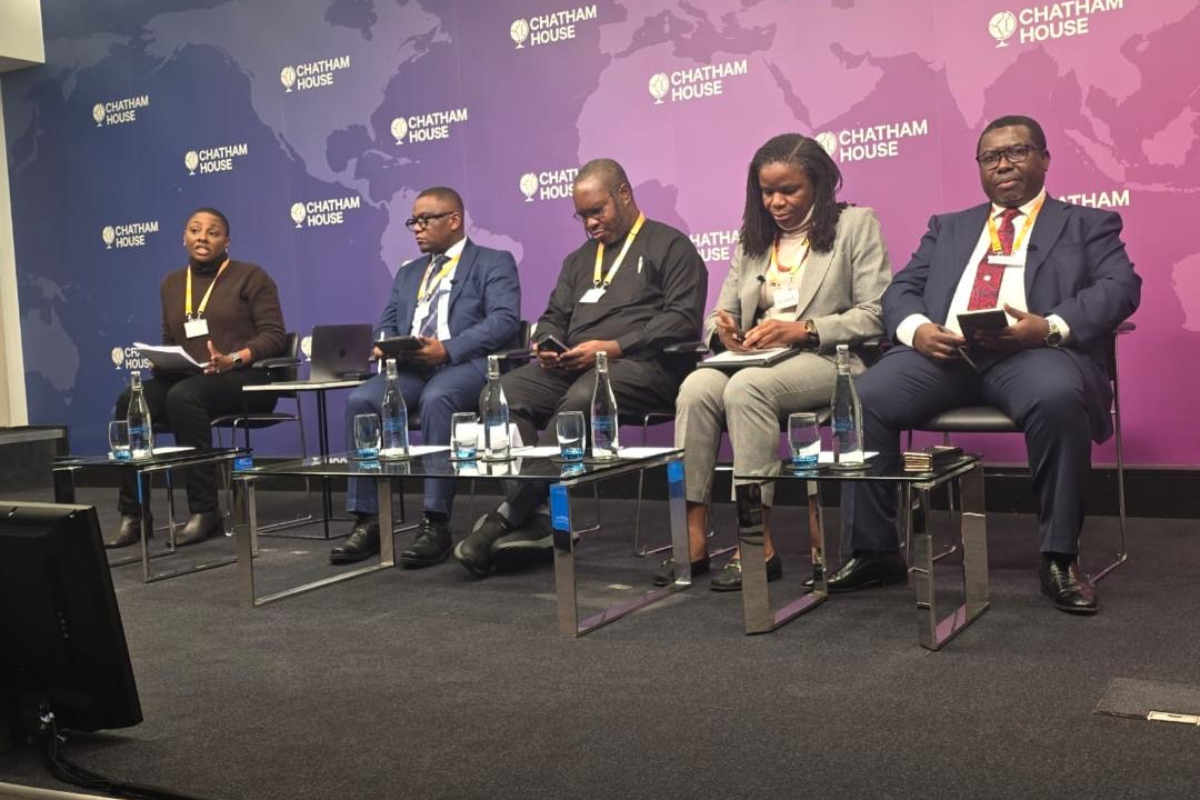
The confrontation came as Amupitan was participating in a high-level dialogue at Chatham House, organised in partnership with the Kimpact Development Initiative (KDI), under the theme, “Nigeria’s 2027 Elections: Democratic Trajectory and Regional Stability Beyond the Ballot.”
At the engagement, the INEC chairman defended his leadership and outlined measures being implemented to improve the conduct of elections, insisting that Nigerians should trust the commission to deliver free, fair and credible elections in 2027.
Amupitan Admits 2023 Election Damaged INEC’s Credibility
Addressing the credibility concerns surrounding INEC, Amupitan acknowledged that the controversies generated by the 2023 presidential election had significantly eroded public confidence in the electoral body.
He admitted that the commission had yet to fully recover from the damage caused by the disputed election, which was characterised by controversies over the electronic transmission of results and the declaration of the presidential winner.
“First and foremost, let me speak about what happened in 2023, which resulted in a significant trust deficit for INEC—damage so large that the Commission has not yet fully recovered from it”, he said.
He, however, maintained that INEC had treated subsequent elections as opportunities to identify operational weaknesses and introduce improvements in voter accreditation, voting procedures and result management.
To support his position, Amupitan cited the governorship elections in Anambra, Osun and Ekiti states, the Federal Capital Territory (FCT) Area Council elections and 16 legislative by-elections conducted under his leadership.
Responding to why Nigerians should trust him to conduct the 2027 elections, he said the improvements recorded in recent off-cycle elections demonstrated the commission’s commitment to addressing previous shortcomings.
“Why must Nigerians trust me? Nigerians must trust me because, number one, I have conducted off-cycle elections—and observers agree that the recent election in Osun State marked a clear improvement. Every election is a lesson. The 2023 general election was a major lesson for Nigeria, and the Anambra election was another”, he stated.
Amupitan recalled that the 2021 Anambra governorship election took approximately five days to conclude, while previous elections in Anambra and Osun had experienced prolonged and sometimes inconclusive processes.
According to him, administrative reforms introduced by the commission had enabled it to declare results in both states the day after voting.
 INEC Introduces Safeguards Against Result Manipulation
On the integrity of election results, Amupitan identified insecurity, logistics and result management as the three major challenges INEC was prioritising ahead of the 2027 general elections.
He disclosed that a post-election review of the 2023 exercise identified collation centres as the major source of some of the discrepancies recorded in election results, rather than polling units where votes were cast and counted.
The chairman said the commission had consequently introduced technical validation measures to prevent inaccurate results and figures indicating over-voting from being uploaded to its INEC Result Viewing Portal (IReV).
“We found that the core problem of election result management and declaration in Nigeria is not even at the polling unit—it is at the collation centres”, he added.
Explaining the new safeguards, Amupitan recalled that inaccurate results and figures reflecting over-voting were uploaded to IReV during the 2023 elections.
He said the upgraded system would prevent results that failed the commission’s validation requirements from being transmitted to the portal.
“In 2023, there were instances of inaccurate results or results with over-voting being uploaded onto IReV. We have now devised a technical safeguard: if a result is not accurate at the polling unit, it will not go to IReV at all. The moment a result appears on IReV, citizens can trust what they see. By eliminating inconsistencies at the source, collation will become a transparent formality”, he said.
Amupitan further disclosed that INEC had considered deploying an entirely new electoral technology for the 2027 elections but decided instead to upgrade and strengthen its existing infrastructure because of the limited time available before the polls.
BVAS: INEC Reduces Voter Allocation, Schedules November 28 Mock Exercise
On the performance of the Bimodal Voter Accreditation System (BVAS), the chairman announced additional measures to address equipment malfunctions experienced during the 2023 elections.
He said INEC was constructing climate-controlled storage facilities across the states to protect the devices against extreme temperatures and unsuitable storage conditions.
The commission had also procured additional BVAS machines and reduced the maximum number of registered voters assigned to each device from 1,250 to 850.
Under the new arrangement, polling units with more than 850 registered voters would be provided with multiple devices to reduce congestion and delays during accreditation.
To assess the effectiveness of the new measures before the general elections, Amupitan announced a nationwide mock accreditation and voting exercise scheduled for November 28, 2026.
The exercise, he said, would test the commission’s preparedness for voter accreditation and electronic transmission of results across the country.
“On the 28th of this month, we will conduct a mock accreditation and voting exercise across all states of the federation to simulate the presidential election and verify that we have gotten both accreditation and electronic result transmission right”, he said.
On funding, the INEC chairman confirmed that the commission had received a substantial portion of its budget for the 2027 elections but was awaiting the release of the outstanding balance.
He explained that part of the outstanding funds was required for the recruitment and welfare of ad hoc election personnel, adding that the commission had received assurances that the money would be released before the end of November.
READ ALSO:
 Amupitan Denies Political Bias, Addresses Voters’ Register Controversy
The INEC chairman also used the Chatham House engagement to respond to allegations questioning his political neutrality, including social media claims linking his telephone number to a controversial account on X, formerly Twitter.
He denied operating an X account, disclosing that an independent forensic examination had been obtained and the matter referred to the Department of State Services (DSS) and the Inspector-General of Police for investigation.
Amupitan also dismissed suggestions that his previous legal representation in political disputes could compromise his impartiality, explaining that he had undertaken such engagements in his professional capacity as a Senior Advocate of Nigeria before his appointment as INEC chairman.
Emphasising his commitment to the country’s legal framework, Amupitan said his allegiance was to the Constitution and the Electoral Act.
“My loyalty is solely to the Constitution of the Federal Republic of Nigeria and the Electoral Act. Every constitutional institution—including the Presidency, the National Assembly, and state governors—owes its primary loyalty to the Constitution and the rule of law”, he assured.
On the allegations of irregularities in the preliminary voters’ register, including claims of an 85 per cent increase in the number of registered voters in a ward in Ebonyi State, Amupitan said INEC had investigated and resolved the complaint in accordance with statutory procedures.
He maintained that the Electoral Act provides opportunities for members of the public to raise claims and objections concerning the voters’ register and request certified true copies of relevant records.
The controversy has intensified following public complaints over suspected AI-generated photographs, duplicate entries, unusual names and registrations allegedly linked to deceased persons. INEC had earlier acknowledged irregularities in the registration process.
On November 9, Amupitan disclosed that the commission had removed 1,608,660 confirmed invalid registrations and 873 records belonging to verified deceased voters from its database.
He also revealed that 54 persons across 10 states had been identified for disciplinary action, including possible prosecution, over their alleged involvement in registration irregularities.
The commission said the clean-up exercise was intended to address identified deficiencies and ensure that only eligible voters were retained in the final register ahead of the 2027 elections.
INEC is expected to publish the final voters’ register on December 15, 2026.
INEC Chairman Warns Against Disinformation Ahead Of 2027
Amupitan also called on Nigerian youths to remain actively involved in the democratic process, urging them to resist misinformation and verify information before sharing it.
He described misinformation as a major threat to democracy and appealed to citizens to contribute to strengthening the country’s electoral process.
“This country belongs to young Nigerians, and they must not relent in working for the Nigeria they desire. Misinformation remains one of the greatest threats to our democracy. Citizens must verify information before acting or sharing, and give our democracy the chance to succeed”, he charged.
The London confrontation adds to mounting scrutiny of INEC’s preparations for the 2027 general elections, particularly the integrity of the voters’ register and the commission’s ability to restore public confidence following the controversies surrounding the 2023 presidential election.
The 2027 presidential and National Assembly elections are scheduled for January 16, 2027, while the governorship and State Houses of Assembly elections will hold on February 6, 2027.
Felix Ifijeh is a journalist with years of professional reporting experience. Known for his keen news sense, compelling storytelling and commitment to accurate, impactful reporting, he has built a reputation for turning leads into clear, engaging, and well-structured reports that resonate with readers. His work reflects deep newsroom experience and a commitment to accurate, impactful journalism.