
SAM DIALA writes that Nigeria stands at a defining economic crossroads of converting potential to prosperity amid challenging operating environment
September 07, (THEWILL) — Nigeria has never suffered from a shortage of economic possibilities. It has suffered from the persistent inability to convert possibilities into productivity, productivity into competitive enterprises, and enterprise into widely shared prosperity. That contradiction defines Nigeria’s business landscape today.
The country possesses one of Africa’s largest consumer markets, a huge and youthful population, abundant agricultural resources, substantial oil and gas reserves, a rapidly expanding digital economy, a vibrant entrepreneurial culture and an increasingly sophisticated financial sector. Yet millions of businesses operate under punishing conditions, while households struggle with declining purchasing power and unemployment and underemployment remain serious concerns.

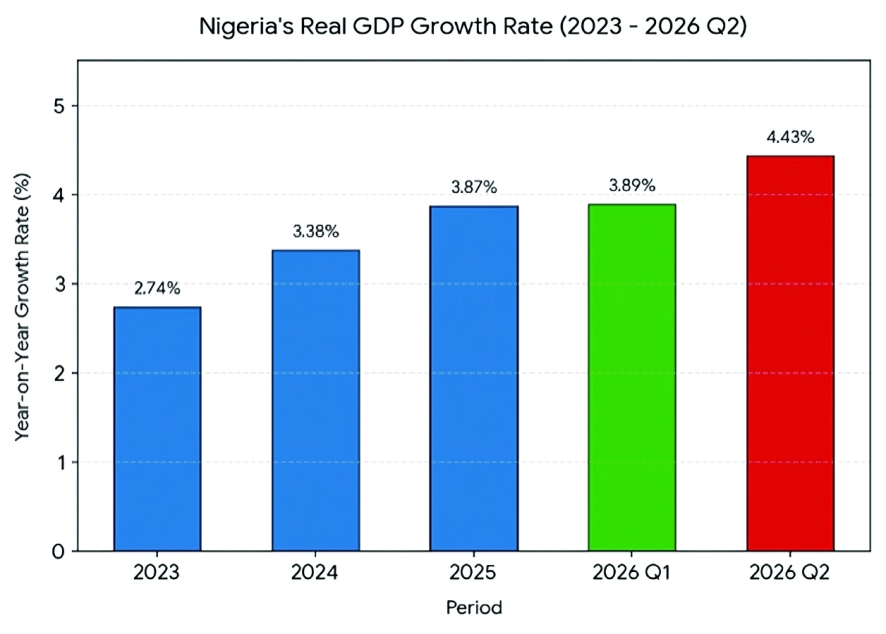
The paradox is therefore unmistakable: Nigeria has an abundance of economic potential but a deficit of economic conversion. Recent economic figures offer reasons for cautious optimism. Nigeria’s economy grew by 4.43 percent year-on-year in the second quarter of 2026, accelerating from 3.89 percent in the first quarter. The economy had also grown by 3.87 percent in 2025, compared with 3.38 percent in 2024. These numbers are encouraging. But growth alone cannot be the final measure of economic success.
The real question is: How much of that growth is translating into productive investment, stronger businesses, better jobs, higher household incomes and improved living standards? That is the test Nigeria must now confront.
The Reform Paradox
Since 2023, Nigeria has embarked on some of its most consequential economic reforms in decades. Fuel subsidies have been dismantled, the foreign-exchange regime has undergone fundamental changes, monetary policy has tightened, and fiscal and tax reforms have been pursued.
The reforms have not been painless. Businesses have confronted higher energy, transportation, financing and imported-input costs. Consumers have faced a dramatic increase in the cost of basic necessities. Entrepreneurs who previously operated on narrow margins have found survival increasingly difficult. Nevertheless, the reforms have also begun to produce important macroeconomic gains.
The International Monetary Fund noted in its 2026 Article IV assessment that reforms since 2023 have strengthened macroeconomic stability, improved foreign-exchange market functioning, rebuilt external buffers and reduced fiscal vulnerabilities.
The World Bank similarly says recent reforms have created a foundation for deeper structural transformation, pointing to improvements in inflation, revenue mobilisation, reserves and exchange-rate flexibility. But there is a crucial distinction between stabilising an economy and transforming an economy. Stabilisation prevents collapse. Transformation creates prosperity. Nigeria must now move decisively from the first to the second.
The Entrepreneur: Nigeria’s Most Important Economic Actor At the centre of that transformation is the Nigerian entrepreneur. Across markets, villages, university campuses, technology hubs and industrial clusters, Nigerians continue to create businesses despite extraordinary obstacles. From agro-processors and manufacturers to fintech companies, logistics operators, fashion businesses, software developers and informal traders, entrepreneurship remains one of the country’s greatest economic assets. Yet Nigerian entrepreneurs are frequently asked to do too much with too little.
A manufacturer may have to provide private electricity because public power is unreliable. A farmer may produce successfully but lose value because roads, storage and processing facilities are inadequate. A technology entrepreneur may develop an innovative product but struggle to obtain affordable capital. A retailer may face multiple taxes and levies from different authorities. The entrepreneur therefore becomes not merely a business owner but, effectively, a substitute for missing infrastructure. This is economically inefficient.
Mike Akannor, a financial analyst, argued that businesses should compete on the quality, price and innovation of their products—not on their ability to survive infrastructure failures. He emphasised that the Nigerian state must redefine its relationship with enterprise, insisting that Government does not need to own every business, but needs to create the conditions under which businesses can succeed.
The MSME Financing Problem
Perhaps nowhere is Nigeria’s structural weakness more visible than in access to finance. Micro, small and medium-sized enterprises (MSMEs) are responsible for a substantial portion of economic activity and employment, but many remain trapped in a cycle of inadequate capital.
Commercial bank lending often requires collateral that young businesses do not possess. Interest rates can make long-term investment prohibitive. Venture capital is concentrated in particular sectors, especially technology, while traditional businesses struggle to attract growth capital.
This produces a damaging economic cycle. A business without affordable capital cannot purchase modern equipment. Without modern equipment, productivity remains low. Low productivity limits profitability. Low profitability makes formal financing more difficult. The result is an economy populated by thousands of businesses that survive but do not scale. Nigeria must break this cycle by developing a deeper ecosystem of patient capital.
Muda Yusuf, CEO, Centre for Promotion of Private Enterprise said Nigeria’s real sector—including manufacturing, agriculture, agribusiness, MSMEs and export-oriented businesses faces enormous financing challenge. He attributed the problem not simply to a shortage of liquidity but to structural weaknesses: prohibitive interest rates, short loan tenors, stringent collateral requirements, limited bank risk appetite and inadequate patient capital.
Pension funds, development finance institutions, commercial banks, private equity firms, venture capital funds and capital-market institutions should be encouraged to create financing instruments specifically designed for productive enterprises. But finance alone is not enough. Businesses also require predictable regulation, reliable infrastructure and stable macroeconomic conditions.
Electricity: The Hidden Tax on Business
Nigeria’s energy crisis remains one of the greatest constraints on competitiveness. When manufacturers generate their own electricity, they incur costs that their competitors in countries with reliable power supplies do not face. When small businesses purchase petrol or diesel to power generators, those expenses are effectively an additional tax on production. The consequence is predictable: Nigerian products become more expensive. This affects not only manufacturers but virtually every part of the economy. Restaurants, hospitals, schools, supermarkets, technology firms, artisans and agricultural processors all bear some version of the energy burden. The electricity sector therefore deserves to be treated as an economic productivity issue rather than merely an infrastructure issue.
The IMF has identified electricity, infrastructure, agriculture and human-capital formation among the structural areas requiring reform to achieve higher and more inclusive growth. Nigeria needs an electricity market in which private investment is rewarded, distribution companies are held accountable, generation expands, transmission becomes more reliable and consumers have greater certainty about supply and pricing. Reliable electricity could be one of Nigeria’s most powerful industrial policies.
Agriculture: From Farming to Agribusiness
Agriculture presents perhaps the country’s greatest opportunity for inclusive economic growth. Nigeria has vast agricultural land, a large domestic food market and millions of farmers. Yet the country struggles with food insecurity and substantial post-harvest losses.
The fundamental problem is that Nigeria has historically viewed agriculture largely as farming rather than as a complete value chain. Modern agriculture should connect farmers to storage, logistics, processing, packaging, finance, insurance and export markets.
Instead of exporting raw commodities, Nigeria should increasingly export processed agricultural products. Instead of allowing tomatoes to rot because there are insufficient storage facilities, the country should develop tomato-processing industries.
Instead of exporting cocoa primarily as a raw commodity, Nigeria should capture greater value through processing. Instead of allowing cassava and other crops to remain low-value commodities, they should feed industrial supply chains. This is where agriculture can become an engine of manufacturing. A stronger agricultural value chain would simultaneously address food security, rural employment, industrialisation, exports and poverty.
READ ALSO:
Digital Economy: Nigeria’s Great Leapfrog Opportunity
If agriculture represents Nigeria’s opportunity in the physical economy, technology represents its opportunity in the digital economy. Nigeria has demonstrated that innovative companies can emerge from difficult economic conditions. Fintech has transformed payments and financial inclusion. Digital platforms have altered commerce and transportation. Nigerian technology entrepreneurs have attracted international attention and capital. But the next phase must go beyond fintech.
Nigeria should become a major African hub for artificial intelligence, software development, cybersecurity, digital education, health technology, agricultural technology and business-process outsourcing.
The country has something many economies would struggle to manufacture: a large, young population capable of supplying a significant pool of digital talent. But talent must be matched by infrastructure.
Affordable broadband, reliable electricity, digital skills, research institutions and modern regulatory frameworks are essential.
Artificial intelligence could become particularly important. Rather than seeing AI merely as a threat to employment, Nigeria should position it as a productivity tool that enables small firms to compete beyond their physical locations. A small Nigerian enterprise should be able to sell software, creative services, consulting, design and digital products to customers across Africa and the world. That is an export opportunity Nigeria cannot afford to miss.
Tax Reform Revenue: Without Killing Enterprise
Nigeria needs more revenue. The government cannot provide infrastructure, security, education and healthcare without adequate fiscal resources. But taxation presents a delicate policy challenge.
An economy with a small formal tax base cannot simply squeeze existing taxpayers indefinitely. The better strategy is to expand the productive economy.
If thousands of informal businesses become formal, if small enterprises grow into medium-sized companies, and if medium-sized companies become large exporters, government revenue will naturally increase.
Tax policy should therefore be designed not simply to collect more money today but to create more taxpayers tomorrow.
Stakeholders and industry experts have emphasised the importance of stronger revenue mobilisation and digitalisation of tax administration while also noting the need to protect vulnerable households and maintain appropriate thresholds for smaller firms. Nigeria’s tax reform should therefore follow three principles: simplicity, fairness and predictability.
A business should know what it owes, why it owes it and which authority is entitled to collect it. Multiple and overlapping levies should be eliminated. The objective should be to make compliance easier, not to make survival harder.
The Infrastructure Gap
Nigeria cannot build a competitive business economy without closing its infrastructure deficit:
Roads determine whether agricultural products reach markets.
Ports determine whether exporters can compete.
Rail determines the cost of moving bulk goods.
Digital networks determine whether businesses can participate in the modern economy.
Electricity determines whether factories can produce competitively.
Infrastructure is therefore not simply government expenditure. It is productive capital.
Nigeria must become much more disciplined in selecting infrastructure projects. The country cannot afford to spend scarce resources on projects primarily because they are politically attractive. Many state governors have invested enormous resources building under-utilised airports and flyovers. The infrastructure investment must be judged by its capacity to increase productivity, reduce business costs and unlock private investment.
A road that connects farmers to a processing centre may have a greater economic impact than a prestigious project that generates little productive activity. The principle should be simple: Public investment must crowd in private productivity.
Security as Economic Policy
No serious conversation about Nigeria’s business environment can ignore insecurity. A farmer who cannot safely reach his farm cannot produce optimally. A transporter who risks kidnapping on a major route charges more. A manufacturer located in an insecure area faces higher insurance and security costs. Investors are less likely to commit capital where property rights and physical security are uncertain. Security is therefore not merely a social or political issue. It is an economic variable. Nigeria must treat security spending increasingly as an investment in productive capacity.
From Consumption to Production
Perhaps the greatest strategic challenge confronting Nigeria is the country’s dependence on consumption. For decades, economic growth has been heavily influenced by government expenditure, oil receipts and consumer demand. But sustainable prosperity requires production.
Nigeria needs more factories, more processors, more exporters, more technology companies, more agricultural enterprises and more globally competitive Nigerian brands.
The country must graduate from an economy that primarily consumes imported value to one that creates and exports value. That requires industrial policy—but not the old form of industrial policy based on permanent protection and government ownership. Modern industrial policy should provide targeted incentives for sectors with genuine competitive potential while demanding performance in return.
Companies receiving incentives should demonstrate investment, employment, exports, technology transfer or productivity improvements.
Support should not become a permanent entitlement.
Governance and Policy Consistency
Perhaps the most valuable incentive government can give business is certainty. Investors can tolerate difficulty. What they cannot easily tolerate is unpredictability. A business can plan around a high tax rate if the rate is stable. It can plan around an exchange rate if the market is transparent.
It can plan around regulatory requirements if they are consistently enforced. But sudden policy reversals destroy business models. Nigeria therefore needs institutional continuity.
Economic policies should survive changes in ministers, administrations and political cycles. This is especially important as the country approaches another electoral cycle. The Nigerian economy should not be repeatedly reset every four years.
Opportunity of Larger African Market
Nigeria’s domestic market is enormous, but its ambition should extend beyond its borders. The African Continental Free Trade Area offers Nigeria an opportunity to become a manufacturing, financial, technological and logistics hub for the continent. Nigerian companies already possess something valuable: experience operating in complex markets. The next step is to transform that experience into export competitiveness.
Nigeria should identify sectors in which it can become a regional leader—financial services, entertainment, pharmaceuticals, processed food, digital services, construction materials, consumer goods and professional services. The country’s entrepreneurs should not think of Africa as 54 separate markets. They should increasingly think of Africa as a single commercial opportunity.
New Social Contract Between Government and Business
Nigeria ultimately needs a new economic compact. Government must provide security, infrastructure, sound institutions, predictable policies and fair regulation. Businesses must respond with investment, innovation, productivity, job creation and tax compliance. Citizens must have opportunities to acquire the skills necessary to participate in the economy.
The objective should not be an economy in which government and business constantly blame one another. It should be an economy in which both recognise their interdependence. Government cannot create prosperity alone. Business cannot thrive without functioning institutions.
Citizens cannot prosper without productive businesses. These three elements must therefore work together.
Nigeria’s economic progress must be determined by the capacity of its people to create and add values. The responsibility of economic policy is to remove the obstacles standing between that creativity and its productive expression. If Nigeria can accomplish that, entrepreneurship will cease to be merely a survival mechanism and become the engine of national transformation. The country’s economic future will then no longer be defined by what Nigeria could become. It will be defined by what Nigerians are actually producing, exporting, building and creating.

Sam Diala is a Bloomberg Certified Financial Journalist with over a decade of experience in reporting Business and Economy. He is Business Editor at THEWILL Newspaper, and believes that work, not wishes, creates wealth.