
The CBN banking recapitalisation policy should reposition finance as an engine of economic transformation, not merely showcasing robust balance sheets.
September 13, (THEWILL) – Nigeria is attempting something that goes beyond repairing its banking system. It is trying to reposition finance as an engine of economic transformation. However, this must be demonstrated as genuine, rather than just a superficial showcase of something significant.
The Central Bank of Nigeria’s recapitalisation programme requires banks to build substantially larger capital bases, with minimum paid-up capital rising to N500 billion for banks with international authorisation, N200 billion for national banks and N50 billion for regional banks.

The objective is not simply to create bigger banks. It is to build institutions capable of absorbing shocks, financing large-scale investments and supporting the country’s ambition of becoming a US$1 trillion economy.
But this raises the most important question in Nigeria’s financial sector today: what is the purpose of stronger banks if stronger balance sheets do not translate into stronger businesses, more factories, more jobs and greater household prosperity?
Capital accumulation cannot be the destination. It must be the bridge between savings and investment. Nigeria has no shortage of financial institutions, banks, fintech companies, payment platforms, pension funds and capital-market operators. What it has lacked is sufficient conversion of financial resources into affordable, long-term productive capital.
That is the central paradox of Nigeria’s financial system. The country can celebrate larger banks, rising transactions and sophisticated digital payments while millions of businesses continue to struggle to obtain affordable credit.
The World Bank’s assessment is sobering: fewer than one in 20 Nigerian MSMEs has access to bank credit, while loans are often short-term and expensive, with collateral requirements excluding otherwise viable businesses.
Therefore, Nigeria’s financial-sector challenge is no longer merely about having more money. It is about directing money to where it can produce the greatest economic value.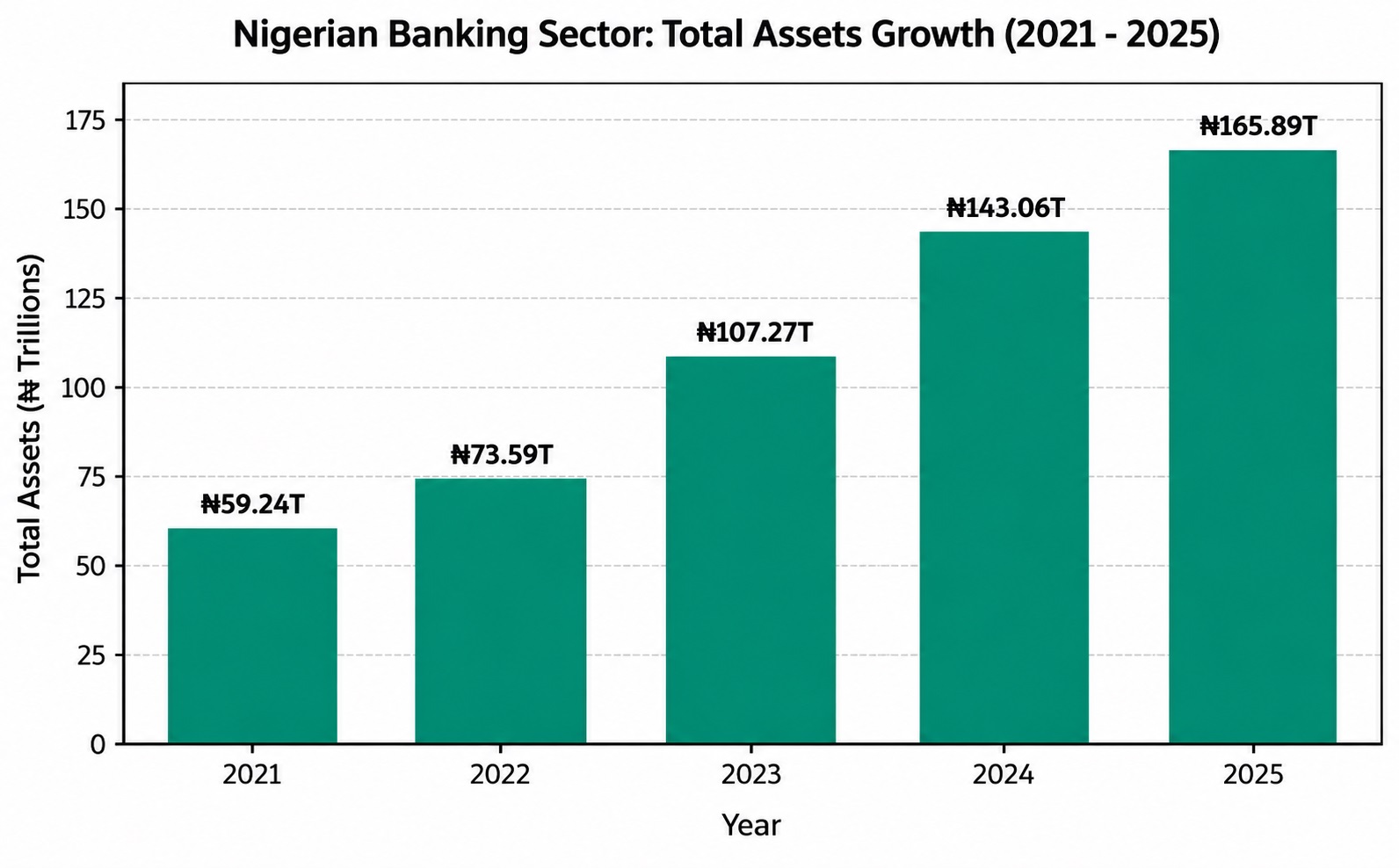
Bigger Banks, Bigger Responsibility
The recapitalisation programme is one of the most consequential financial reforms in Nigeria in recent years.
Its logic is straightforward. A bank with a larger capital base can theoretically absorb greater risks, finance larger transactions and withstand economic shocks better than a weakly capitalised institution. The CBN itself argues that stronger capital should improve banks’ ability to finance infrastructure, energy, manufacturing and other large-scale projects required to achieve a trillion-dollar economy.
That is sound financial reasoning. But recapitalisation also creates a responsibility. If shareholders inject billions of naira into banks and investors provide fresh capital, the Nigerian economy should eventually see the benefits through increased lending, productive investment and economic expansion. Otherwise, recapitalisation risks becoming an exercise in balance-sheet enlargement rather than economic transformation.
A bank can be exceptionally profitable without necessarily being exceptionally developmental. Indeed, a financial institution may prefer government securities, high-yielding fixed-income instruments and other relatively attractive assets to lending to a manufacturing company whose repayment depends on electricity availability, foreign exchange stability, consumer demand and infrastructure.
From the bank’s perspective, this may be rational risk management. From the perspective of national development, however, it presents a serious dilemma.Finance exists not merely to preserve money but to allocate capital efficiently.
The Cost of Money
One of Nigeria’s greatest obstacles to productive finance is the price of credit. The CBN retained its Monetary Policy Rate at 26.5 per cent in July 2026, while the Cash Reserve Requirement for deposit money banks remained at 45 per cent. Such a monetary environment has consequences.
When the benchmark cost of money is high, commercial lending rates inevitably become expensive. For a small manufacturer, farmer, trader or technology company, borrowing at very high interest rates can turn an otherwise viable investment into an unprofitable proposition. The result is a vicious cycle.
Businesses need credit to expand. Expensive credit discourages borrowing. Limited borrowing constrains investment. Weak investment limits production. Limited production restricts employment and income. Low income suppresses demand. Weak demand then makes businesses even more reluctant to borrow.
This is how a financial constraint becomes an economic constraint. Nigeria therefore needs a financial architecture in which monetary stability and productive credit reinforce each other.
Inflation must be controlled. The naira must remain credible. Banks must remain safe. But monetary stability should ultimately create the conditions under which productive businesses can obtain capital at sustainable rates. The objective should not be cheap money at any cost. It should be affordable money for productive activity within a stable financial system.
The Forgotten Engine: MSMEs
If Nigeria wants inclusive economic growth, it cannot depend exclusively on large corporations. Micro, small and medium enterprises are where millions of Nigerians earn livelihoods. They operate in agriculture, manufacturing, transportation, retail, technology, hospitality, construction and services.
Yet they remain among the most financially constrained participants in the economy. This is why the World Bank’s $500 million FINCLUDE programme is significant. The initiative is designed to expand affordable, longer-term finance to Nigerian MSMEs, with plans to support debt financing for 250,000 enterprises and mobilise approximately $1.89 billion in private capital. It also seeks to expand credit guarantees and extend average MSME loan maturity to about three years.
The lesson is important: Nigeria does not merely need more lending; it needs better lending. A three-year loan that enables a manufacturer to acquire machinery is fundamentally different from a three-month loan used merely to survive a cash-flow crisis.
Muda Yusuf, CEO, Centre for Promotion of Private Enterprise said Nigeria’s real sector—including manufacturing, agriculture, agribusiness, MSMEs and export-oriented businesses, faces enormous financing challenge. He attributed the problem not simply to a shortage of liquidity but to structural weaknesses: prohibitive interest rates, short loan tenors, stringent collateral requirements, limited bank risk appetite and inadequate patient capital.
Innocent Ohagwa, President of the Chartered Institute of Nigeria (CITN) said the intention of the new tax regime from the outset is to streamline the tax system and reduce the burden of multiple and overlapping taxes, particularly on SMEs. He noted that the reform has rationalised the multiplicity of taxes into a more coherent and manageable structure, while State Governments are already domesticating the Tax Reform Laws to promote harmonisation at sub-national levels.
“With sustained implementation, effective oversight, and continued stakeholder engagement, the framework provides a strong basis for significantly reducing multiple taxation and creating a more business-friendly environment,” he said.
Long-term capital finances productivity. Short-term emergency credit often finances survival. The financial system must therefore evolve from collateral-based lending towards cash-flow-based lending, credit scoring, reliable business records and data-driven risk assessment.
Technology provides an opportunity to achieve this. Digital payment histories, tax records, transaction data and verified business information can help lenders understand the real economic activity of small enterprises.
The entrepreneur who lacks landed property should not automatically be regarded as unbankable.
READ ALSO:
Fintech: From Payments to Productive Finance
Nigeria has emerged as one of Africa’s most dynamic financial-technology markets. Digital payments have transformed how millions of Nigerians transfer money, receive payments and conduct commerce. The World Bank recognises payment systems and digital financial services as important instruments for financial inclusion, economic development and financial stability.
But Nigeria’s next fintech revolution must go beyond payments. The country does not need only faster transfers. It needs better financial intermediation.
The next generation of financial technology should help a farmer obtain working capital, enable a small manufacturer to finance equipment, provide an entrepreneur with invoice financing and allow a growing enterprise to establish a credible digital credit history.
Fintech should therefore become a bridge between informal economic activity and formal finance. But innovation must be accompanied by regulation.
The CBN’s 2026 initiatives, including stronger fraud controls, identity verification and payment-system reforms, demonstrate the growing importance of building trust alongside digital expansion. A financial system that is fast but insecure will ultimately lose public confidence.
The future must therefore be digital, inclusive and safe.
Capital Market Must Enter the Conversation
Nigeria’s financing problem cannot be solved by banks alone. The capital market must become a much stronger source of long-term funding. Banks are fundamentally better suited to certain forms of credit, particularly working capital and conventional business lending. Capital markets, pension funds, insurance companies and institutional investors can provide longer-duration capital for infrastructure, housing, energy, transportation and industrial development.
Nigeria possesses substantial pools of institutional savings. The challenge is converting those savings into productive domestic investment without compromising the safety of investors. This requires stronger corporate governance, reliable disclosure, credible regulation and deeper market liquidity.
A functioning capital market should allow a successful Nigerian company to move from bank borrowing to bonds, equity and other instruments as it expands.
That creates a financing ladder: microfinance → bank credit → development finance → corporate bonds → equity capital. Such an ecosystem allows businesses to graduate financially as they grow.
Role of Development Finance
Development finance must complement, not replace commercial finance. Nigeria’s development-finance institutions also have a critical role.
The Development Bank of Nigeria has disbursed more than N1 trillion to over one million Micro, Small and Medium Enterprises (MSMEs), helping to create over 1.6 million jobs since it began operations in 2017. DBN Managing Director, Dr. Tony Okpanachi, said the development finance institution has made significant progress in addressing the financing challenges faced by small businesses, which remain a critical driver of Nigeria’s economy. According to Okpanachi, the bank has built a network of 84 participating institutions, including commercial banks, microfinance banks and development finance institutions, enabling it to reach businesses across the country.
In May 2026, the African Development Bank approved a $200 million facility for the Bank of Industry to expand long-term financing to enterprises in infrastructure, transport, agro-processing, healthcare, pharmaceuticals and green industrialisation, with at least 30 per cent expected to benefit SMEs.
Similarly, a $61 million AfDB package was approved to expand affordable finance for women-owned and women-led businesses, particularly in agriculture. These interventions matter because some economically valuable projects have long gestation periods and risks that ordinary commercial banks may be unwilling to assume.
But development finance must not become a substitute for a functioning private financial system. Government-backed institutions should crowd private capital in, not crowd it out. Their greatest success should be measured by how effectively they demonstrate that previously neglected sectors can become commercially financeable.
The Growth/Development Paradox
Nigeria must resist the temptation to equate financial-sector growth with economic development. More bank branches do not automatically mean more prosperity. More digital transactions do not automatically mean higher productivity. Higher bank profits do not automatically mean lower poverty. Bigger capital markets do not automatically mean better living standards.
The real test is what happens outside the financial sector: Does the farmer produce more? Does the manufacturer employ more people? Does the entrepreneur export more? Does the technology company scale? Does the young graduate find a productive job? Does the household have access to affordable housing? Does the economy generate enough businesses capable of competing internationally?
Those are the indicators by which Nigeria should judge its financial reforms. A trillion-dollar economy cannot be built simply by changing numbers on financial statements. It requires factories, farms, infrastructure, technology, exports, skilled workers and productive enterprises.
Finance is the bloodstream of that transformation. But bloodstream alone does not create a healthy body. It must reach the right organs.
What Nigeria Must Do
First, banks should be encouraged to increase productive lending without compromising prudential standards. Regulatory incentives can reward lending to manufacturing, agriculture, exports, renewable energy and scalable MSMEs.
Second, Nigeria must deepen credit infrastructure. Reliable credit bureaux, digital identity, collateral registries, business records and alternative data can reduce information asymmetry and lower lending risks.
Third, credit guarantees should be expanded intelligently. Properly designed guarantees can encourage banks to lend to viable enterprises without forcing taxpayers to absorb reckless lending.
Fourth, the government must reduce the structural risks that make productive lending expensive. Reliable electricity, better transport infrastructure, predictable taxation and stable foreign-exchange conditions would reduce the risk premium embedded in business finance.
Fifth, Nigeria should develop longer-term local-currency financing. Businesses cannot sustainably build factories with excessively short-term loans.
Sixth, financial literacy must become a national economic priority. Citizens and entrepreneurs need to understand savings, insurance, pensions, investments, credit and capital markets.
Seventh, regulators must maintain a delicate balance between innovation and stability. Nigeria cannot afford either a financial system paralysed by excessive regulation or one destabilised by regulatory weakness.
Finally, the performance of the financial sector should be measured not only by assets, profits and capital adequacy but also by productive credit, employment creation, business survival, investment and financial inclusion.
Real Promise of Banking Recapitalisation
Nigeria’s ambition to build a US$1 trillion economy is not unrealistic. But it will not happen merely because banks have larger capital bases or because financial transactions are becoming increasingly digital. The country must answer a more fundamental question: what is finance for?
If finance merely circulates money among financial institutions, it will enrich the financial system without necessarily transforming the economy. If finance mobilises savings and channels them into factories, farms, technology, infrastructure, housing, exports and entrepreneurial expansion, it becomes an instrument of national development.
That is the real promise of banking recapitalisation. The new generation of Nigerian banks should not be judged simply by how much capital they raise, how large their balance sheets become or how impressive their profits appear. They should ultimately be judged by how effectively they transform idle savings into productive investment.
The same applies to fintech companies, pension funds, insurers, development-finance institutions and the capital market. Nigeria does not suffer from a complete absence of money. It suffers from a shortage of efficient, affordable and appropriately structured finance reaching productive hands.
The country’s financial revolution must therefore move from capital adequacy to capital productivity; from financial inclusion to economic inclusion; and from transactions to transformation. The objective is not simply to create bigger banks. It is to create a bigger economy.
And the true measure of Nigeria’s financial-sector reform will not be found inside bank headquarters. It will be found in the factory that opens, the farm that expands, the business that hires its first ten workers, the exporter that enters a new market and the household whose income rises because finance finally reached productive enterprise.
Nigeria’s trillion-dollar dream will ultimately depend on whether its financial system can turn capital into capacity, credit into production and finance into shared prosperity.

Sam Diala is a Bloomberg Certified Financial Journalist with over a decade of experience in reporting Business and Economy. He is Business Editor at THEWILL Newspaper, and believes that work, not wishes, creates wealth.