
-
Nigeria’s crude oil production rose by 0.4 per cent in August 2026 to an average of 1.68 million barrels per day, including condensates.
-
Excluding condensates, Nigeria produced 1.50 million barrels of crude daily, enabling the country to meet its OPEC production quota for the fourth consecutive month.
-
Bonny and Forcados remained Nigeria’s leading producing streams, with average outputs of 320.04 thousand barrels per day and 317.40 thousand barrels per day respectively.
-
Despite the recovery, August output remained below the Federal Government’s 2026 budget benchmark of 1.84 million barrels per day.
September 14, (THEWILL) – Nigeria’s crude oil production rose marginally in August 2026, with total output including condensates reaching an average of 1,677,777 barrels per day, even as the country maintained compliance with its Organisation of the Petroleum Exporting Countries (OPEC) production quota for the fourth consecutive month.
A statement issued by the Head of Media and Corporate Communications at the Nigerian Upstream Petroleum Regulatory Commission (NUPRC), Eniola Akinkuotu, said the August figure represented a 0.4 per cent increase from the previous month.
When condensates were excluded, Nigeria’s average crude oil production stood at 1,500,190 barrels per day, keeping the country around its OPEC quota benchmark.

The development indicates a gradual improvement in Nigeria’s upstream production performance after years of challenges that have constrained the country’s ability to fully exploit its oil-producing capacity.
NUPRC said total daily production of crude oil and condensates fluctuated between 1.64 million barrels and 1.71 million barrels during the month.
The commission attributed the increase largely to the resolution of operational challenges associated with the Single Buoy Mooring (SBM) system at the Erha field, which had negatively affected production in the preceding month.
It said the restoration of normal production and crude evacuation activities at the asset contributed to the overall increase recorded in August.
“While the increase recorded in August was modest, it reflects the industry’s continued efforts to address operational bottlenecks and restore affected production capacity.
Stakeholders remain focused on enhancing asset reliability, improving operational resilience and advancing intervention programmes to support sustained production growth in the coming months,” NUPRC said.
Bonny, Forcados Lead Production
A breakdown of production by terminal showed that Bonny Terminal remained Nigeria’s largest producing stream in August, with average output of 320.04 thousand barrels per day (kbpd). Forcados Terminal followed closely with 317.40 kbpd.
Qua Iboe Terminal recorded an average production of 171.72 kbpd, while Escravos Terminal produced 131.71 kbpd.
The offshore Bonga field ranked fifth, contributing an average of 92.50 kbpd during the month.
NUPRC said production across most oil assets remained stable, supported by measures aimed at improving operational efficiency, maintaining infrastructure integrity and minimising disruptions to crude evacuation.
The commission said the August performance demonstrated the importance of timely interventions, effective asset management and cooperation among operators and other stakeholders in sustaining Nigeria’s production capacity.
READ ALSO:
Fourth Straight Month Above OPEC Quota
August marked the fourth consecutive month Nigeria achieved its OPEC crude production quota, reinforcing the recovery recorded in the upstream sector since the beginning of the year.
OPEC data showed that Nigeria’s average crude production increased to 1.525 million barrels per day in the second quarter of 2026, compared with 1.388 million barrels per day in the first quarter.
In July, however, crude production declined to about 1.505 million barrels per day from 1.555 million barrels per day recorded in June. Despite the decline, July production remained above Nigeria’s 1.5 million barrels per day OPEC quota.
The recent performance also places Nigeria ahead of several other major African oil producers. Libya produced about 1.391 million barrels per day in July, while Algeria recorded approximately 995,000 barrels per day.
The improvement follows years of production difficulties linked to crude oil theft, pipeline vandalism, ageing infrastructure, technical problems, inadequate investment and disruptions to crude evacuation.
The Federal Government and industry regulators have consequently placed greater emphasis on restoring shut-in production, improving security around oil infrastructure and attracting fresh investment into upstream assets.
Budget Target Still Out Of Reach
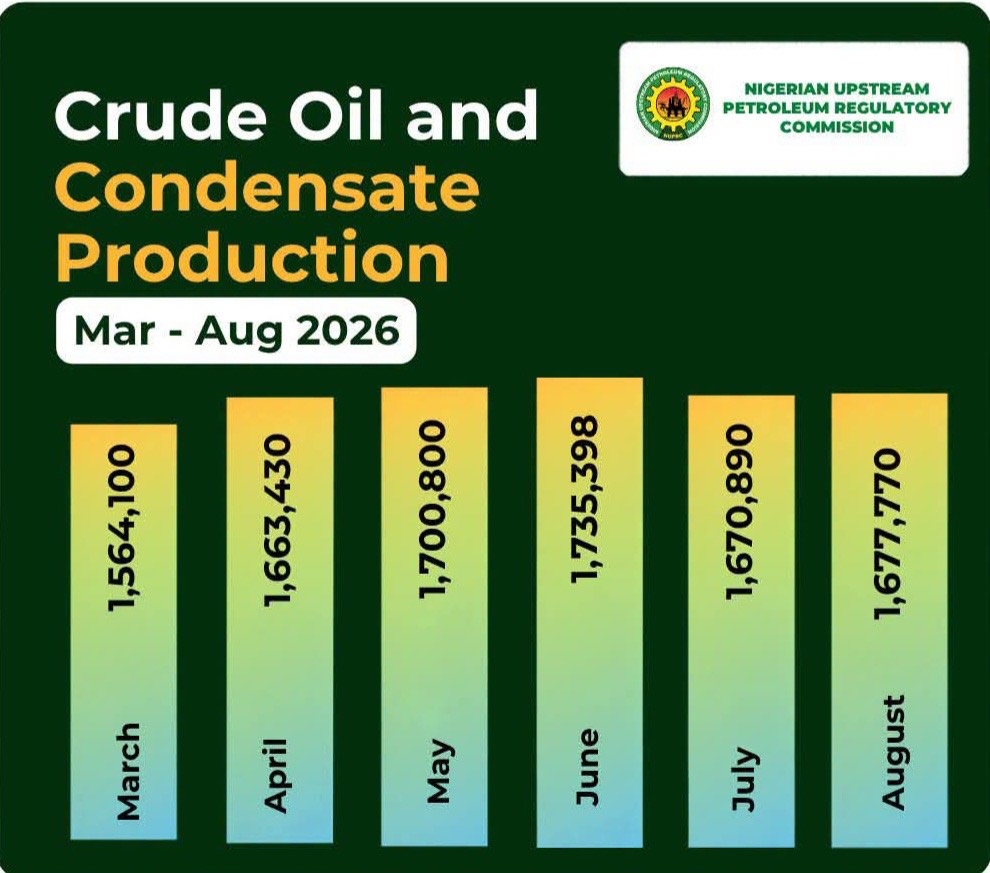
Despite meeting its OPEC quota, Nigeria’s August performance exposes a major gap between actual oil production and the benchmark used by the Federal Government in preparing the 2026 budget.
The 2026 budget was predicated on crude oil production of 1.84 million barrels per day, including condensates.
At 1.68 million barrels per day, August production was therefore about 162,000 barrels per day below the government’s budget benchmark.
The gap is significant because oil production remains central to Nigeria’s foreign exchange earnings and government revenue projections.
While meeting the OPEC quota provides some evidence of improved production stability, it does not necessarily mean that Nigeria is producing enough crude to meet the fiscal assumptions contained in its national budget.
The country therefore faces the dual challenge of sustaining its recent compliance with OPEC limits while increasing production towards the higher level required to support government revenue expectations.
Industry stakeholders have identified the resolution of operational bottlenecks, intensified action against crude oil theft, improved infrastructure and accelerated investment in upstream projects as critical to closing the production gap.
NUPRC said it remained focused on improving asset reliability, reducing disruptions and supporting interventions capable of restoring lost production capacity.
The commission’s August figures suggest that Nigeria’s oil sector is gradually regaining lost ground, but the distance between current production and the 2026 budget benchmark underscores the scale of the task ahead.
For Nigeria, the immediate test is no longer merely meeting its OPEC quota, but translating the recent production recovery into sustained higher output capable of strengthening oil revenues and supporting the government’s broader fiscal projections.

Felix Ifijeh is a journalist with years of professional reporting experience. Known for his keen news sense, compelling storytelling and commitment to accurate, impactful reporting, he has built a reputation for turning leads into clear, engaging, and well-structured reports that resonate with readers. His work reflects deep newsroom experience and a commitment to accurate, impactful journalism.