
-
About 550,000 people marched across France on Saturday against soaring living costs, fuel prices and deteriorating public services, while organisers put nationwide participation as high as 800,000.
-
Demonstrations descended into riots in Paris and several major cities, with vehicles and public buildings torched, shops looted and security forces battling masked groups as authorities struggled to contain simultaneous attacks.
-
Interior Minister Laurent Nuñez said Sunday that 1,800 people had been arrested and more than 500 police officers, gendarmes and firefighters injured, as France counted the cost of one of its worst outbreaks of civil unrest in years.
-
The unrest deepens pressure on President Emmanuel Macron, who is due to address the nation Sunday night, as anger over household costs, schools and public services threatens to develop into a broader political and social crisis.
October 18, (THEWILL) – France was counting the cost of widespread destruction on Sunday after mass demonstrations over the cost of living and deteriorating public services descended into riots, arson, looting and clashes with security forces across Paris and several other cities.
The Interior Minister, Laurent Nuñez, said 1,800 people had been arrested and more than 500 police officers, gendarmes and firefighters injured in Saturday’s unrest, as authorities faced mounting questions over the scale of the violence and the ability of security forces to contain it.
About 550,000 people participated in demonstrations across France, according to the Interior Ministry, including about 110,000 in Paris. Protest organisers put the nationwide turnout higher at about 800,000.

Although large sections of the demonstrations were peaceful, violence erupted in Paris, Marseille, Lyon, Lille, Bordeaux, Rennes, Strasbourg, Toulouse and several other cities as groups of masked rioters attacked public buildings, confronted police, set vehicles ablaze and looted businesses.
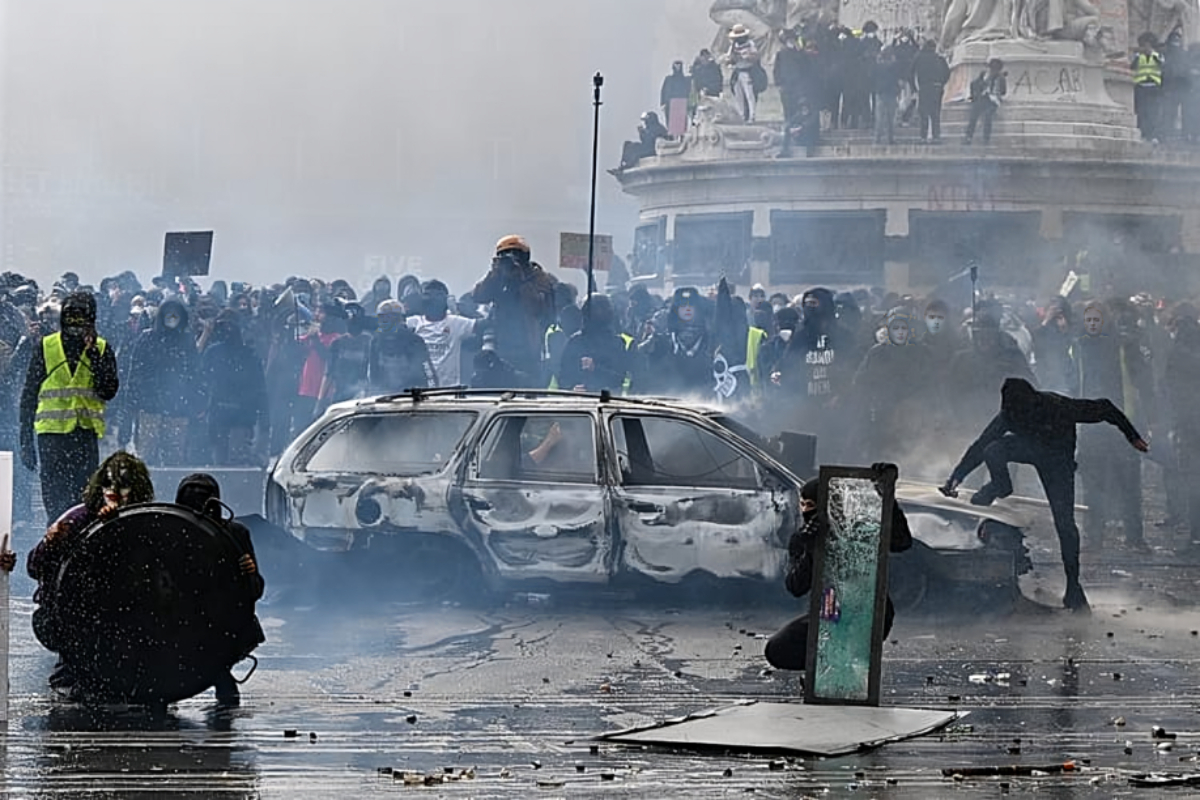
The destruction left parts of France waking up Sunday to burnt-out vehicles, smashed shopfronts and streets littered with broken glass and debris.
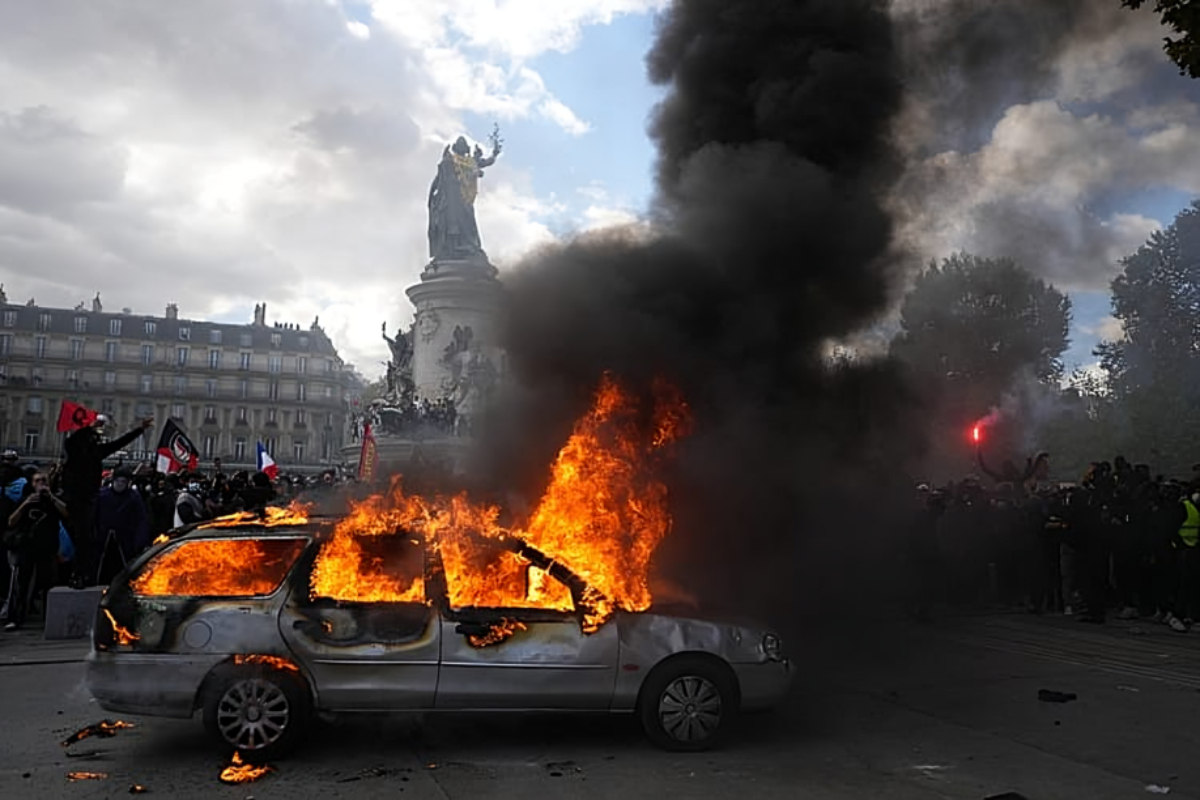
In Paris, riot police deployed tear gas and water cannon as confrontations intensified. Vehicles were torched, and businesses vandalised or looted, leaving shop owners and residents to begin a massive clean-up operation on Sunday.
Luxury stores and other businesses were among those damaged in the capital, while graffiti carrying anti-wealth slogans was sprayed on some buildings.
The violence was not restricted to Paris. In Limoges, the historic town hall was devastated by fire after rioters attacked the building. Local authorities said parts of the structure collapsed as firefighters struggled with the blaze. Le Monde reported that the town hall and Lyon’s tourist office were among prominent public buildings set ablaze during the disturbances.
In Lyon, Mayor Grégory Doucet described the burning of the city’s tourist office as a tragedy, while authorities said hostile individuals complicated efforts by firefighters to tackle the blaze.
Marseille also witnessed serious disturbances, with protesters forcing their way into the city hall. Officials subsequently said the damage inside the building was relatively limited, although the city was among several places hit by wider violence and looting.
In Bordeaux, rioters broke into and vandalised the official residence of the regional prefect, prompting the deployment of the elite RAID police unit. Violence and destruction were also reported in Lille, Nice, Rennes, Toulouse, Grenoble and other cities.
Nuñez blamed much of the organised violence on several thousand people he described as belonging to the far-left or ultra-left, alongside criminals who he said exploited the demonstrations to loot businesses.
The Interior Minister said attacks on police, firefighters, government institutions and commercial premises could not be justified by the right to demonstrate.
President Emmanuel Macron had earlier vowed that those responsible for attacking government buildings, businesses and other institutions would be prosecuted and punished, while accusing violent groups of preventing peaceful demonstrators from legitimately expressing their grievances.
The violence has also intensified political pressure on the government and Nuñez, with figures from both the left and the far-right calling for the Interior Minister’s resignation over the authorities’ handling of the unrest.
Macron was scheduled to address the French people at 8:00 p.m. local time on Sunday as the government confronted the political fallout from the disturbances.
READ ALSO:
From School Protests To Wider Cost-Of-Living Revolt
 The weekend explosion of anger followed weeks of student-led demonstrations over conditions in French schools.
Students have complained about teacher and staff shortages, overcrowded classrooms, deteriorating buildings and what they regard as inadequate government investment in education.
But the movement has broadened beyond education, drawing in trade union activists, students, Yellow Vest supporters and other groups angry over fuel prices, household costs and the state of public services.
The convergence of those grievances produced Saturday’s huge nationwide mobilisation, with the government estimating 550,000 participants and organisers claiming 800,000.
The violence revived memories of the Yellow Vest, or Gilets Jaunes, uprising, which erupted in 2018 over proposed fuel-tax increases before developing into a wider revolt against economic inequality and Macron’s government.
Le Monde said Saturday’s scenes of rioting and systematic destruction in parts of Paris recalled the violence of December 1, 2018, when the Arc de Triomphe was vandalised during one of the most explosive episodes of the Yellow Vest crisis.
The latest unrest, however, comes at a particularly sensitive political moment for France, with the country moving towards the 2027 presidential election and Macron facing growing public anger over economic hardship, public services and political instability.
While the overwhelming majority of Saturday’s hundreds of thousands of demonstrators were not involved in violence, the scale of the rioting has transformed what began largely as a protest over schools and living costs into a major security and political challenge for the French government.
By Sunday, burned vehicles, shattered storefronts and damaged public buildings had become the most visible evidence of a protest movement whose underlying grievances remain unresolved — leaving Macron confronting the danger that France’s cost-of-living anger could fuel a wider and more sustained wave of unrest.

Felix Ifijeh is a journalist with years of professional reporting experience. Known for his keen news sense, compelling storytelling and commitment to accurate, impactful reporting, he has built a reputation for turning leads into clear, engaging, and well-structured reports that resonate with readers. His work reflects deep newsroom experience and a commitment to accurate, impactful journalism.
