
-
Presidential aspirants and political parties are intensifying visits to churches, mosques and influential religious leaders in a growing contest for religious endorsements and congregational support ahead of the 2027 general elections.
-
President Bola Tinubu’s re-election campaign has taken consultations to prominent Islamic clerics in Northern Nigeria, while Peter Obi’s church engagements have attracted attention following a viral video of a Catholic priest leading worshippers in a song endorsing the NDC presidential candidate and his running mate, Rabiu Musa Kwankwaso.
-
FCT Minister Nyesom Wike has taken Tinubu’s re-election message to Dunamis International Gospel Centre, where he fulfilled his promise to use the occasion to promote the administration’s achievements, despite an appeal by the church’s founder, Pastor Paul Enenche, against campaigning at the event.
-
The Sultan of Sokoto, Muhammadu Sa’ad Abubakar III, and the Federal Government have warned religious leaders against turning churches and mosques into political platforms, amid concerns over religious mobilisation, divisive pronouncements and the potential impact on national unity.
November 4, (THEWILL) – Churches, mosques and influential religious leaders are increasingly becoming important destinations for Nigeria’s leading politicians and presidential aspirants as political activities gather momentum ahead of the 2027 general elections, raising fresh concerns about the growing intersection of religion and partisan politics.
From consultations with prominent Islamic clerics in Northern Nigeria to appearances at Christian conventions, church services, religious conferences and prayer meetings, politicians across party lines are stepping up engagements with faith-based organisations in an apparent effort to secure the goodwill, influence and support of religious leaders and their congregations.
President Bola Tinubu, who is seeking re-election in 2027, opposition presidential candidate Peter Obi, his running mate Rabiu Musa Kwankwaso and other influential political figures have featured prominently in the emerging contest for the attention of religious institutions.

The activities have also exposed the different ways politicians are approaching religious constituencies, with some seeking private consultations with clerics, others attending worship services and religious gatherings, while some organisations have gone further to publicly endorse presidential candidates.
However, the growing political attention being paid to religious institutions has generated controversies over the appropriateness of using places of worship for partisan mobilisation, the endorsement of candidates by religious organisations and the tendency of some clerics to introduce political preferences into sermons and public religious engagements.
Although politicians often describe their visits as consultations, expressions of solidarity, thanksgiving or opportunities to seek prayers, the timing and political implications of some engagements have attracted public scrutiny, particularly as parties intensify preparations for the next general elections.
The development has also revived memories of the controversies surrounding the religious composition of political tickets, the mobilisation of Christian and Muslim voters and the influence of prominent clerics during the 2023 presidential election.
Tinubu’s Campaign Takes Religious Route
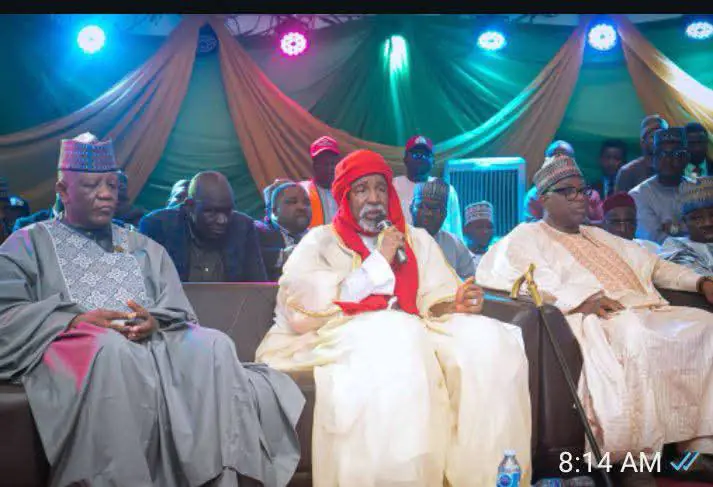
One of the clearest illustrations of the growing relationship between political campaigns and religious institutions is the mobilisation effort by the All Progressives Congress (APC) Presidential Campaign Council for Tinubu’s second-term ambition.
In September 2026, the Director-General of the APC Presidential Campaign Council, Senator Abdulaziz Yari, led a delegation of party leaders on consultations with influential Muslim clerics and Islamic organisations across Northern Nigeria.
The delegation visited religious leaders in Jos, Plateau State, before proceeding to Kano, Kaduna and Bauchi states, where it held meetings with Islamic scholars and leaders of the Izala, Tijjaniyya, Jama’atu Izalatil Bid’ah Wa Iqamatis Sunnah (JIBWIS) and Qadiriyya movements.
Among those who accompanied Yari were former Kano State Governor and former APC National Chairman, Abdullahi Ganduje; former Borno State Governor, Ali Modu Sheriff; former Kebbi State Governor, Senator Adamu Aliero; APC National Secretary, Senator Ajibola Bashiru; and other party leaders.
The meetings were part of the campaign council’s consultations with faith-based stakeholders ahead of the 2027 elections, with the delegation seeking the cooperation and support of influential Islamic leaders for Tinubu’s re-election bid.
The engagement with the spiritual leader of the Qadiriyya movement, Khalifa Sheikh Qaribullah Nasiru Kabara, in Kano, was particularly significant given the movement’s extensive religious following.
The APC’s engagement with Muslim organisations was followed by another significant political development in September when the Charismatic Bishops Conference of Nigeria (CBCN) publicly endorsed Tinubu for the 2027 presidential election.
At the grand finale of the conference’s 2026 synod, held at the National Christian Centre in Abuja, its President-General, Archbishop Professor Leonard Bature Kawas, announced the organisation’s support for the President.
The endorsement was particularly noteworthy because the conference had previously expressed concerns over the Muslim-Muslim presidential ticket adopted by the APC during the 2023 general elections.
Kawas said Tinubu had, however, surprised the organisation through the appointment of Christians to key positions in his administration, arguing that the President had demonstrated an ability to accommodate Nigeria’s religious diversity.
“We are here today to reassure him of our solid support. We are standing with him in prayers and advocacy for the good programmes he has brought forth for the liberation of Nigeria. We stand with the President today, and as long as he is willing to be our President and even come in 2027, we will still be standing with him”, he stated.
Kawas disclosed that the conference had members in 52 countries, including 950 canonical bishops in Nigeria.
The endorsement was announced at an event attended by the Secretary to the Government of the Federation, Senator George Akume, and Information and National Orientation Minister, Mohammed Idris.
The CBCN’s position has added another dimension to the emerging political engagement between religious organisations and presidential aspirants, with an organised Christian body publicly declaring support for an incumbent President whose Muslim-Muslim ticket had attracted criticism from sections of the Christian community in 2023.
Obi’s Church Visits Generate Controversy
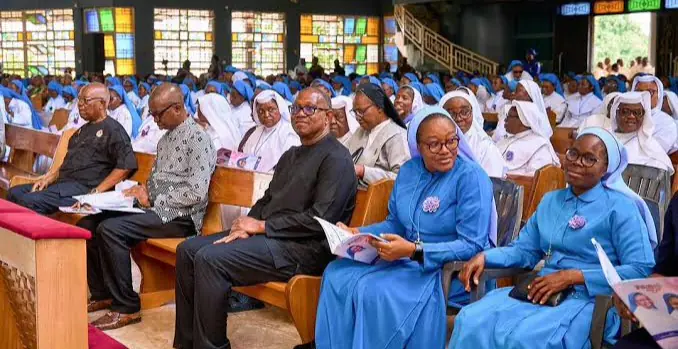
Another presidential candidate whose engagements with religious institutions have generated public attention is the Nigeria Democratic Congress (NDC) candidate, Peter Obi.
Obi, who contested the 2023 presidential election on the platform of the Labour Party, has maintained a visible relationship with churches and Christian religious leaders, even as he has also made efforts to engage Muslim communities.
His visits to mosques during Ramadan in previous years attracted attention, particularly when photographs and videos of him breaking the Ramadan fast with Muslim faithful circulated on social media.
At the time, his campaign spokesman, Yunusa Tanko, dismissed suggestions that the visits were politically motivated, insisting that they were humanitarian gestures intended to demonstrate solidarity with Muslims.
Tanko explained that Obi had been criticised during the 2023 election for allegedly not visiting mosques and had decided to use the Ramadan period to demonstrate that he was not religiously prejudiced.
The issue has resurfaced with Obi’s appearance at Koinonia Global Ministries, an interdenominational worship centre founded by Apostle Joshua Selman in Abuja.
During the church service on August 30, 2026, Obi urged Nigerians to pray for politicians, admitting that political leaders were largely responsible for the country’s problems.
“I believe that people like you are the ones keeping our country. The only thing I can ask all of you who are gathered here, because I know he’s praying for the country, is that you remember us, the politicians, in your prayers. We are the problem of the country. There’s nothing wrong with Nigeria. What is wrong in Nigeria is the leadership, the politicians God created in this country”, he declared.
Obi also appealed to the congregation to pray that politicians would develop the willingness to use public resources for the benefit of citizens and stop stealing public funds.
Although Obi’s remarks centred on leadership, accountability and prayers for the country, the visit further brought his relationship with Christian religious institutions into the emerging debate over political mobilisation through places of worship.
His supporters have maintained that visiting churches and mosques should not automatically be interpreted as an attempt to exploit religious sentiments, while critics have questioned the increasing prominence of political figures at religious gatherings ahead of elections.
READ ALSO:
Catholic Priest Leads Congregation In Obi-Kwankwaso Campaign Song
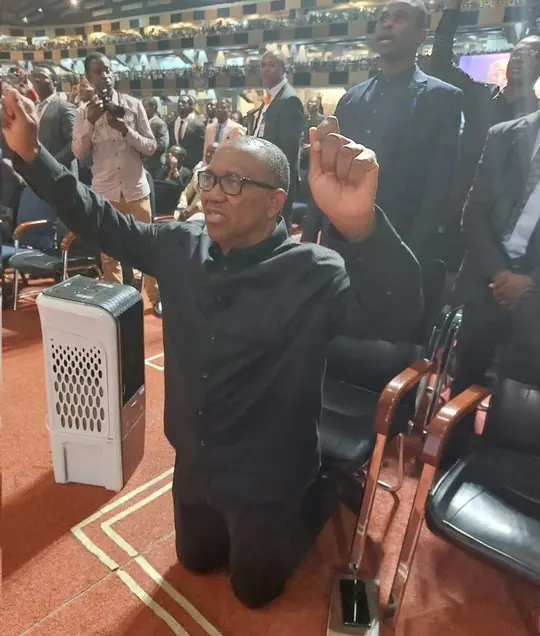
The growing involvement of religious leaders in political activities ahead of the 2027 elections has received further attention following a viral video showing a Catholic priest leading worshippers in a church service in a song endorsing Obi and his running mate, Kwankwaso.
In the video circulating on X, the priest is seen leading members of the congregation in singing in Igbo, describing the NDC as a better political platform.
“NDC, NDC ka mma. Party Peter Obi ka mma; Party Kwankwaso, ka mma!” meaning, “NDC is better. Peter Obi’s party is better; Kwankwaso’s party is better”, the priest sang.
The video, which circulated widely on social media, has drawn attention to the question of whether church services should be used to express partisan political preferences and mobilise support for particular candidates. The development has also brought into focus the growing tendency of some religious leaders to publicly identify with political candidates, while others have criticised particular political arrangements on religious grounds.
In August, Islamic cleric Sheikh Sani Yahaya Jingir urged Muslims to vote for a Muslim-Muslim presidential ticket in the 2027 election. He made the call at a mass wedding organised by the Kano State Government for 1,500 couples, where he urged Muslims to vote in a manner that would reflect their numerical strength in the country.
Reaffirming his support for the Muslim-Muslim arrangement adopted by the APC in the 2023 presidential election, the cleric called on Muslims to mobilise their votes for a similar ticket in 2027.
The remarks attracted criticism, particularly given that Tinubu and Vice-President Kashim Shettima, who are both Muslims, currently occupy the country’s two highest executive offices.
Kwankwaso condemned Jingir’s remarks in a statement on his official X account, describing them as divisive and warning that religious leaders should promote peace, unity and reconciliation rather than make statements capable of deepening divisions.
“I am deeply concerned by the comments made by Sheikh Sani Yahaya Jingir at an event in Kano this weekend. At this critical moment in our nation’s history, statements that promote division and disunity must be firmly discouraged”, he said.
The contrasting positions of the Catholic priest and the Islamic cleric have further brought the influence of religious leaders in the emerging presidential contest into focus, with both Christian and Muslim religious platforms featuring in political conversations ahead of the election.
Wike Takes Tinubu’s Re-Election Campaign To Dunamis Church
The involvement of religious institutions in the emerging political contest has also drawn attention to FCT Minister Nyesom Wike, one of the most outspoken supporters of Tinubu’s re-election despite remaining a member of the opposition Peoples Democratic Party (PDP).
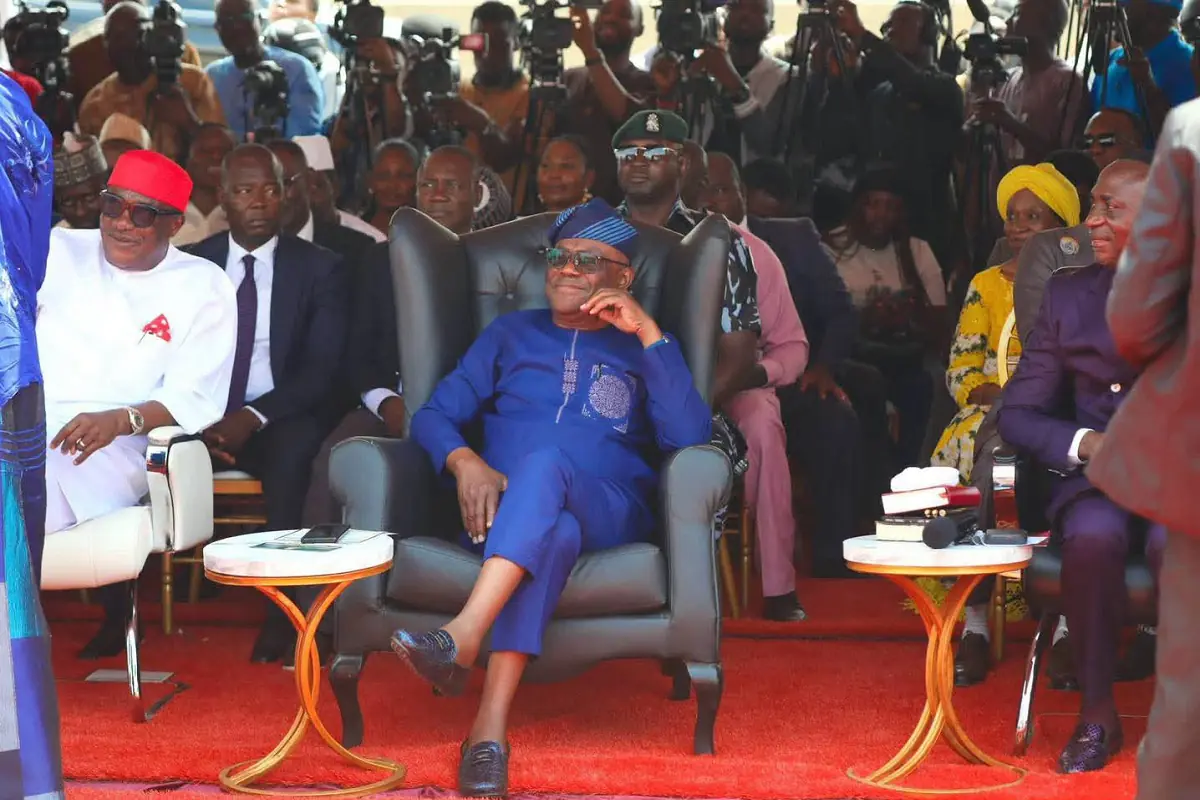
Wike, who has repeatedly declared support for the President’s second-term ambition, took Tinubu’s re-election message to Dunamis International Gospel Centre in Abuja on October 30, 2026, when he honoured an invitation from the church’s Senior Pastor, Pastor Paul Enenche, to inaugurate a pedestrian bridge constructed by the church.
The minister had earlier announced that he intended to use the occasion to publicise the achievements of the Tinubu administration and explain the benefits of the Federal Government’s policies to the congregation.
Announcing his intention ahead of the visit, Wike said: “I’m going to Dunamis Church. Pastor Enenche invited me to commission their pedestrian bridge. I’ll go there and speak to the people and tell them there are lots of advantages under this government. I’ll tell them nobody approved this bridge until we came. Yes! It’s correct.”
Wike subsequently honoured the invitation and commissioned the pedestrian bridge at the church’s headquarters in Abuja, using the occasion to defend his position on communicating government achievements to Nigerians, including through religious gatherings.
However, the event took a political turn when the minister disclosed that Enenche had cautioned him against campaigning at the church.
Wike, who disagreed with the restriction, argued that discussions about governance and political accountability were not out of place in religious settings, pointing out that the pastor himself sometimes spoke about bad governance during sermons.
Addressing the gathering, the minister said: “The Chairman of AMAC, even though I have been asked by Pastor Paul Enenche not to campaign here, I already told him some weeks ago at the Idoma Hall of Fame event while delivering a paper that I was coming to use it as an opportunity, even in the church when he preaches, he talks about bad governance and that is politics So, commissioning a project like this isn’t something we’ll just come and thank God and go. No, it is not going to work.”
The exchange between Wike and Enenche brought the question of political campaigning in places of worship into sharper focus, particularly as the country approaches another presidential election.
While the minister maintained that political discussions should not be excluded from religious gatherings, the pastor’s caution against campaigning at the event highlighted the concerns of religious leaders about maintaining the distinction between worship and partisan political activities.
Sultan, Akume Warn Against Turning Churches, Mosques Into Campaign Grounds
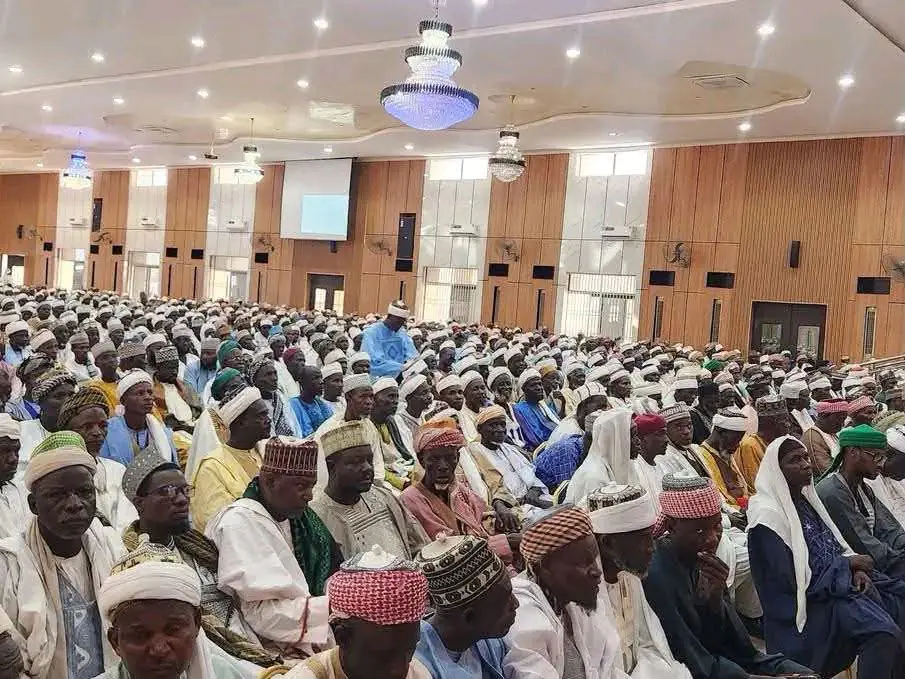
Amid the growing political activities around religious institutions, the Sultan of Sokoto, Muhammadu Sa’ad Abubakar III, and the Secretary to the Government of the Federation, George Akume, have cautioned religious leaders against allowing churches and mosques to become platforms for partisan politics and inflammatory statements.
The two leaders gave the warning at the second 2026 meeting of the Nigeria Inter-Religious Council (NIREC) in Abuja in September.
The Sultan, who is the co-chairman of NIREC and President-General of the Nigerian Supreme Council for Islamic Affairs, urged clerics to exercise restraint in their sermons, prayers and public statements as political activities intensify. He cautioned religious leaders against using their positions to determine political outcomes by praising or condemning individual politicians.
“We’re into campaign for 2027 elections, so our religious leaders must be wary of what they say at the churches or mosques or any religious gathering”, the Sultan said:
He further urged Nigerians to pray for political office holders irrespective of their personal opinions about their performance.
“No matter how bad you think they are, continue to pray. That prayer will make God touch their lives and then they will change. And then you will see better things coming out in this country”, he added.
The Sultan also warned against the use of proceeds of corruption to sponsor religious pilgrimages to Saudi Arabia and Jerusalem.
“God is not corrupt, so he doesn’t like corruption. So you cannot use corrupt money to send people to Jerusalem or to Saudi Arabia for Hajj or for any other thing”, he noted, while urging religious leaders not to shield individuals accused of corruption because of their religious affiliations or personal relationships.
The President of the Christian Association of Nigeria (CAN) and NIREC co-chairman, Archbishop Daniel Okoh, also called on Christians and Muslims to work together to address the challenges confronting the country.
Okoh identified insecurity, poverty, unemployment, inequality, communal tensions and declining public trust as issues requiring collective action by the two religious communities.
“When any Nigerian is killed, displaced, kidnapped or deprived of dignity, our common humanity demands that we care”, he said.
Akume, who represented Tinubu at the meeting, urged religious leaders to prevent political activities from becoming sources of religious and ethnic tension.
“During the upcoming electioneering campaign, please issue the clear, unambiguous public message: that politics belongs in the ballot, not at the altar or mosque”, he said.
FG Raises Concern Over Exploitation Of Religious Sentiments
The Federal Government has also expressed concern over attempts by politicians and other influential individuals to exploit religious and ethnic differences ahead of the 2027 elections.
At the NIREC meeting, Akume urged Christian and Muslim leaders to speak with one voice against violence and ensure that political activities remained within the boundaries of democratic engagement.
The government warned that places of worship should not become platforms for political violence, intimidation or the promotion of religious divisions.
Information Minister Mohammed Idris had similarly urged religious leaders to protect national unity and discourage the presentation of Nigeria’s security challenges as a religious war.
Speaking at the September 2026 synod of the Charismatic Bishops Conference of Nigeria in Abuja, Idris urged church leaders to use their influence to promote peace, national unity, responsible citizenship and peaceful democratic participation ahead of the elections.
He warned against allowing political competition to deepen religious and ethnic divisions, stressing that Nigeria belongs to all its citizens irrespective of their faith or background.
The minister’s intervention came at the same gathering where the Charismatic Bishops Conference announced its endorsement of Tinubu for the 2027 presidential election.
2023 Election And Religious Politics Background
The increasing attention being paid to religious institutions ahead of the 2027 elections is taking place against the background of the intense religious debates that characterised the 2023 presidential campaign.
THEWILL recalls the controversy over the APC’s Muslim-Muslim ticket, was one of the most prominent issues during that election. Tinubu, a Muslim from the South-West, chose Shettima, also a Muslim from the North-East, as his running mate, a decision that attracted opposition from several Christian organisations and political figures.
While the Christian Association of Nigeria and other Christian groups expressed reservations about the arrangement, arguing that the decision did not reflect Nigeria’s religious diversity; the APC and its supporters defended the ticket, maintaining that the Constitution did not require presidential candidates to choose running mates from different religious backgrounds.
With the 2027 elections approaching, the central question remains how religious leaders can participate in national conversations and hold political office holders accountable without turning their pulpits and worship platforms into extensions of partisan campaigns.
Religious leaders occupy influential positions in a country where churches and mosques attract large congregations and command considerable social influence. Their public statements, endorsements and positions on national issues often attract widespread attention, making their institutions important destinations for politicians seeking to broaden their political reach.
While politicians continue to seek prayers, goodwill and support from religious leaders and their congregations, the interventions by the Sultan of Sokoto and the Federal Government have highlighted the need to prevent religious institutions from becoming sources of political division
Felix Ifijeh is a journalist with years of professional reporting experience. Known for his keen news sense, compelling storytelling and commitment to accurate, impactful reporting, he has built a reputation for turning leads into clear, engaging, and well-structured reports that resonate with readers. His work reflects deep newsroom experience and a commitment to accurate, impactful journalism.
