
-
The programme will provide $1.5m each to six universities to establish specialised professorial research chairs.
-
The initiative will focus on developing practical solutions to challenges in the energy and industrial sectors.
-
Google, Cisco and MTN have indicated interest in supporting the programme, according to NLNG’s chief executive.
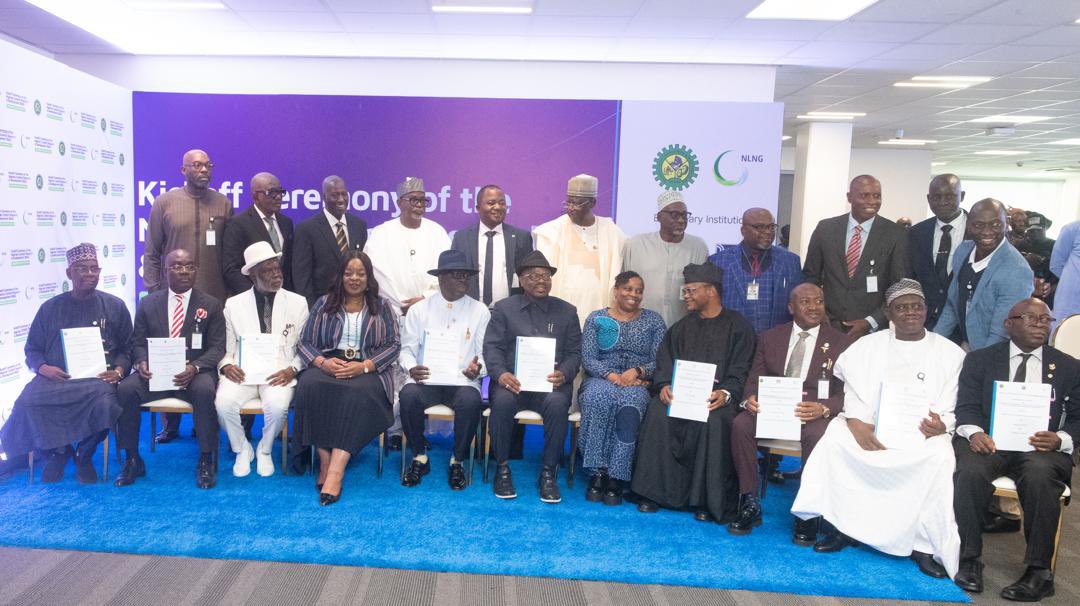
November 11, (THEWILL) – The Nigerian Content Development and Monitoring Board and Nigeria LNG Limited have committed $9m to establish professorial research chairs in six Nigerian universities, in a move aimed at strengthening local research capacity and developing solutions to industry challenges.
Under the Nigerian Content Research and Development Professorial Chair Endowment Programme, each institution will receive $1.5m to establish a specialised research chair focusing on agreed industry priorities.
The beneficiary institutions are the University of Ibadan, Oyo State; Rivers State University; Modibbo Adama University, Yola, Adamawa State; Aliko Dangote University of Science and Technology, Kano State; the University of Nigeria, Nsukka, Enugu State; and Yakubu Gowon University, formerly the University of Abuja.
The programme is being implemented in partnership with the NCDMB under the supervision of its Planning, Research and Statistics Directorate.
Speaking at the kick-off ceremony, NLNG’s Managing Director and Chief Executive Officer, Adeleye Falade, said the initiative was designed to help Nigeria translate academic research into practical solutions for industry.
In his keynote address, titled “Reshaping Nigeria’s Future Through Innovation, Research and Capacity Development,” Falade stressed the need for sustained collaboration among government, industry and universities.

“In the energy industry, we understand that technology and energy systems are evolving and the requirement for sustained research cannot be overemphasised,” he said.
Research to address industry challenges
Falade said the research programme would address issues central to the future of the energy industry, including operational efficiency, emissions management, safety, critical infrastructure maintenance and sustainable industrial processes.
He also called for a stronger partnership between government, industry and academia through what he described as a “triple helix” approach.
The model, he said, could be advanced through specialised training programmes, academic sabbaticals, exchange opportunities, practical testing of research findings and joint development of postgraduate curricula.
The six universities will conduct research in different areas, while the NLNG Research and Innovation Centre for Computer and Electrical Engineering at Rivers State University is expected to serve as the coordinating point for collaboration among the institutions.
Falade said discussions had begun with Rivers State University on the implementation arrangements.
He also commended the university’s Vice-Chancellor, Professor Isaac Zeb-Obipi, for supporting the proposed collaboration.
He disclosed that other organisations, including Google, Cisco and MTN, had indicated interest in supporting the initiative.
However, he did not provide details of any financial or technical commitments from the prospective partners.
READ ALSO:
Focus on commercialisation and local capacity
Falade said the endowments would create opportunities for younger researchers to deepen their expertise, investigate practical industry problems and work with experienced academics and professionals.
He urged the beneficiary universities to use the funding as a foundation for attracting additional grants, expanding research partnerships and commercialising intellectual property developed through their work.
“Expand the scope, reach for more grants and funding which can push the frontiers of knowledge and commercialisation of intellectual property,” he said.
Acknowledging the NCDMB’s role in establishing the programme, the NLNG chief executive called for continued investment in technology transfer and locally developed solutions.
He said efforts to build indigenous research capacity must be accompanied by strong quality assurance and safety standards.
The programme’s long-term impact, he added, would depend on whether research findings could be translated into solutions deployed in industry, stronger research institutions, and a new generation of Nigerian researchers and professionals.

Ogochukwu Onwaeze is a writer specializing in business and economic journalism. At THEWILL News Media, she translates market trends, financial developments, and policy shifts into clear and engaging stories.
