
-
Dangote Refinery applies for an offer of up to $5 billion on the NGX as a “People’s IPO.”
-
The 650,000 bpd refinery targets expansion to 1.4 million bpd.
-
Follows a $2.5 billion private placement that was 3.7 times oversubscribed.
-
Offers everyday Nigerians a chance to move from customers to shareholders.
August 17, (THEWILL) — For a country that has spent decades trying to build companies Nigerians can point to and call their own, there is something unusually significant about being invited to buy a piece of Dangote Petroleum Refinery.
The refinery is already woven into everyday economic life. Its fuel reaches motorists, its aviation products are finding customers abroad, and its 650,000-barrel-per-day capacity has made it one of the most consequential industrial projects Nigeria has produced. Ownership, however, has remained concentrated in the hands of its existing investors.
That could change with the company’s proposed public offering on the Nigerian Exchange.

Dangote Refinery has applied to Nigeria’s Securities and Exchange Commission for an offer of up to $5 billion, while management has described the transaction as a “People’s IPO”. The language is deliberate.
Rather than simply raising another large cheque from institutional investors, Dangote wants the offering to reach Nigerians who have spent years watching the refinery’s rise from the sidelines.
For ordinary investors, the attraction is easy to understand. A familiar company, a business tied to one of the country’s biggest markets and an asset valued at roughly $40 billion after its recent private placement is a very different proposition from buying shares in a company most people have never heard of.
Broad ownership, though, will depend on what happens after the marketing language gives way to the mechanics of the offer.
David Bird, Chief Executive Officer of Dangote Petroleum Refinery. Source: Dangote Refinery Official Website.
A People’s IPO Can Still Become an Institutional Deal
Dangote’s choice of words has created an expectation that ordinary Nigerians will have a meaningful chance to own the refinery. Making that happen will require more than putting the shares on the NGX.
Pension funds, asset managers and wealthy investors are already natural buyers for an offering of this scale. Dangote Refinery raised $2.5 billion through a private placement in July, and demand was reportedly 3.7 times the amount initially offered. Institutional appetite, in other words, is not a theoretical problem waiting to be solved.
Retail participation, however, is the harder part.
The eventual offer document should provide the details that matter most to smaller investors, including the minimum amount required to subscribe, how shares will be allocated when demand exceeds supply and if a defined portion of the offering will be reserved for individual investors.
Those rules could determine if the “People’s IPO” produces a genuinely broad shareholder base or simply becomes a public offering in which large investors secure most of the available equity.
Nigeria has seen what can happen when household names enter the stock market. For instance, the MTN Nigeria listing drew substantial retail interest and helped bring more Nigerians into equities, while earlier privatisation programmes created a generation of shareholders who had previously had little exposure to the market.
Dangote Refinery has an advantage those transactions did not always have. Nigerians already understand what the business does.
They see the refinery’s products in the fuel market and have followed the political and economic arguments surrounding its development. Its expansion is equally visible. Dangote plans to take capacity to 1.4 million barrels per day, which would put the facility on an even larger footing in the international refining market.
Now, for a first-time investor, familiarity can make the leap into equities feel considerably smaller. But it can also create a trap.
A company can be widely admired and still be a poor investment if the price paid for its shares is too high.
The Investment Case Is Bigger Than the Dangote Name
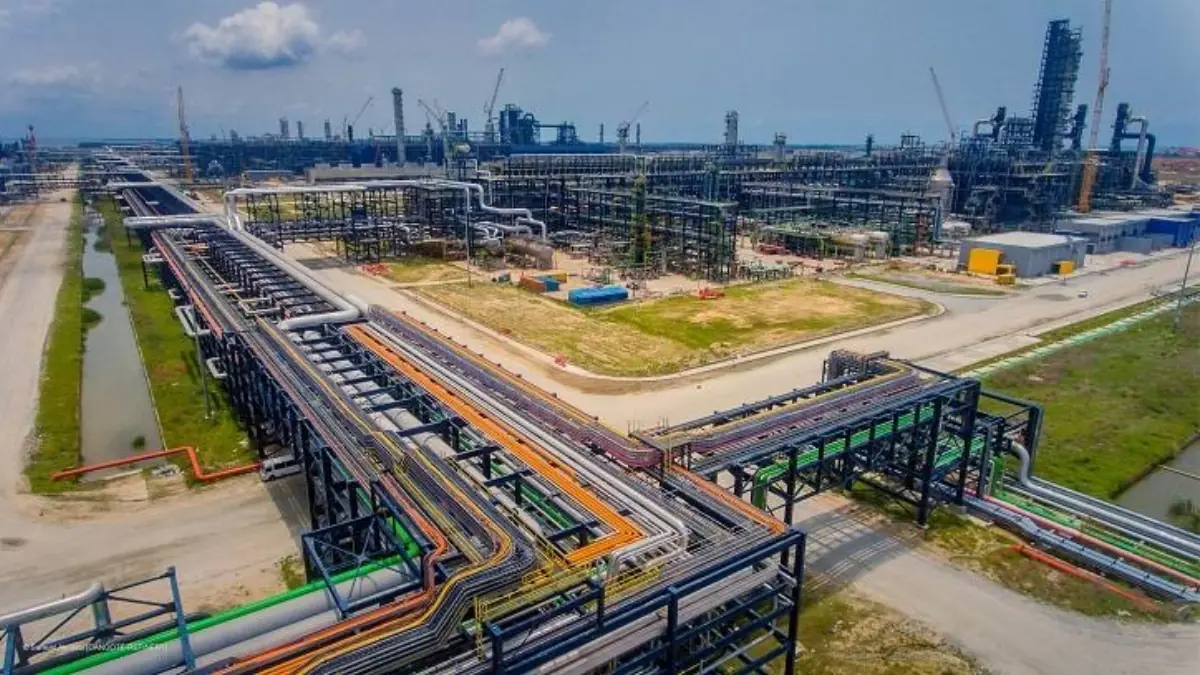
The refinery’s scale gives investors plenty to consider beyond its brand.
It has been moving increasing volumes of refined products into international markets, including aviation fuel, while serving a domestic market where demand for petroleum products remains enormous.
Its revenues are therefore tied to forces well beyond Nigeria’s borders, from crude prices and refining margins to shipping costs and international fuel demand.
For Nigerian investors dealing with inflation and currency volatility, such international exposure may look particularly appealing. A company participating in dollar-linked commodity markets can have a different earnings profile from a business whose revenues are almost entirely tied to the naira economy.
Calling the shares a direct hedge against inflation or currency depreciation would nevertheless go too far.
Shareholders remain exposed to the company’s operating performance, valuation and capital-allocation decisions.
If refining margins weaken, crude becomes more expensive or expansion absorbs more cash than expected, the investment case changes. A strong underlying business does not protect an investor who buys at an unreasonable price.
Crude supply is another variable that deserves attention.
Dangote Refinery’s enormous capacity only works to its full potential if the company can secure enough crude at commercially sensible prices.
Nigeria’s domestic crude-supply framework has been the subject of continuing debate, with local refiners pushing for more reliable access to Nigerian crude and changes to the way supplies are priced and allocated.
For a refinery targeting 1.4 million barrels per day, feedstock is not a footnote in the prospectus. It is one of the central questions around future profitability.
Expansion itself will also compete with shareholder returns for attention.
Dangote is still building the next stage of the business, so investors will need to understand how much capital will go towards increasing capacity, how much debt the company intends to carry and what room remains for dividends.
Those considerations matter because retail investors may approach the offering with very different expectations. Some will be looking for long-term capital appreciation, others for dividend income, while a sizable number of first-time buyers may simply see an opportunity to own part of a company they already know.
A public company eventually has to reconcile all three groups through its financial performance.
For the Nigerian capital market, meanwhile, the IPO presents a rare opportunity to test if a major industrial asset can attract a genuinely broad domestic shareholder base.
Allocation rules that make participation realistic for smaller investors could bring a significant number of new Nigerians into the equities market.
Heavy institutional demand, on the other hand, could leave the “People’s IPO” sounding considerably more democratic than the ownership structure itself.
Either outcome will tell the market something useful.
READ ALSO:
Dangote Refinery’s $5bn IPO Could Reach South Africa After Nigeria Listing
Dangote’s $2.5bn Capital Raise Casts Long Shadow Over Nigeria’s Costly Idle Refineries
The refinery has already established that sophisticated investors are willing to put billions of dollars behind its future. Its public offering will reveal if Nigerians with considerably smaller amounts of capital want to make the same bet.
For Dangote, the transaction could provide another source of capital as the refinery moves towards 1.4 million barrels per day.
For the NGX, it could be a test of how much of Nigeria’s growing industrial wealth can actually be shared through the public market.
And for the Nigerian investor, the question is ultimately less romantic than the phrase “People’s IPO” makes it sound. The real opportunity will come down to three things; access to the shares, fairness of allocation and a price that makes sense.
If those pieces fall into place, Dangote will have done more than list a refinery.
It will have given Nigerians a chance to move from being customers of one of the country’s biggest industrial businesses to becoming some of its owners.

Joy Onuorah is a business journalist and brand communications specialist covering financial markets, artificial intelligence, digital economy, and the ideas reshaping business across Africa and the global market. Beyond her reporting for TheWill, Joy uses brand strategy, storytelling, copywriting, and high-value SEO to help brands build lasting market authority.
