
- When Kenya, Tanzania and Uganda were awarded the right to co-host the 2027 Africa Cup of Nations, the decision represented more than a football tournament.
- An opportunity to bring Africa’s biggest international competition back to East Africa for the first time in 51 years, showcase the region’s infrastructure ambitions and demonstrate what cross-border cooperation could achieve.
- But with the opening match scheduled for June 19, 2027, the celebration is gradually giving way to a more pressing question: Will the three host nations be ready when the tournament begins?
September 22, (THEWILL) – The Confederation of African Football (CAF) continues to express confidence in the project, insisting that there is no plan to postpone or relocate the competition. Yet the tone surrounding preparations has become increasingly urgent.
Following inspections in Tanzania and Kenya this month, CAF president, Patrice Motsepe, called on the co-hosts to develop a “heightened sense of urgency”, warning that stadiums must be ready for testing by January 2027.
That deadline leaves organisers only a few months to complete outstanding construction, address technical shortcomings and ensure that facilities meet CAF’s requirements. Motsepe acknowledged that considerable progress had been made but also admitted that some venues remained below the required standard.


The Warning Behind the Optimism
Motsepe’s latest comments are not an announcement of failure. They are, however, a reminder that progress on paper must eventually translate into stadiums, training grounds, hotels, transport systems and security arrangements that can withstand the demands of a major continental tournament.
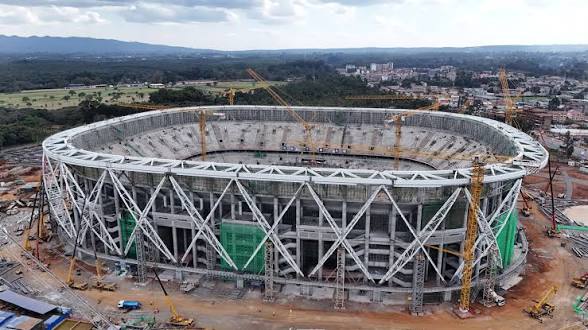
During his visit to Kenya, the CAF president inspected the newly constructed 60,000-capacity Talanta Sports City Stadium and Kasarani Stadium in Nairobi. While Talanta was met with positive feedback, Kasarani and its associated training facilities remain among the areas attracting concern.
Reports indicate that work is still required on the playing surface, broadcast cabling, floodlights and VIP facilities at Kasarani. Stadium designs may also need to be revised to accommodate the security and seating arrangements required for heads of state and other high-profile guests.
Kenya’s Cabinet Secretary for Sports, Salim Mvurya, has responded by promising to accelerate the work and complete outstanding preparations by December, allowing test matches to be staged before CAF’s January assessment.
READ ALSO:
The significance of the January deadline is difficult to ignore. A stadium may appear complete from the outside, but tournament readiness extends beyond construction. Broadcast infrastructure, crowd management, emergency response, pitch quality, media facilities and access routes must all be tested under realistic matchday conditions.
That is why CAF’s concern is not simply whether buildings will be standing by June. It is whether the facilities will be operational, safe and reliable months before the first ball is kicked.
East Africa Has Already Faced This Test
The current pressure carries an uncomfortable historical reminder. Kenya, Tanzania and Uganda were previously entrusted with hosting the African Nations Championship, commonly known as CHAN, in February 2025. The tournament, which is reserved for players competing in their domestic leagues, was postponed only 18 days before its scheduled start after CAF determined that stadiums and other facilities had not reached the required standard.
CHAN eventually took place in August 2025, giving the three countries an opportunity to complete the necessary work and gain experience in hosting a CAF competition.
Motsepe has presented that episode as evidence of what can be achieved through cooperation and flexibility rather than as proof that AFCON 2027 is in danger. In February 2026, he defended the decision to retain the CHAN tournament in the three countries despite the earlier postponement, describing the eventual edition as highly successful.
He has also repeatedly dismissed reports that AFCON 2027 could be moved elsewhere. After his latest inspection, Motsepe maintained that there was “not the slightest consideration of a postponement”, while stressing that the hosts must act with urgency.
The message from CAF is therefore twofold: confidence remains in the hosting arrangement, but confidence does not remove the need for measurable progress.
Three Countries, Three Preparation Stories
The infrastructure challenge is not identical across the three nations.
In Kenya, preparations are concentrated around Nyayo Stadium, Kasarani Stadium and Talanta Sports City Stadium in Nairobi. The new Talanta venue is one of the most visible symbols of the country’s AFCON ambitions, but the condition of existing facilities and their training grounds remains an important part of the readiness debate.
Uganda’s preparations centre on Mandela National Stadium in Kampala, Akii-Bua Olympic Stadium and Hoima City Stadium. The Ugandan Local Organising Committee said in September that it expected all three stadiums to be ready by the end of December 2026. It also projected that 10 of the country’s 12 training facilities would be completed by that date, with the remaining two expected to be ready by the end of January 2027.
Tanzania, meanwhile, has identified Dar es Salaam, Arusha, Dodoma and Zanzibar as host locations. CAF’s inspection programme has included stadiums, training venues, hotels, airports and other support facilities, reflecting the broader operational demands of hosting a tournament across multiple cities.
The uneven pace of progress means that the three countries cannot be assessed solely through a single regional readiness figure. Each host must meet CAF’s requirements within its own infrastructure, funding and construction timelines, while also coordinating with its neighbours.
The Logistics Challenge Beyond the Stadiums
One of the defining features of AFCON 2027 is its three-country format. It offers the potential for a wider regional celebration, but it also introduces logistical complications that a single-country tournament might avoid.
The distances between Kenya, Tanzania and Uganda create challenges for the movement of teams, supporters, officials, broadcasters and tournament personnel. Road travel between Kampala and Dar es Salaam, for instance, can take more than 48 hours, making efficient air connections, border procedures and coordinated transport planning essential.
CAF and the host governments have already identified cross-border mobility, visa arrangements, security, medical services and hospitality as key areas requiring cooperation. The PAMOJA framework is intended to make movement across the three countries easier, but the effectiveness of that system will depend on how well the plans work in practice.
Stadium completion alone cannot resolve these issues. A successful tournament requires a connected operational network in which airports, hotels, roads, security agencies, medical teams and match venues function together.
That is where the January testing phase becomes particularly important. It should reveal not only whether the stadiums are ready but also whether the wider matchday systems can operate under pressure.

A Deadline That Cannot Be Ignored
AFCON 2027 is scheduled to run from June 19 to July 17, with 24 teams expected to compete. The tournament’s qualification process and international calendar are being organised around those dates, meaning any late change would affect national federations, players, broadcasters, sponsors and travelling supporters.
The previous CHAN postponement demonstrated that CAF can move a tournament when facilities fail to meet expectations. However, a similar decision involving AFCON would carry much wider consequences because of the competition’s scale, commercial importance and place in the international football calendar.
For now, CAF insists that postponement is not under consideration. The three governments have also reaffirmed their commitment to completing the required work, while national organising committees continue to report progress.
But the central question is no longer whether East Africa has the ambition to host AFCON. That has already been established. The question is whether the remaining months will be enough to convert ambitious plans into facilities and systems that can withstand CAF’s scrutiny.
The January testing deadline will provide an important indication. By then, the conversation should move beyond promises, construction updates and assurances towards evidence that the venues can host matches safely and efficiently.
East Africa has been given a historic opportunity. The race to deliver it, however, is entering its most demanding phase.

Olumide Atiba is a sports journalist with THEWILL, known for his keen news sense and compelling storytelling. He has built a reputation for turning leads into clear, well-structured reports that resonate with readers, with a strong focus on football coverage