
-
Says Nigeria’s security crisis is rooted in weak governance, poor service delivery, poverty, exclusion and the collapse of local authority, warning that military force alone cannot deliver lasting peace
-
Advocates deeper Nigeria-US cooperation on intelligence, surveillance, reconnaissance, logistics and technical capacity, but insists foreign partnerships must strengthen, not replace, African institutions
-
Links Boko Haram, ISWAP, banditry and kidnapping to weak state presence and declining public trust, urging stronger community-based security and effective local governments
-
Calls for improved troop welfare, civil defence, youth participation and regional coordination as part of a fundamental restructuring of Nigeria and the Sahel’s security architecture
September 09, (THEWILL) — Security analyst and scholar, Dr. Sani Abubakar Muhammad, has called for stronger Nigeria-United States security cooperation, including consideration of a jointly managed military base in the North-East, arguing that “Nigeria needs help, not pride” as the country battles an increasingly complex security crisis.
Muhammad, however, stressed that Nigeria’s insecurity cannot be defeated through military operations alone, saying the deeper causes of terrorism and criminality lie in weak governance, poor public service delivery, poverty, exclusion, intelligence failures and the collapse of effective local authority.
THEWILL reports that Muhammad made the observations during an interview with Waweru Njoroge on the Panel 54 Podcast, in an episode titled “Dr. Sani Muhammad – Sahel Crisis,” published on July 31, 2026.

The 1-hour, 23-minute discussion examined Nigeria’s worsening security situation and the broader instability in the Sahel, including the Boko Haram insurgency, Islamic State West Africa Province (ISWAP), banditry, kidnapping for ransom, intelligence failures, weak local government structures and the changing security relationship between African countries and foreign powers.
Muhammad’s position is that Nigeria’s security crisis is fundamentally a crisis of governance and state presence, rather than simply a military problem.
He argued that where government institutions are weak, absent or too slow to respond to citizens’ needs, armed groups and criminal networks can exploit the resulting vacuum, establish relationships within vulnerable communities and, in some instances, assume functions traditionally associated with the state.
Security Crisis Goes Beyond Military Force
Muhammad’s assessment challenges the conventional approach of relying primarily on military deployments and kinetic operations to tackle Nigeria’s insecurity.
While acknowledging the importance of the armed forces and other security agencies, he argued that military victories cannot produce sustainable peace where the conditions that enable violent groups to recruit, operate and gain influence remain unresolved.
According to him, insecurity is driven by a combination of governance failures, economic hardship, political exclusion, weak institutions and lack of confidence in government.
He particularly highlighted the weakening of local government institutions, noting that local authorities are often the first point of contact between citizens and the state.
When those institutions become ineffective or disconnected from communities, he said, government loses an important mechanism for detecting grievances, resolving local disputes and obtaining early intelligence on emerging threats.
The analyst also identified the breakdown of trust between communities and security agencies as a major obstacle to effective counter-terrorism operations.
Security forces require cooperation from residents to identify criminal networks, track suspicious movements and detect threats before they escalate, he said, warning that distrust can prevent valuable intelligence from reaching authorities.
Boko Haram, ISWAP, Banditry Exploit State Weakness
Muhammad placed Boko Haram, ISWAP, banditry and kidnapping within a broader ecosystem of insecurity rather than treating them as entirely separate challenges.
The North-East has remained the principal theatre of the Boko Haram insurgency and the activities of ISWAP, while banditry and kidnapping networks have expanded across other parts of the country.
According to Muhammad’s analysis, the growth of such groups is aided by weak state presence, poverty, exclusion and inadequate access to justice and basic services.
He argued that when communities feel abandoned by government, criminal and extremist organisations can exploit grievances and vulnerabilities to establish influence.
The security scholar further situated Nigeria’s challenges within the wider Sahel crisis, where porous borders allow terrorist and criminal groups to operate across several countries.
Political instability, military coups, weakened regional cooperation and changing relationships between African governments and foreign powers have, he said, created additional complications for the region’s security architecture.
READ ALSO:
Calls For Stronger US-Nigeria Cooperation
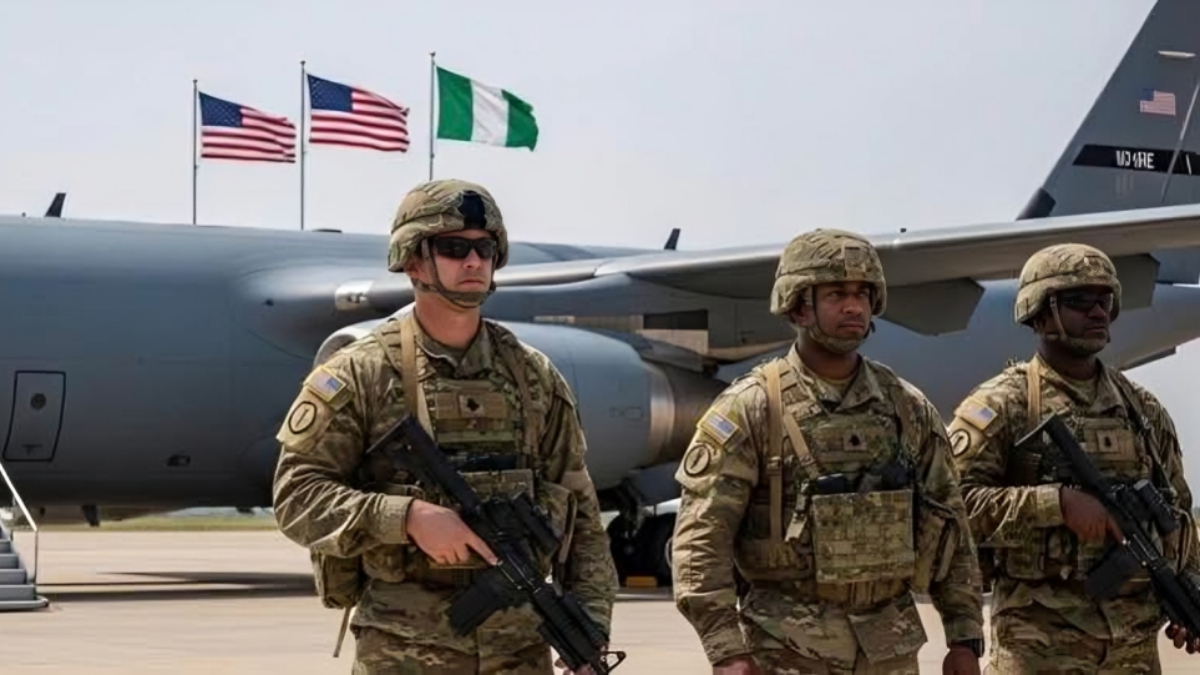 A major component of Muhammad’s argument is the need for Nigeria to deepen its security partnership with the United States and other capable international partners.
He identified intelligence sharing, Intelligence, Surveillance and Reconnaissance (ISR), logistics and technical capacity as areas where stronger cooperation could improve Nigeria’s ability to detect and respond to threats.
He also discussed the possibility of jointly managed security infrastructure in Nigeria’s North-East or North-West, including a potential US-Nigeria military base.
The proposal is premised on the need to strengthen Nigeria’s ability to monitor terrorist movements, gather intelligence and respond rapidly to threats across difficult terrain.
Muhammad described a joint US-Nigeria military base in the North-East as necessary and long overdue, particularly in the effort to secure the wider Sahel.
He questioned why such a proposal should be controversial when American military personnel are already involved in security cooperation with Nigeria.
“Nigeria is fighting a security crisis across a country of 230 million people,” he stated, questioning opposition to a US base while noting that about 200 American personnel were already in the country.
Despite advocating stronger American involvement, Muhammad’s position is not for Nigeria to surrender ownership of its security policy to foreign powers.
Rather, he argued that international assistance should be designed to strengthen Nigerian institutions and capabilities.
African governments, he said, must retain ownership of the partnerships and structures through which foreign interests operate, particularly in sensitive areas involving security, natural resources and strategic infrastructure.

Felix Ifijeh is a journalist with years of professional reporting experience. Known for his keen news sense, compelling storytelling and commitment to accurate, impactful reporting, he has built a reputation for turning leads into clear, engaging, and well-structured reports that resonate with readers. His work reflects deep newsroom experience and a commitment to accurate, impactful journalism.