
-
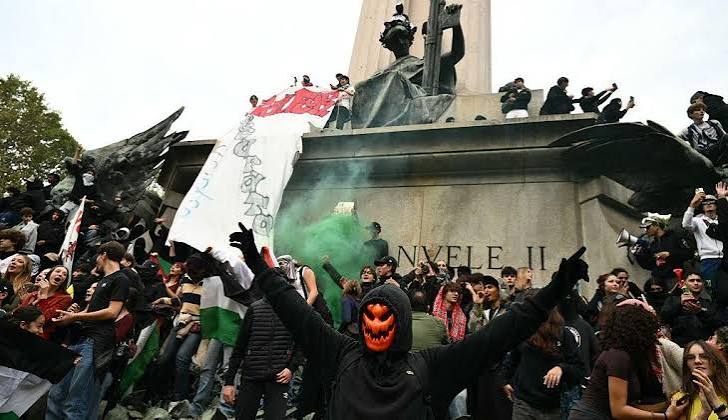
Tens of thousands of young people staged protests in 34 German cities, demanding increased investment in education, lower living costs and an end to compulsory military service.
-
Hooded rioters looted at least two stores in Frankfurt, smashed shop windows and hurled Molotov cocktails at emergency responders as demonstrations turned violent.
-
Barricades were set ablaze in Hamburg, while police reported up to 18,000 protesters in Frankfurt, Munich and Berlin, half the figure claimed by organisers.
-
German authorities warned of attempts by extremist groups to exploit the demonstrations, prompting heightened security measures and precautionary closures by businesses.
November 1, (THEWILL) – Tens of thousands of young people took to the streets across Germany on Saturday to protest rising living costs, inadequate educational facilities and compulsory military service, as demonstrations in 34 cities were marred by violence, looting and firebomb attacks.
In Frankfurt, Germany’s financial hub, hooded rioters looted at least two stores, smashed shop windows and hurled Molotov cocktails at emergency responders, forcing police to intensify efforts to contain the unrest.
The demonstrations, organised by the youth campaign group Gen Z regelt, meaning Gen Z takes charge, were held in major cities, including Berlin, Frankfurt and Munich, amid growing discontent among younger Germans over economic pressures, government spending priorities and the state of public services.

THEWILL gathered that several shops were damaged in Frankfurt as hooded individuals broke into stores and looted goods.
Confirming the disturbances, Frankfurt police said in a statement posted on X that violent incidents were continuing in the city centre.
“Violent disturbances are continuing. In the city centre, windows have been smashed at several shops. Molotov cocktails are also being thrown at the emergency services. We urge all bystanders to avoid the city centre or to leave the area”, the police said.
In Hamburg, some barricades were set on fire, adding to security concerns as authorities monitored the demonstrations.
Although organisers had initially projected a nationwide turnout of about 182,000, figures released by Saturday afternoon indicated a significantly lower attendance.
Police in Frankfurt, Munich and Berlin estimated that up to 18,000 people had participated in demonstrations across the three cities, compared with approximately 36,000 claimed on the organisers’ website.
German authorities said the demonstrations had been largely peaceful in most locations but warned that extremist groups could exploit the gatherings to provoke violence.
Gen Z Mobilises Against Economic Hardship
The protests form part of a wider wave of Gen Z-led demonstrations that have swept several European countries this year, with young people mobilising over economic hardship, education, employment prospects and government policies.
In Serbia, student-led activism contributed to political pressure that preceded the removal of the country’s longtime leader through the ballot box, while demonstrations in France have been accompanied by episodes of rioting, looting and attacks on public infrastructure.
In Germany, organisers said the campaign was driven by mounting concerns about the economic and social conditions confronting younger generations in Europe’s largest economy.
The group is opposed to compulsory military service and is demanding increased government investment in education, improved support for healthcare and a fairer distribution of public responsibilities.
Speaking at a demonstration in Berlin, campaign spokesperson, Lina Friedrich, said the protesters were demanding peace, freedom and improved public services rather than military mobilisation.
“We are here today to fight for peace and freedom, rather than for war and coercion. What matters most to us is better support for the health and education systems. We are against compulsory military service, and we are in favour of a fairer distribution of the burden”, Friedrich stated.
An 18-year-old protester identified as Steve, who was scheduled to address a rally in Munich, accused the government of ignoring the concerns of younger Germans.
Addressing Chancellor Friedrich Merz, he said the government had failed to respond to their grievances, instead continuing to cut spending and impose additional financial burdens.
“The government has offered no response to our concerns other than to continue making cuts and piling further burdens upon us”, he charged.
Steve vowed that young people would continue to exercise their constitutional right to assemble until the government addressed their demands.
READ ALSO:
Police Warn Of Extremist Groups As Businesses Fear Looting
German authorities had raised concerns before the demonstrations that extremist organisations could exploit the gatherings to promote violence and advance their political objectives.
The Federal Interior Ministry said sections of Germany’s far-left extremist scene, alongside some groups linked to foreign extremist movements, had joined efforts to mobilise support for the campaign.
The concerns prompted heightened security preparations in several cities, particularly around commercial districts and shopping centres.
Roman Poseck, Interior Minister of Hesse State, whose capital is Frankfurt, warned against allowing the demonstrations to degenerate into the kind of violence witnessed during protests in France.
“We all have those images from France in our minds — looting, burning houses, burning police vehicles, and attacks on police officers. France must not be held up as a model in this regard”, Poseck said.
Ahead of Saturday’s demonstrations, several businesses across German cities boarded up their windows and planned early closures to protect their premises against possible attacks and looting.
Among the areas affected was Berlin’s luxury Kurfürstendamm shopping boulevard, where businesses took precautionary measures ahead of the protests.
The demonstrations coincided with Halloween festivities, adding to security concerns over possible disturbances in major urban centres.
Questions Emerge Over Campaign’s Leadership
The campaign has also attracted questions about its leadership and the extent to which it represents Germany’s young population, given the involvement of different political and civil society groups.
Germany’s national umbrella organisation for school students, the Federal Student Conference (BSK), has distanced itself from the initiative and announced plans to organise a separate day of protest on November 20.
Despite the disagreement over representation, students who participated in Saturday’s demonstrations said their concerns reflected longstanding problems affecting educational institutions across the country.
Sean Baker, a student at the Technical University of Berlin, said he joined the protest to draw attention to the deteriorating condition of university buildings and facilities. He described some of the classrooms and other facilities as being in a state of disrepair, making the learning environment difficult for students.
“When you go inside and enter the rooms, it looks like an abandoned building. Yet this is where we’re expected to study on a regular basis”, Baker said.
Germany has struggled to revive economic growth, while demographic changes have placed increasing pressure on public finances, pension systems and essential services.
The retirement of the baby-boomer generation, alongside a shrinking working-age population, has intensified concerns over labour supply, public expenditure and the sustainability of social services.
Against this backdrop, the Gen Z campaign has brought renewed attention to demands for better-funded educational institutions, stronger healthcare services, lower living costs and greater consideration of the economic challenges confronting younger generations.

Felix Ifijeh is a journalist with years of professional reporting experience. Known for his keen news sense, compelling storytelling and commitment to accurate, impactful reporting, he has built a reputation for turning leads into clear, engaging, and well-structured reports that resonate with readers. His work reflects deep newsroom experience and a commitment to accurate, impactful journalism.
