
-
APC dismisses NEIS figures purportedly showing Peter Obi leading INEC’s 2027 mock election.
-
Dele Alake questions how party-specific results emerged from a ballot without party names or logos.
-
INEC’s exercise covered 17,618 polling units, approximately 10 per cent of the national total.
-
APC says the commission neither collated nor declared results from the technology assessment exercise.
November 29, (THEWILL) – The All Progressives Congress (APC) has challenged the authenticity of figures released by the Nigeria Election Intelligence System (NEIS), purportedly showing Peter Obi leading the Independent National Electoral Commission’s (INEC) 2027 mock election with more than five million votes, insisting that the electoral commission did not conduct any result collation or declare winners from the exercise.
The ruling party, through the spokesperson of its Presidential Campaign Council, Dele Alake, described the figures as fabricated and calculated to mislead Nigerians, questioning how an organisation could attribute millions of votes to political parties and candidates in an exercise that neither featured party identities on the ballot papers nor produced officially declared results.
In a statement issued on Sunday, Alake said the publication lacked an identifiable basis in INEC’s exercise, which was conducted primarily to assess the commission’s electoral technology and operational preparedness ahead of the 2027 general elections.
He specifically challenged NEIS to explain the methodology behind its purported figures, including how it arrived at more than 17 million votes from an exercise that covered only a fraction of the country’s polling units.
Mock Election Was Technology Assessment
INEC conducted the mock election on Saturday across two polling units in each of Nigeria’s 8,809 wards as part of preparations for the 2027 general elections.
The exercise covered 17,618 polling units out of the country’s 176,846, representing approximately 10 percent of the national polling infrastructure.

A major objective was to test the effectiveness of the commission’s Bimodal Voter Accreditation System (BVAS), alongside other operational arrangements ahead of the next general elections.
The exercise differed fundamentally from a conventional election. The ballot papers did not carry the names or logos of registered political parties or their candidates. Instead, participants were presented with colour-coded options identified as “AQUA”, “BLUE”, “COAL”, “CYAN” and “GOLD”.
INEC did not announce any winner or loser following the exercise. Neither did the commission undertake the conventional collation and declaration of results at polling unit, ward, local government, state or national levels.
It was against this background that Alake questioned the emergence of NEIS figures assigning votes to political parties, including the APC, National Democratic Congress (NDC), African Democratic Congress (ADC) and other political platforms.
Alake Questions Origin of Party-Specific Figures
The APC spokesperson argued that the absence of political party identities on the ballot papers made the purported attribution of votes to individual parties particularly questionable.
He demanded an explanation of how NEIS determined which political parties or candidates participants supposedly supported, given that the exercise did not provide the conventional party-based choices available during an actual election.
“How did NEIS arrive at figures for the APC, NDC, ADC and other political parties when none of them featured on the ballot papers?” he queried.
Alake also challenged the organisation’s reported claim that Obi secured more than five million votes, describing the figure as unsupported by any results officially released by INEC.
He said the commission had not collated results from the exercise, making it necessary for NEIS to explain the source of the figures it attributed to the mock election.
“After the exercise, INEC did not collate or announce any results at the polling unit, ward, local government, state, or national levels. If the commission did not collate results, where did NEIS get the figures it claims to have recorded?” he asked.
He further questioned the plausibility of the organisation’s reported aggregate of more than 17 million votes, considering that the mock election covered approximately one-tenth of the country’s polling units.
READ ALSO:
APC Faults NEIS Over Simulation Claims
Alake also drew attention to NEIS’s description of the process on its website as a “simulation”, arguing that figures generated through such an arrangement should not be presented or interpreted as the outcome of an actual electoral exercise.
He maintained that the distinction between a simulation and an election was significant, particularly in a politically charged environment where purported electoral figures could be circulated as evidence of a candidate’s popularity.
According to him, the publication did not constitute a reliable measure of public opinion or provide a credible basis for projecting the outcome of the 2027 general elections.
The APC spokesperson characterised the exercise as an online political activity apparently designed to generate attention, engagement and internet traffic, rather than an authoritative assessment of voters’ preferences.
He consequently urged Nigerians to disregard the figures and resist attempts to draw conclusions about the relative electoral strength of political parties or candidates from the publication.
Ruling Party Raises Alarm Over Election Disinformation
The APC also situated the controversy within what Alake described as a broader pattern of attempts by opposition elements to influence public perception ahead of the 2027 elections.
He recalled previous warnings by the party about alleged efforts to manipulate public opinion through fake news, artificial intelligence-generated images and other forms of disinformation, as well as campaigns intended to discredit INEC and undermine confidence in the electoral process.
Alake warned that the circulation of unauthorised electoral figures could contribute to public confusion and create misleading impressions about the credibility of the electoral commission and the likely outcome of the forthcoming elections.
He said Nigerians should distinguish between politically generated claims and information formally issued by the statutory electoral authority.
While acknowledging that members of the Obidient movement might celebrate the figures published by NEIS, he said such celebrations should not be presented as evidence of an actual electoral victory or nationwide support for Obi.
The APC maintained that the NEIS publication should not be confused with an official INEC result, insisting that the commission neither declared a winner nor released party-based voting figures from Saturday’s mock election.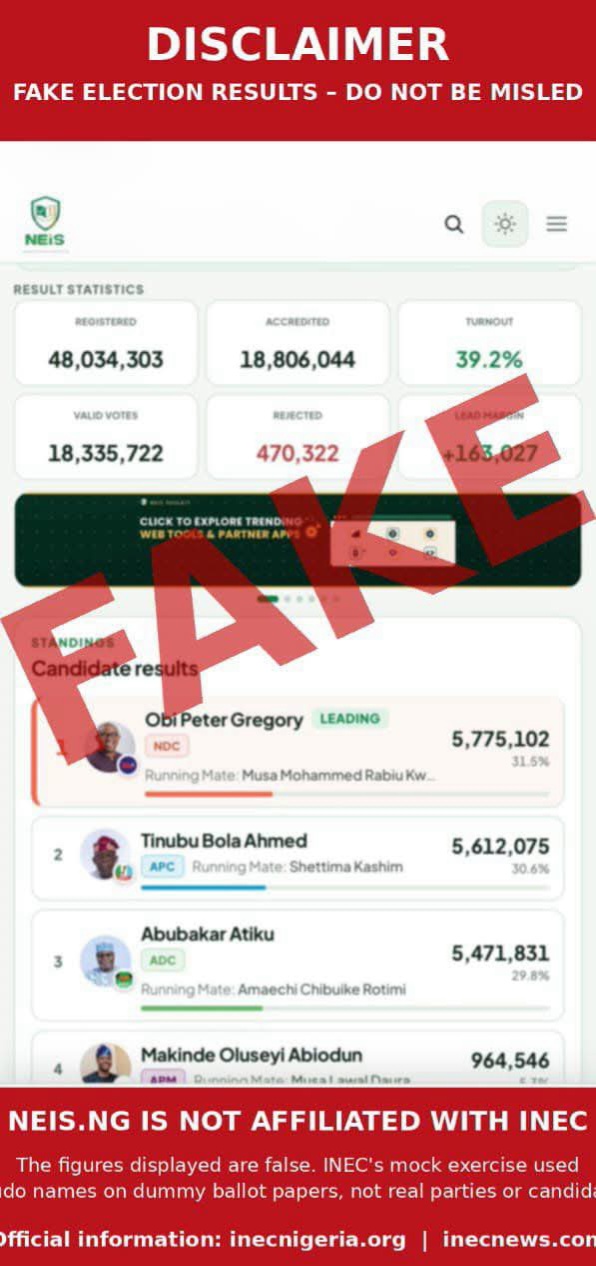

Felix Ifijeh is a journalist with years of professional reporting experience. Known for his keen news sense, compelling storytelling and commitment to accurate, impactful reporting, he has built a reputation for turning leads into clear, engaging, and well-structured reports that resonate with readers. His work reflects deep newsroom experience and a commitment to accurate, impactful journalism.