
-
CAF has scrapped its proposal to organise the Africa Cup of Nations every four years, confirming a return to the traditional two-year format.
-
The governing body acknowledged that its proposed Africa Nations League could take several years to generate the revenue required to strengthen African football and make its competitions financially sustainable.
-
CAF President Patrice Motsepe confirmed that the 2027 tournament will be hosted by Kenya, Tanzania and Uganda, with subsequent editions scheduled for 2028, 2031 and 2033.
-
Since the 1968 edition in Ethiopia established the regular two-year cycle, AFCON has largely maintained the format, although CAF shifted the competition from even-numbered to odd-numbered years after the 2012 tournament to avoid clashes with the FIFA World Cup.
October 30, (THEWILL) – The Confederation of African Football (CAF) has announced that the Nations Cup will return to the two-year format, scrapping the plans to organise it every four years.
It would be recalled that CAF President Patrice Motsepe proposed that the Nations Cup should be held every four years starting from 2028.
The governing body had planned to introduce a new pan-African Nations League, which would take place every two years and replace the current AFCON format.

However, the plan has been scrapped with CAF acknowledging that the proposed African Nations League could take several years to generate the revenue required to strengthen African football and make its tournaments financially self-sufficient
Patrice Motsepe announced at the continent’s strategy conference in Cabo Verde on Thursday that the CAF Exco would be reassessing and reconsidering the decision it took last year.
He said: “The decision by the CAF EXCO that the CAF AFCON should take place every Two Years was based on advancing, protecting and promoting the interest of African Football and CAF’s 54 Member Associations, as well as the interest of African players employed by Football Clubs outside Africa.
“We were also concerned by the several years required before the proposed new Africa Nations League Pan-African competition, (which was supposed to be identical to the current AFCON and take place Every Two Years), could make the substantial financial and football development contributions for African Football and CAF competitions to be globally competitive and self-supporting.”
The South African administrator expressed confidence that the 2027 Nations Cup to be co-hosted by Kenya, Tanzania and Uganda would be a success.
READ ALSO:
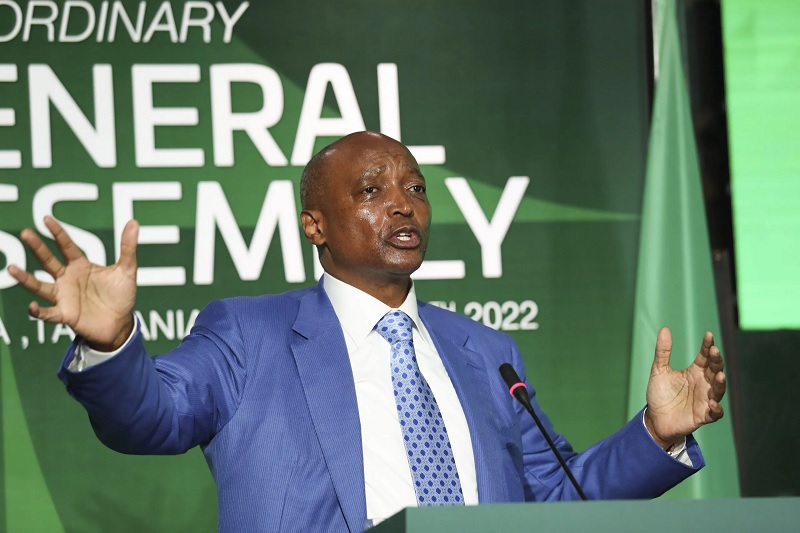
Motsepe added: “The next TotalEnergies CAF AFCON will take place in 2027 in Kenya, Tanzania and Uganda and I am confident that it will be very successful. The subsequent AFCONs thereafter will take place in 2028, 2031 and 2033.
“The forthcoming FIFA World Cup will take place in 2030 and in accordance with the FIFA tradition, the final tournament of the AFCON and other Confederations’ National Teams competitions may not take place during the year of the FIFA World Cup. ”
The first edition of the Africa Cup of Nations was held in 1957.
The 1968 edition in Ethiopia marked the beginning of AFCON’s established two-year cycle.
From that point, the competition was organised every two years, with editions taking place in 1970, 1972, 1974, 1976, 1978 and 1980, before continuing on the same pattern through subsequent decades.
The schedule continued through 1982, 1984, 1986, 1988, 1990, 1992, 1994, 1996, 1998, 2000, 2002, 2004, 2006, 2008 and 2010.
Following the 2012 edition in Equatorial Guinea and Gabon, CAF decided to move the tournament from even-numbered to odd-numbered years.
The adjustment was designed to avoid clashes with the FIFA World Cup, which is traditionally held in even-numbered years.
As a result, the competition returned in 2013 in South Africa, before continuing in 2015, 2017, 2019, 2021, 2023 and 2025.

