
-
Wike’s aide, Lere Olayinka, has questioned the seriousness of several of the 19 presidential candidates cleared for the 2027 election, arguing that not all of them are entering the contest with a realistic expectation of winning.
-
Olayinka singled out Omoyele Sowore and Peter Obi’s Nigeria Democratic Congress (NDC), arguing that presidential ambition without a strong grassroots structure cannot translate into electoral victory.
-
The Wike aide said serious presidential contenders must look beyond rallies, social media visibility and political noise and concentrate on the organisation of polling units.
-
Olayinka also defended Wike’s fear of political retaliation should the Tinubu administration lose power in 2027, saying the FCT Minister understands the consequences of his role in the political events surrounding the 2023 presidential election.
September 04, (THEWILL) — As political parties intensify preparations for the 2027 presidential election, a media aide to the Minister of the Federal Capital Territory (FCT), Nyesom Wike, Lere Olayinka, has dismissed the prospects of some of the presidential candidates, arguing that political noise and public visibility alone cannot deliver victory at the polls.
Olayinka, who spoke during an interview on Arise News on Friday, said the emergence of 19 presidential candidates had not necessarily translated into 19 serious contenders for the presidency.
According to him, some of those in the race are more interested in establishing their presence in the political space or making an impression than in winning the election.

“There are 19 presidential candidates. Can we say honestly that all the 19 are contesting with the mindset of winning? The answer is no,” Olayinka said.
He argued that the presidential contest would ultimately be determined by the ability of candidates and their political parties to build structures across the country’s 36 states and the Federal Capital Territory.
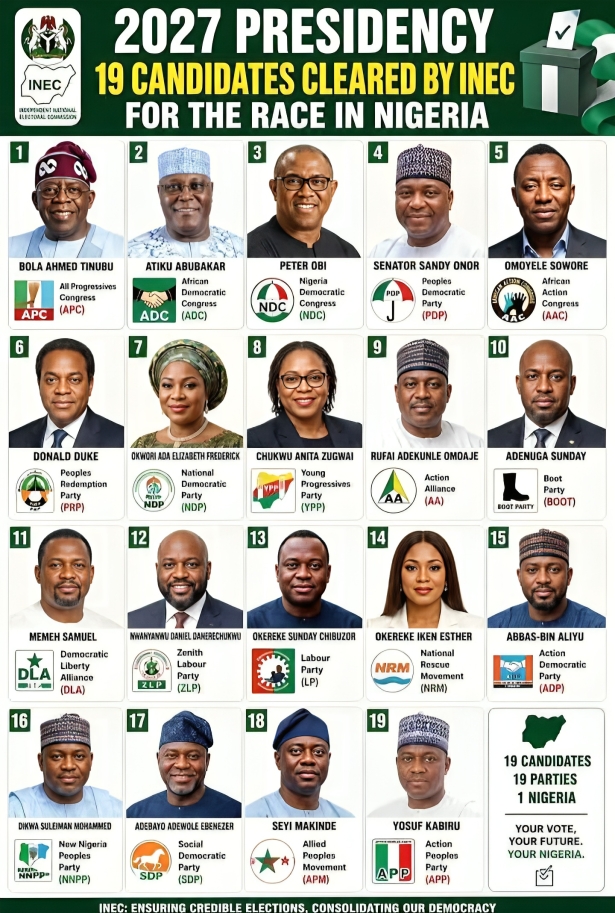
Olayinka’s comments come against the backdrop of a crowded 2027 presidential race involving incumbent President Bola Tinubu of the All Progressives Congress (APC), former Vice President Atiku Abubakar of the African Democratic Congress (ADC), Peter Obi of the NDC, Omoyele Sowore of the African Action Congress (AAC), and other candidates.
The Independent National Electoral Commission (INEC) has published the particulars and credentials of 19 presidential candidates and their running mates.
The presidential campaign began officially on August 19, putting the candidates under increasing pressure to demonstrate not only their policy programmes but also their capacity to organise voters across the country.
But Olayinka said the number of candidates should not be mistaken for the number of genuine contenders with the capacity to win.
He specifically questioned the presidential ambition of Sowore, who is contesting on the platform of the AAC, referring to his performance in the 2023 presidential election as part of his argument.
Olayinka’s central point was that a candidate cannot build a winning presidential coalition merely through media visibility, criticism of the government or rallies.
“It is not about making noise,” he said.
The FCT Minister’s aide also turned his attention to Peter Obi and the NDC, arguing that the party’s organisational reach remains inadequate for a successful presidential bid.
Olayinka claimed that the party did not have governorship candidates in 15 states and had candidates in only 13 states.
He also pointed to its absence from recent governorship contests in Ekiti and Osun states, arguing that such gaps raise questions about the party’s ability to establish the political network necessary to prosecute a nationwide presidential election.
“Even NDC, the party of Peter Obi, they know they cannot win the election. They are just contesting to try to register their presence,” he said.
Obi is one of the most prominent opposition figures in the 2027 race, having finished third in the 2023 presidential election on the Labour Party platform.
He is now contesting under the NDC ticket, with former Kano State governor Rabiu Kwankwaso as his running mate. INEC’s published 2027 candidate list confirms Obi’s NDC candidacy.
Olayinka’s argument was that presidential elections require more than a popular candidate.
According to him, a party must have people capable of canvassing votes, mobilising supporters, protecting its interests and monitoring the electoral process at the grassroots.
Lere Olayinka said some of the presidential candidates are more interested in establishing their presence in the political space or making an impression than in winning the election
‘Five People At Every Polling Unit’
To underscore his argument, Olayinka cited INEC’s polling-unit structure, saying Nigeria has 176,846 polling units nationwide.
INEC’s own 2023 General Election report confirms that the country has 176,846 polling units, following the commission’s expansion of the number from 119,974 through the conversion of voting points and voting point settlements into full polling units.
Olayinka argued that a serious presidential candidate would need a substantial number of trained and trusted personnel at the polling-unit level.
According to him, if a candidate were to deploy at least five people to manage activities at every polling unit, the scale of the organisational requirement would run into hundreds of thousands of personnel.
His argument was that this grassroots machinery would be necessary to canvass votes before the election and monitor voting, counting and collation on election day
READ ALSO:
Wike’s Role In 2023 Still Haunts Opposition Relationship
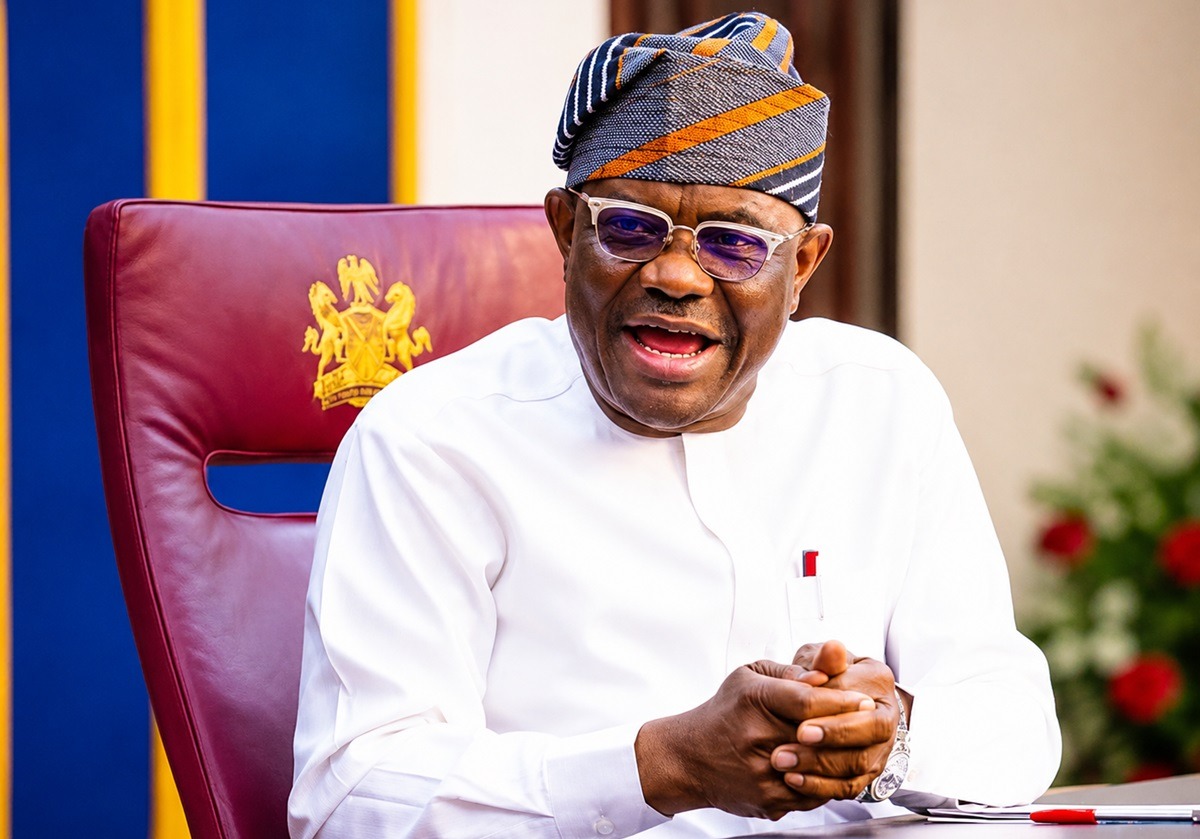
Beyond his assessment of the presidential candidates, Olayinka addressed the increasingly contentious question of what could happen to Wike if there is a change of government after the 2027 election.
He said Wike was fully aware that his political decisions could have consequences if an opposition candidate takes power.
“One thing you must understand about Wike is that he is a realist. He does not deceive himself. If today government changes, he knows,” Olayinka said.
He specifically referenced Wike’s role in the political crisis that preceded the 2023 presidential election.
Wike, then governor of Rivers State, was one of the five PDP governors who formed the G5 and refused to support Atiku after the former vice-president emerged as the party’s presidential candidate.
The dispute centred largely on the demand by the G5 for the PDP national chairman, Iyorchia Ayu, to resign and for the party to address what the governors described as a lack of fairness in the distribution of key party positions.
The rebellion weakened Atiku’s campaign in several states and contributed to the deep political divide within the PDP ahead of the 2023 election.’
According to Olayinka, the political wounds from the 2023 election remain relevant to the 2027 contest. He said Wike’s opposition to Atiku had made the minister a political enemy in the eyes of supporters of the former vice-president.
“He was part of those who were instrumental to Atiku not winning the 2023 election. The same thing Atiku people see Wike as an enemy. We did not allow Atiku to win the election.
“If Atiku could become president today, he (Wike) is automatically a target. He knows,” Olayinka said, adding that the same political antagonism extended to supporters of Peter Obi, whose emergence as a major opposition figure further complicated the 2023 political landscape.
He maintained that Wike should not assume that political relationships would automatically be repaired if any of his former political adversaries returned to power.
“He has injured Atiku too much. He has injured Peter Obi too much, and when you injure people politically, you should expect a kind of a payback,” he said.
Olayinka stressed that he was not claiming that political retaliation had already been planned or would necessarily occur.
Rather, he said Wike’s concern was based on the political consequences of his actions and alliances.
“He is not deceiving himself to believe that if Atiku becomes president tomorrow, he will now become Atiku’s friend. No,” he said.
Felix Ifijeh is a journalist with years of professional reporting experience. Known for his keen news sense, compelling storytelling and commitment to accurate, impactful reporting, he has built a reputation for turning leads into clear, engaging, and well-structured reports that resonate with readers. His work reflects deep newsroom experience and a commitment to accurate, impactful journalism.