
-
Former Osun State Governor and National Secretary of the African Democratic Congress (ADC), Rauf Aregbesola, has described President Bola Tinubu’s “Emilokan” slogan as despotism, arguing that it represents more than the assertion that it is an individual’s turn to occupy political office.
-
Aregbesola said the expression suggests a belief in a divine right to control a political space and exercise authority over it, warning that Nigerians are now witnessing what he described as the physical demonstration of a principle that was once expressed only rhetorically.
-
The former minister urged Nigerians to use the opportunity available to them to prevent what he called an “assault on democracy,” as political activities and alignments intensify ahead of the 2027 general elections.
-
His viral video has triggered a fierce backlash from Tinubu supporters, who accused Aregbesola of deliberately misrepresenting the context of “Emilokan,” insisting that Tinubu used the expression to demand power rotation to the South-West and assert his own presidential ambition.
October 7, (THEWILL) – Former Osun State Governor and National Secretary of the African Democratic Congress (ADC), Rauf Aregbesola, has described President Bola Tinubu’s famous “Emilokan” political expression as despotism, arguing that the phrase represents a claim of personal or divine authority rather than simply an assertion that it is someone’s turn to occupy political office.
Aregbesola made the assertion in a viral video in which he discussed the political meaning of the Yoruba expression, which became one of the defining slogans of Tinubu’s 2023 presidential campaign.
According to the former minister of Interior, “Emilokan” should not be understood merely as a statement that a particular individual, group or political party is next in line for power.

Instead, he argued that the expression conveys a belief by an individual that they possess a divine right to control a particular political space and exercise authority over it.
Aregbesola said the closest single English word to capture the meaning, as he understands it, is “despotism”.
“Despotism is a single word for Emilokan. I don’t know if you understand what I mean. Despotism. You know, despot. A man who believes that he has a divine right to administer space and time. That’s Emilokan”, he said.
He further explained that the emphasis was on “Emi”, meaning “me”, rather than a collective claim to political power.
“It is Emi. That is affirming a divine authority, a divine right to who. If that was not well understood then, I want to believe Nigerians now know what it really means”, Aregbesola said.
The former minister claimed that Nigerians were now witnessing the practical manifestation of what he described as the underlying principle behind the expression.
“So we are now having it not just being merely said rhetorically, but being physically demonstrated. But Nigerians have the opportunity today to prevent the assault on democracy”, he added.

Fierce Backlash
The former minister’s interpretation of “Emilokan” has provoked strong reactions, particularly from supporters of Tinubu who accused him of deliberately giving a negative meaning to a phrase that was used in a specific political context.
One respondent on X, Don Juvae, argued that Tinubu had openly stated during the 2023 campaign that presidential power should return to the South-West and that he believed himself to be the best candidate to represent the region.
He questioned why Aregbesola was now criticising the phrase after having benefited from the political structure associated with Tinubu.
READ ALSO:
Another commentator, Quadri Abiodun, said political disagreements should not erase history, arguing that Tinubu’s political relationships, support and strategic work had helped create platforms from which several political figures, including Aregbesola, benefited.
He suggested that Aregbesola should consider the history of their political relationship before publicly attacking Tinubu.
Another Tinubu supporter, who identified himself as Balogun, challenged Aregbesola to account for his achievements as Interior Minister and accused him of overlooking Tinubu’s political contributions.
He defended Tinubu’s use of “Emilokan”, interpreting it as a self-affirmation of his presidential ambition rather than evidence of dictatorial tendencies.
‘Emilokan Means It Is My Turn’
Muftau Gbadegesin was particularly critical of Aregbesola’s interpretation, accusing him of selectively recalling Tinubu’s 2023 speech.
Gbadegesin argued that Tinubu had used the speech to make a broader case for the rotation of presidential power from the North to the South.
He recalled Tinubu’s reference to his relationship with former President Muhammadu Buhari and his long-standing political support for Buhari’s presidential ambitions.
According to him, Tinubu’s argument was that, after supporting others and helping them attain political power, the presidency should eventually move to the South-West and, specifically, to him.
Gbadegesin maintained that “Emilokan simply means it is my turn”, rather than a declaration of divine entitlement.
He accused Aregbesola of being “mischievous, mendacious and malicious” in his interpretation of the phrase.
Another respondent, Ayelabowo Odunita, also attacked Aregbesola over the video, accusing him of misinterpreting political statements and making a personal allegation about the former minister’s state of mind.
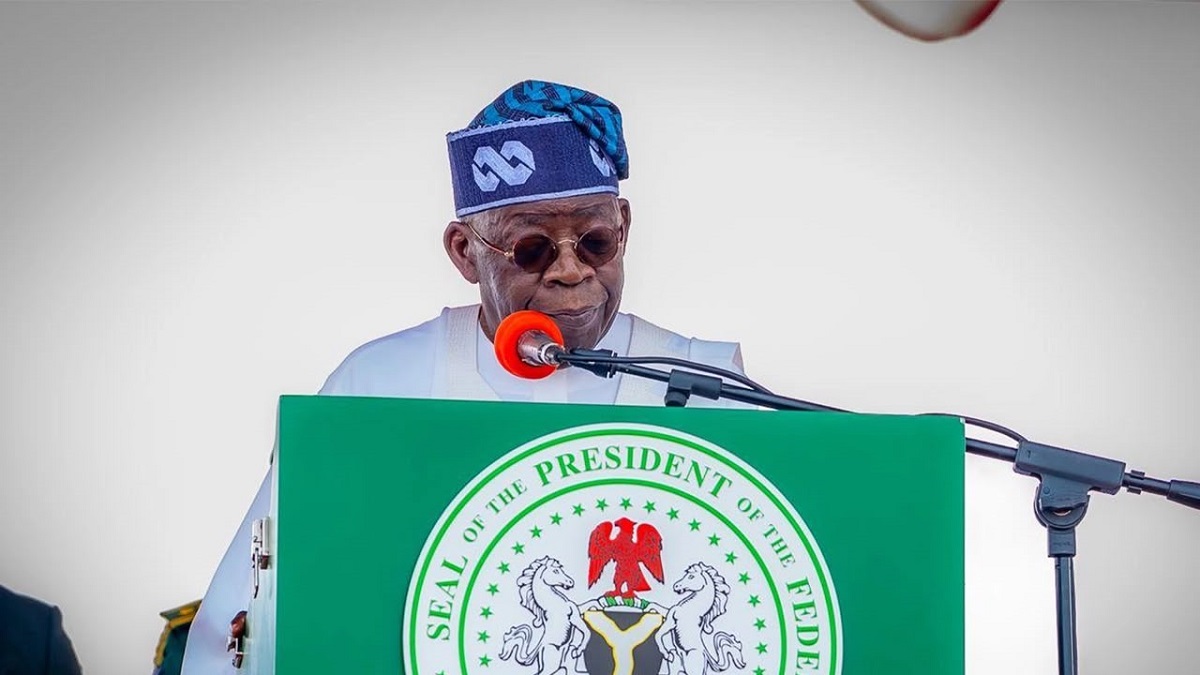
What Tinubu Meant By ‘Emilokan’
The controversy over the expression dates back to the 2023 presidential nomination contest within the All Progressives Congress.
Tinubu used “Emilokan” — commonly translated as “it is my turn”, to advance his argument that he deserved the party’s presidential ticket after years of supporting political allies and presidential aspirants.
The expression became one of the most memorable phrases of the 2023 election campaign.
For Tinubu’s supporters, it represented a claim based on political experience, sacrifice and the principle of power rotation.
For his critics, however, the phrase came to symbolise what they considered an excessive sense of entitlement to political power.
Aregbesola’s latest intervention has now given the expression another dimension, arguing that its meaning goes beyond political succession to suggest a claim of personal authority.
Background
“Emilokan” became a major part of Tinubu’s political messaging during the 2023 presidential campaign, particularly during his efforts to secure the APC presidential ticket.
Tinubu eventually won the APC nomination and went on to win the 2023 presidential election.
Since his emergence as President, the expression has continued to feature prominently in political arguments surrounding his administration, with supporters viewing it as a declaration of political entitlement earned through years of service, while critics have used it to question his approach to power.
Aregbesola, a former governor of Osun State and former Interior Minister under the administration of Muhammadu Buhari, was himself once closely associated with Tinubu’s political camp.

Felix Ifijeh is a journalist with years of professional reporting experience. Known for his keen news sense, compelling storytelling and commitment to accurate, impactful reporting, he has built a reputation for turning leads into clear, engaging, and well-structured reports that resonate with readers. His work reflects deep newsroom experience and a commitment to accurate, impactful journalism.
