
For decades, Nigeria remained a major crude oil producer while relying heavily on imported petroleum products, exposing the economy to global price shocks, foreign exchange pressures and supply disruptions.
That equation is beginning to change with the emergence of the Dangote Refinery, but its planned $14.3bn expansion could determine whether Nigeria merely becomes a major refining hub or develops a broader industrial advantage from its refining capacity.
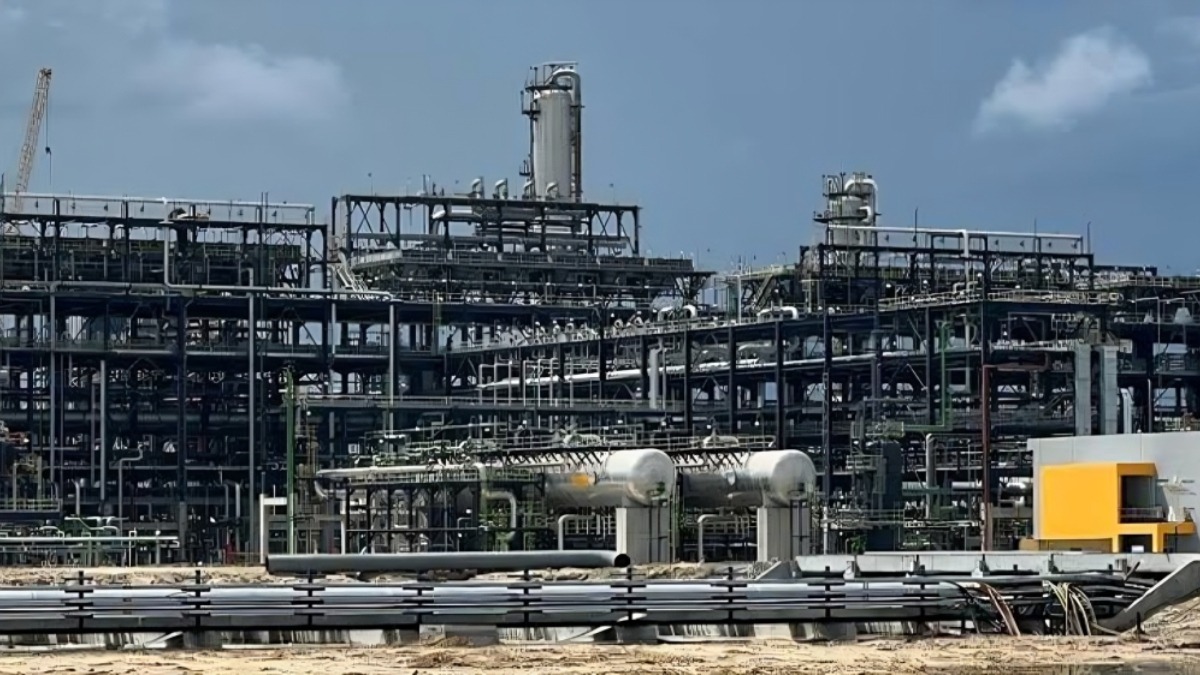
Dangote Industries announced plans to invest $14.3bn to double the refinery’s capacity to 1.4 million barrels per day by 2029. The expansion will add new refining and petrochemical capacity and strengthen the company’s plans to supply both Nigeria and regional markets.

The refinery began operations in 2024 after an estimated $20bn construction investment. Following maintenance work earlier in 2026, its crude distillation capacity has risen to about 700,000 barrels per day.
The scale of the expansion would place the facility among the world’s largest refining complexes and could significantly alter Nigeria’s position in Africa’s downstream petroleum market.
From Refining to Regional Energy
The refinery is already changing Nigeria’s petroleum trade flows. According to the US Energy Information Administration, Nigeria’s seaborne petroleum-product shipments averaged 561,000 barrels per day in the second quarter of 2026, up from 79,000 bpd in 2023. Petroleum-product exports averaged about 350,000 bpd, compared with 46,000 bpd in 2023.
At the same time, seaborne imports fell below 130,000 bpd from almost 400,000 bpd in 2023.
The shift reflects the growing contribution of domestic refining, particularly Dangote’s operations. Nigeria is increasingly positioned to supply refined products to Europe and other African markets, rather than depending almost entirely on imports.
READ ALSO:
EIA data showed Nigeria’s petroleum-product exports to Europe averaged about 130,000 bpd in the second quarter, compared with 40,000 bpd in 2025 and 15,000 bpd in 2023. Shipments to other African markets also approached 120,000 bpd.
The planned expansion therefore has implications beyond petrol supply. It could deepen Nigeria’s participation in regional petroleum-product trading and create opportunities in storage, logistics, marine services and petrochemicals.
The Crude Supply Challenge
However, the biggest question surrounding the expansion is whether Dangote can secure enough competitively priced crude to keep the additional capacity running efficiently.
Reuters reported in August that the refinery was importing around 30–40 percent of its crude requirements, including US WTI Midland.
The issue is not simply whether crude exists in Nigeria. Domestic crude supply has to be available at commercially competitive prices and delivered under terms that make sense for the refinery.
Data from the Nigerian Upstream Petroleum Regulatory Commission showed that in the second quarter, 53.7 million barrels were supplied to domestic refineries, representing 97.4 percent performance under the Domestic Crude Supply Obligation.
For Dangote specifically, producers offered 68.1 million barrels against a requirement of 63 million barrels, while the refinery accepted 52.6 million barrels, or about 78 percent of what was offered.
That suggests the challenge extends beyond physical availability. Pricing, crude quality, logistics and commercial terms can influence how much domestic crude the refinery ultimately accepts.
The Federal Government and regulators have consequently been examining reforms to improve domestic crude allocation and pricing, including direct crude deliveries and possible discounts for nearby refineries.
Stronger Earnings Support Expansion
Dangote’s expansion comes as the refinery’s financial performance has strengthened sharply.
For the first half of 2026, the company reported profit after tax of $1.82bn, compared with a $476m loss for full-year 2025. EBITDA stood at $2.60bn.
The earnings performance has been supported by strong refining margins and favourable global petroleum-market conditions. However, the extent to which those conditions persist remains an important consideration for the expansion’s economics.
The company is also raising capital through an initial public offering. The Securities and Exchange Commission approved the offer of 4.1 billion shares at N525 per share, targeting about N2.15tn, equivalent to approximately $1.63bn.
The offer is scheduled to run from September 14 to October 13, with trading expected to begin in November.
The IPO provides an important financing channel as the company prepares for its next phase of expansion and gives investors an opportunity to participate directly in what could become one of Africa’s most strategically significant industrial assets. The larger opportunity for Nigeria lies in what happens around the refinery.
A 1.4 million bpd refinery can create demand for domestic transportation, engineering, storage, shipping, fabrication, maintenance, chemicals and financial services. Its petrochemical operations could also provide feedstock for plastics, fertiliser-related products and other manufacturing activities.
This could help Nigeria capture more value from crude oil instead of exporting crude and importing higher-value products.
There is also a regional opportunity. Nigeria’s proximity to major West African markets gives the refinery access to countries that remain dependent on imported petroleum products. Greater exports could generate foreign exchange while strengthening Nigeria’s role as a regional energy supplier.
But these benefits are not automatic.
The refinery’s success as an industrial platform will depend on reliable infrastructure, crude supply, predictable regulation, competitive pricing and the ability of local businesses to participate in its supply chain.
The planned expansion also faces risks from global refining margins, crude prices and geopolitical disruptions. Dangote’s strong first-half earnings have benefited from unusually favourable global market conditions, meaning future profitability cannot simply be extrapolated from current performance.
Nigeria’s broader oil-production ambitions will also matter. The government has targeted production of three million barrels per day by 2030, which, if achieved alongside efficient domestic crude allocation, could improve the feedstock environment for local refineries.
Ultimately, Dangote’s $14.3bn expansion is bigger than a refinery expansion. It is a test of whether Nigeria can convert downstream capacity into a wider industrial ecosystem. The immediate benefit is reduced dependence on imported refined products. The bigger prize is the creation of an integrated energy and manufacturing platform that supports exports, attracts investment, retains foreign exchange and generates activity across multiple industries.
For Nigeria, therefore, the real measure of success will not be the 1.4 million barrels per day nameplate capacity alone. It will be how much additional industrial activity, investment, exports and domestic value that capacity creates.

Ogochukwu Onwaeze is a writer specializing in business and economic journalism. At THEWILL News Media, she translates market trends, financial developments, and policy shifts into clear and engaging stories.