
-
Federal High Court authorises the playing of CCTV footage as ICPC and former Kaduna Governor Nasir El-Rufai battle over alleged restrictions on his family’s access to him in custody.
-
Court limits both sides to 20 minutes each, rejecting El-Rufai’s request for the entire six-hour-plus recording to be publicly screened over time and security concerns.
-
ICPC says restrictions followed alleged security breaches involving El-Rufai’s family, while the former governor insists fuller recordings could contradict the commission’s account.
-
Court rejects bid to cross-examine two ICPC officials as El-Rufai pursues N10 billion in damages; substantive hearing fixed for November 3.
October 22, (THEWILL) – The Federal High Court in Abuja on Thursday ordered selected Closed-Circuit Television (CCTV) footage to be played in open court as the Independent Corrupt Practices and Other Related Offences Commission (ICPC) and former Kaduna State Governor, Nasir El-Rufai, battle over alleged restrictions on his family’s access to him while in custody.
Justice Chigozie Onah granted an application by the ICPC seeking permission to demonstrate portions of the recordings, which have emerged as key evidence in El-Rufai’s N10 billion fundamental rights suit against the anti-corruption agency.
The judge, however, rejected El-Rufai’s request to have the entire recording, spanning more than six hours, played publicly, ruling instead that both sides would be allowed 20 minutes each to present portions considered relevant to their respective cases.

Justice Onah said the court could not be turned into a “viewing centre” and did not have the luxury of time to watch more than six hours of footage.
He also accepted the argument of ICPC counsel, Yetunde Mosunmola, that the recordings contained sensitive information about the commission’s facility which could create security vulnerabilities if the entire footage was displayed publicly.
The judge held that should it become necessary to view the complete recordings, they could be screened in chambers.
He directed that the selected footage be played at 1pm, when the courtroom would ordinarily be less crowded.
Court Rejects Cross-Examination Request
Justice Onah also rejected El-Rufai’s request to compel two ICPC officials to appear for cross-examination over the affidavits and CCTV evidence filed by the commission.
El-Rufai had sought the attendance of Sadiq Baba, who certified the CCTV exhibit, and John Uche, who deposed to the ICPC’s counter-affidavit.
The former governor wanted them questioned over the selection, copying and certification of the three clips submitted by the commission, whether additional recordings existed and why footage covering other relevant periods had not been produced.
But Justice Onah held that fundamental rights enforcement proceedings are sui generis and are principally determined on affidavit evidence. The court consequently declined the application and other related reliefs sought by El-Rufai.
The matter was adjourned until November 3 at 1pm for definite hearing of the substantive applications.
N10bn Rights Suit
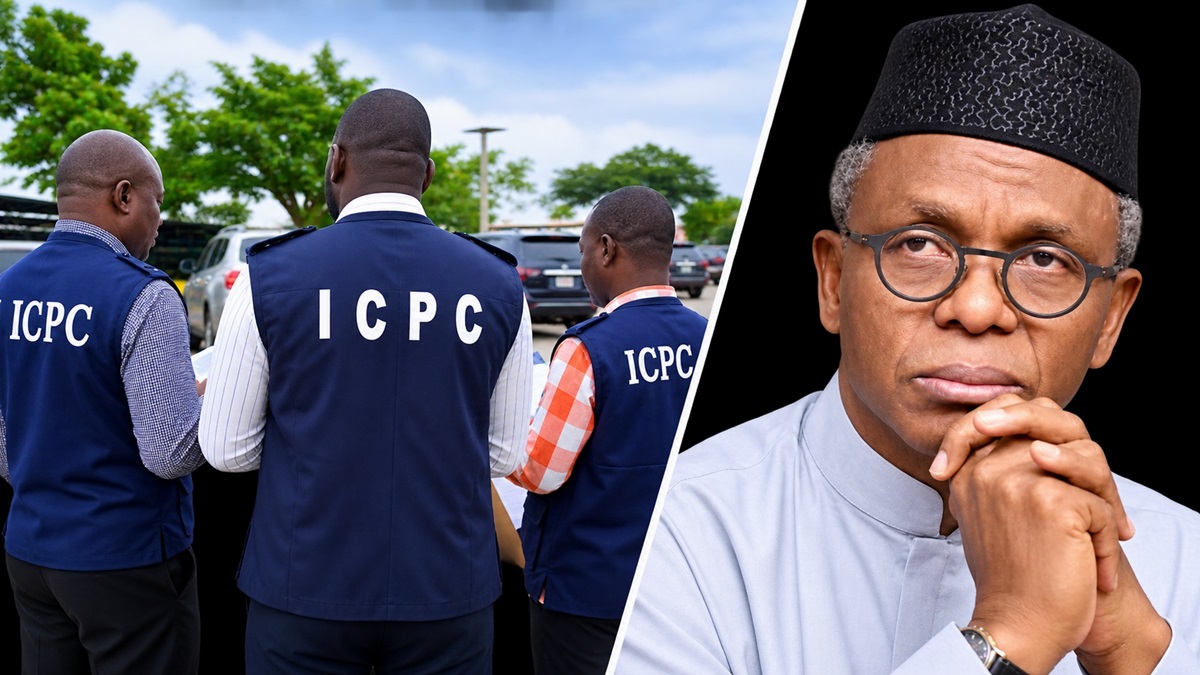 El-Rufai instituted the action, marked FHC/ABJ/CS/1852/2026, against the ICPC, its Chairman, Musa Aliyu, SAN, and the Attorney-General of the Federation.
In the originating motion filed on August 13 by his counsel, Ubong Akpan, the former governor sought N10 billion in damages, alleging that the commission violated his fundamental rights by preventing his wife, Aichatou Asabe, and son, Abba El-Rufai, from having access to him while he was in custody.
Among nine reliefs, El-Rufai asked the court to declare that his fundamental rights guaranteed under Part IV of the 1999 Constitution, as amended, remained inviolable notwithstanding his detention and must be respected by the commission.
The ICPC and its chairman have denied wrongdoing, insisting that restrictions placed on access to the former governor followed security concerns rather than an attempt to violate his rights.
In a joint counter-affidavit, John Uche, a Chief Anti-Corruption Assistant in the ICPC’s Internal Security Support Unit, said El-Rufai was being held pursuant to an order of the Federal High Court, Kaduna Judicial Division, in charge number FHC/KD/73C/2025.
Uche said that on July 7, in compliance with a court order allowing El-Rufai access to his personal physician, the commission facilitated a medical visit involving the former governor, his doctor, his wife and ICPC officials.
According to the commission, it subsequently received reports that the medical visit had allegedly been turned into a political meeting in breach of its security protocols.
The ICPC said the development exposed weaknesses in its access-control arrangements, prompting the introduction of temporary restrictions on non-essential visits while it reviewed security around the former governor.
The commission also alleged that Asabe had earlier been brought into its premises at about 7:35pm on July 4, after official visiting hours, with the connivance of some ICPC personnel.
It said personnel allegedly involved in the incident were facing disciplinary proceedings.
According to the ICPC, the alleged incidents led it to conclude that Asabe’s continued unrestricted access posed a security risk, resulting in the temporary suspension of her visits pending completion of its security review.
READ ALSO:
Conflicting Accounts Over Son
Another major point of contention concerns what happened when El-Rufai’s son, Abba, arrived at the ICPC facility on July 7 seeking to visit his father.
Uche alleged that after Abba was prevented from entering the building, he lay in a gutter and repeatedly rubbed his leg against its edge.
El-Rufai strongly disputes that account, arguing that the CCTV evidence tells a different story.
According to the former governor, footage from about 2:53pm shows his son being dragged, with his leg becoming trapped in the gutter, while another section at about 2:54:55pm allegedly shows an ICPC officer falling into a ditch.
El-Rufai maintains that those images contradict the account presented in the commission’s counter-affidavit.
The disagreement has placed the CCTV recordings at the centre of the case.
Battle Over CCTV Evidence
The ICPC and its chairman had applied for permission to demonstrate CCTV footage stored on a USB device attached to their counter-affidavit as Exhibit ICPC B.
David Efut, a litigation officer in the commission’s Legal Services Department, said the exhibit contained three recordings material to the determination of disputed facts in the suit.
The commission said the recordings would enable the court to assess the sequence of events, identify those present and examine the conduct of the people captured by the cameras.
It divided the selected footage into three segments titled “The Scuffle,” “The Son Being Taken Away” and “Unauthorized Entry.”
But El-Rufai challenged the reliance on selected clips and demanded the complete, unedited recordings covering the periods at the centre of the dispute.
His application sought footage covering June 7 from about 7pm to 11pm, including his arrival and that of his wife; July 4 from about 6pm to 9pm, when the ICPC alleges Asabe was brought into the premises after visiting hours; and July 7 from noon to 6pm.
He also demanded visitor registers, entry and exit records and other contemporaneous records relating to visits by his wife and other family members.
El-Rufai argued that because the ICPC controlled the cameras, storage systems and visitor records, the three selected clips could not establish that they represented the complete record of what occurred.
He asked the court to invoke Section 167(d) of the Evidence Act, 2011, if the commission failed to produce the requested material, arguing that evidence capable of being produced but withheld could be presumed to be unfavourable to the party withholding it.
The ICPC opposed the request, warning that publicly displaying the complete footage could reveal sensitive information about the layout and security arrangements of its facility.
Justice Onah ultimately adopted a limited approach, allowing both sides equal time to demonstrate relevant portions while refusing a public screening of the entire six-hour-plus recording.
Felix Ifijeh is a journalist with years of professional reporting experience. Known for his keen news sense, compelling storytelling and commitment to accurate, impactful reporting, he has built a reputation for turning leads into clear, engaging, and well-structured reports that resonate with readers. His work reflects deep newsroom experience and a commitment to accurate, impactful journalism.
